


Filed under “Ideas”

June 16, 2009

Idea: The Outlet Wall

Instead of hiding your outlets behind furniture and worrying about the mess of wires tangled behind your entertainment center, consider making an entire wall that’s nothing but outlets. Then you can artfully plug in your appliances wherever the cords look pleasing to you.

Imagine no more crowded outlets or multi-plug adapters.

Of course you don’t have to actually wire all the outlets on the whole wall for electricity, but you’d better come up with a good way to remember which ones are live.

Detail:

May 6, 2009

Idea: Motion-detecting cell phone ringer

Sometimes it’s not appropriate to have my cell phone ringer on (like at the movies, for example), so I set the ringer to vibrate. It’s not a big deal if I forget to turn it back on right away because I keep my phone in my pocket, so I’ll feel the vibration when I get a call. But sometimes I come home and empty my pockets and forget to turn the ringer back on. I’ve missed calls because I didn’t hear the phone vibrate from across the room.

The phone has an accelerometer built in. So how about an optional setting for vibrate mode called “motion-sensing vibrate”? If it doesn’t detect any movement for, say, 15 minutes, it would automatically turn the ringer back on, and also make a noise if I missed a call in those 15 minutes so I know to check my messages.

Before automatically turning the ringer back on, it could vibrate steadily for 15 seconds as a warning indicator, just in case the phone is still in my pocket but I’ve somehow managed to stay perfectly still for the past 15 minutes (which seems unlikely to me). This would give me fair warning that the ringer is going to turn on so I can override it if needed.

Of course, if you keep your phone in a bag or purse, you would not want to use this setting.

April 8, 2009

I wrote it, you made it: The Bulbdial Clock

Just about a year ago, I came up with a concept for a clock whose hands are shadows projected by bulbs shining on a center post. I called it the Bulbdial Clock, and my concept design looked like this:

Well, I’m thrilled to see that the evil mad scientists over at Evil Mad Scientist Laboratories have actually built a working model! They posted lots of pictures, and it’s pretty awesome:

Head over to their site and see how they made it. They’re considering making a kit available so people can build their own Bulbdial Clocks. If you’d like to see that happen, let them know in the comments on their blog.

March 23, 2009

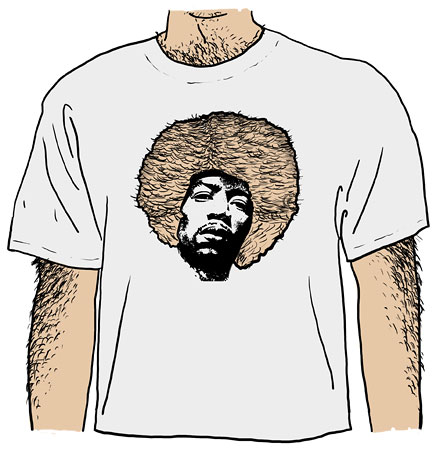
Idea: T-Shirts for Hairy-Chested Men

As the weather gets warmer, smooth-chested guys nationwide will be hanging out shirtless in parks and on beaches. A hairless chest is so trendy these days that it’s practically a fashion accessory. But what’s a guy with a hairy chest supposed to do? How can he incorporate his hairy chest in his own fashion?

Well, that’s why I’ve come up with T-Shirts for Hairy-Chested Men, with strategic cutouts that allow your hairy chest to show through. They could feature portraits of famous curly-haired celebrities like Jimi Hendrix, Bob Dylan, and Harpo Marx (for blondes). At last, the Hairy-Chested Man can finally showcase his own natural chest hair with style.

March 16, 2009

Idea: Not Your Usual Talking Dog Movie

The movie begins in the middle of a chase. Our hero, Buttons, a scrappy little dog, is running as fast as he can through dark and scary woods. A pack of slobbering wolves are hot on his heels. We hear Button’s cute voice saying lines like, “Oh, no! I’ve got to outrun these guys!” His lips don’t move when he talks. We just hear his voice, like in the Talking Dog Movies of the 1980s.

The thick woods reach an end, and Buttons is in a clearing. It’s bright, sunny, and he can see his home out in the distance at the edge of the field. His owner, a young boy, is standing outside calling out his name. “Buttons! Buttons! Where are you?” Buttons is running his little heart out, saying things like, “Tommy! I’ve got to reach Tommy! Almost there! I’m coming, Tommy!” The wolves are close behind. Buttons reaches Tommy and jumps up into the safety of his arms. The camera swirls around them, joyous music swells, Buttons licks Tommy’s face, and the wolves cautiously retreat back into the woods.

Suddenly, in voice over, we hear a gruff voice saying, “Wait a minute, wait a minute. What the hell is this crap? How many times have I said I’m not going to be in any more cheesy kids’ movies?” The chase scene ends abruptly, and we find ourselves in a Hollywood movie producer’s office. This is the Real World. Seated around a table are several people, and a dog. It’s the same dog we just saw. Or, rather, it’s the Dog Actor named Buddy Duke, one of the most famous actors in the world. With him are several humans: his manager, his agent, his assistant, his bodyguard, a producer, a director, and a writer. They’re pitching a new movie to Buddy, and we’ve been watching the corny scene they’re describing to him. Buddy hates it.

Here in the Real World, when Buddy speaks, we do see his lips move. In fact, all dogs can talk in this world, and their lips move like in any modern Talking Dog Movie. They have normal jobs, just like people. They work in every industry, alongside humans. But when humans speak, on the other hand, we don’t see their lips move. We just hear their words as voice overs. Preferably, the voices will be done by different actors than the ones we see on-screen. So the human actors on screen will have to act with body language and facial expressions alone, and then their voices will be supplied by other actors in voice over.

Buddy is pissed at this waste of time, and he leaves, followed by the studio people begging him to make the Buttons movie. He makes a sexist comment to the receptionist, a hot young poodle, on his way out.

Outside, Buddy’s assistant takes a phone call on his Blackberry. It’s Buddy’s Mom, and she needs to talk to Buddy right away. The assistant puts a little Bluetooth headset on Buddy (who relies on his assistant for these sorts of things, since he has no opposable thumbs). His mom is in a panic. “Buddy, your father has disappeared. He said something about digging up old bones, and left to go back to the old house in Montana. This was a week ago, and I haven’t heard from him since! I’m worried that something’s happened to him!”

Well, Buddy remembers the old Montana house, and the hiking trips he used to take with his dad in the woods nearby. He remembers that they’d go fishing, and sometimes his Dad used to leave Buddy by himself while he’d wander off alone, and he always came back with his paws dirty. Maybe he was burying something secret? Something that, after all these years, he had to go dig up again? What could it be? Treasure? A body? Bones?

Only Buddy knows where that old camping spot is, so he has to fly back to Montana to visit his Mom, and then venture out into the woods to find his Dad. But, being a big movie star now, he brings along his assistant, his bodyguard, his manager, and his agent, because he’s too big a celebrity to go do something like this by himself. And he has no opposable thumbs, so the extra human hands are helpful.

They all spend the first full day in Montana hiking in the woods. Every twist and turn looks identical, but Buddy knows exactly where he’s going. It’s a two day hike, so eventually they stop and set up camp for the first night. They build a campfire, and Buddy tells a heartfelt story about growing up in Montana with his father as his best friend. After dinner, everybody retreats to their tents, and they fall fast asleep.

In the middle of the night, a bear enters the camp looking for food. Buddy wakes up. The bear is spooked by the noise. It tears open Buddy’s tent, grabs him in his teeth, and throws him against a tree, killing him instantly. Everyone else wakes up, scared to death. They manage to get away from the bear safely and regroup to assess their situation.

Buddy is dead. It’s the middle of the night. There’s an angry bear nearby. And the assistant, the agent, the manager, and the bodyguard are all in the middle of the forest with no idea how to get home.

And thus begins the real adventure in the movie. It’s not your usual talking dog movie because as of this point the humans take over as the main characters. They are four scared people in the middle of the woods who now have to find their way home. Do they try heading straight back? Do they continue trying to find Buddy’s Dad? Do they unravel the mystery of whatever it was he buried? Do they get along? Do they fight? Do any of them have any wilderness survival training at all?

Other plot points I’ve considered: At some point the humans find themselves running as fast as they can through the woods, trying to outrun a pack of wolves who are chasing them. Also, maybe Buddy had a rival (who the receptionist poodle was in cahoots with?) who had a hand in Buddy’s misfortune. Perhaps he sends the wolves to go after the humans, to tie up loose ends. Also, at some point maybe the humans meet an old Dog Hermit who lives in the woods. I’m not sure what purpose he plays to the plot yet, but he might know something about why Buddy’s dad disappeared.

While you’re pondering those plot points, just try to remember that the actors’ lips never move in this world, and their voices are supplied by other actors. But the dogs all talk like normal people. It’s a 1980s talking dog movie flipped upside down. I guess it’s a big high concept, and it probably couldn’t sustain more than 90 minutes without getting old, but I’d sure get a kick out of it.

March 11, 2009

Idea: Progressively Packed Produce

I go to the grocery store, and I see delicious-looking ripe bananas. I buy three of them, figuring I’ll eat them over the next day or two. Inevitably, I don’t eat as much banana as I think I will, and one or more of them ends up getting overripe and rotten before I have a chance to eat it. Into the garbage it goes.

Next time I’m at the grocery store, I think ahead. I’ll buy some not-yet-ripe bananas so I have them when I want them. Of course, inevitably I overestimate the ripeness and bite into a banana that isn’t ripe yet. Have you ever eaten an unripe banana? Gross. Another banana wasted.

Grocery stores should sell progressively packed produce. Instead of buying a bunch of bananas picked at the same time, you get a packaged bundle of bananas (or other quick-to-ripen food), each at a different stage in ripeness, with stickers on them telling you in which order you should eat them. Sure, there would be a premium attached to progressively packed produce to account for the back-end difficulties, but just think of the savings in wasted food.

[Original banana photo by Jason Gulledge via Flickr]

February 19, 2009

Idea: The Blogosphere Adventure Game

A couple years ago, I thought it would be fun to make an old school geeky Sierra-style adventure game using Adventure Game Studio. I got far enough to realize that it would take a lot more time (and probably skill) than I had to make it. But I did do some work sketching the game on paper in a spiral notebook which I happened to come across this week. I’ve scanned in some pages so I could show you the aborted adventure game I never made.

I hadn’t settled on a name for the game, but I thought about calling it “Blogosphere” or “Blogosfear” or “Blogosphear.” The opening animated narrative would introduce you to the protagonist “Dave” who was staying up late reading blogs instead of going to bed. Some sort of mishap (energy drink spilled on the computer?) was going to start a chain of events that digitally teleports him into the internet. The teleportation was going to look like Flynn being digitized in Tron.

So the gameplay begins with Dave finding himself materialized in a waiting room like one would find in a doctor’s office:

The only door, with a sign reading “Blogosphere,” is locked. But when Dave pulls a number from the “Take a Number” display, the receptionist’s window opens. The receptionist was to be played by Clippy the MS Office Paperclip, who has had to find other work since he’s no longer employed by Microsoft. Through witty interactive dialogue, Dave would protest that he doesn’t belong there and needs to get back home. Clippy would explain that once you’ve entered the blogosphere, the only way to cancel your account is to consult the Great and Powerful Eula. And this sets up your adventure to find Eula and learn how to get home. Clippy buzzes Dave through the door to start his adventure.

The next room is the BlingBling room:

This room has an airport-style metal detector which doesn’t allow anyone through to the blogosphere with anything in their pockets. The sign says “BlingBling: the Gateway to Wonderful Things.” The gateway is guarded by Cory Doctorno and Jenny Gardner. The walls are covered with banner ads for t-shirts. Dave turns over his belongings, which means he starts his adventure with nothing. Cory and Jenny explain that to find the Great and Powerful Eula, Dave should follow the Yellow Paved Road. He continues on his way.

The next screen reveals that the Yellow Paved Road isn’t very long. In fact, the Great and Powerful Eula’s place is right next door.

Eula is a big floating head, a la the Wizard of Oz, but I don’t remember why I gave him glasses. Anyway, he tells Dave that in order to get back home, he must bring Eula the broomstick (or something) of the Wiki Witch of the Web. That’s the real goal in the game.

This is a path away from Eula’s place. There’s a path to the right, but up ahead there’s a building in the distance that looks like it’s made out of giant forks.

It is made out of giant forks. It’s Fork.com.

Inside Fork.com you meet Drew Curtains. He sits on a throne of forks. He has chandeliers made out of forks. He’s kind of obsessed with forks. Somehow this would have figured into a puzzle.

Taking the other path would have brought you to this rundown shack. It’s Jason Tchochke’s place.

Inside, Tchochke’s place is full of shelves and shelves of various tchochkes. Somehow this would have figured into a puzzle.

Further along the path you would encounter the domain of the Wonkess. It’s supposed to be reminiscent of the White House.

Inside, the Wonkess sits at a desk in an oval office. I’m not sure exactly how, but somehow this would have figured into a puzzle.

Further still along the path lies a sign that says “Dig.” At first you can’t do anything here, but eventually you would find a shovel, and you could come back here to dig.

An animated cut scene would have simply shown you digging into the ground. It would either be visually similar to a scene from Dig Dug, or (as shown here) you would see the fossilized remains of video game characters buried in the ground.

Eventually you would break through to the underground lair of Kevin Rouse, wearing a backwards baseball cap and headphones. He was going to be a bit crazy, throwing piles of money in the air, since an article in BusinessGeek Magazine said he’s worth $60 million, so he took out a loan. In the background is the secret elevator that would take you back up to the grassy patch where you started digging.

This is PooTube. It’s a series of tubes. One of the tubes has a door on it. As you approach the door, a mechanic was going to pop out from behind a tube and tell you that you don’t want to go in there. He’s the character you interact with here. Not sure what he was going to say, though.

This is the entrance to Slashbot, a company that makes Robots for Nerds. There was going to be a puzzle that requires you to come here and retrieve an iPod that contains some secret information on its hard drive.

Inside, there would be nothing but empty cubicles as far as the eye can see. Nobody works here anymore because they’ve all been replaced by foreign workers. But one computer was left on to keep an eye on things. His name is CAL.

He has the iPod that you need, but he keeps it locked away in a special iPod bay. This is all a convoluted way of getting you to say, “Open the iPod bay door please, CAL.” And then he can say, “I’m sorry, Dave, but I’m afraid I can’t do that.”

Elsewhere, you would come across the entrance to the Huff’n’Puff Post newspaper.

Inside the building’s art deco lobby would sit a security guard. Somehow there would be a puzzle you would need to solve in order to get past him, possibly posing as a bicycle messenger.

A lovely animated cut scene would show you going up in an elevator to the top of the building.

Eventually you would get to the office of Ariana Huff’n’Puff. But she speaks in such a thick accent that nobody understands a word she says, so her assistant is also her interpreter.

That’s about as far as I’d gotten. I had some ideas for what kinds of puzzles you’d actually have to do, and what the dialogue trees would be like, but I didn’t write any of that down. I did make a list, though, of websites and other things to lampoon in the game. I brainstormed what the parody names could be for real websites. This is what the list looked like:

February 2, 2009

I wrote it, you made it: Histoface

The previous “I wrote it, you made it” posts have been examples of people who executed an idea I proposed. But this time I’m writing about people who took one of my ideas to another level altogether.

In September, 2007, I demonstrated how an image can be hidden in the histogram of another image. The example I used was the New York City skyline…

…hidden in the histogram of a simple gradient:

I followed that up by writing about Josh Millard, a reader who figured out how to embed the histogram in a more recognizable picture than just a gradient. He was able to embed the NYC skyline histogram in the original source image of the NYC skyline!

But I never wrote about what Stewart Smith did with this concept. He took the idea in a different direction, wondering if it would be possible to embed an actual word or phrase in the histogram of an image. So he developed Histoface, a web app that allows you to generate a gradient which contains a secret message in the histogram.

So this image…

…has this histogram:

It should be obvious that it says “STARWARS” but unfortunately not all the letters in the typeface are as easy to recognize as these. It’s difficult to create recognizable letters that work in a histogram. But I give Stew major credit for making it this good!

I’d love to see a combination of Stew’s project and Josh’s project, allowing you to type a message and hide it in the histogram of any grayscale image. Who wants to work on that?

January 26, 2009

I wrote it, you made it: A commercial

Back in November, 2006, I posted an idea for a commercial I’d like to see. Some time later, I was contacted by Ethan Cushing who wrote, “I am a director trying to expand my reel and would love with your permission to hire a crew, rent some great HD cameras, and film [this].”

So without further ado, I now present… the commercial:

Nice work, Ethan! Going back and reading my original post, I was surprised to realize that he more or less used what I wrote verbatim. If I’d known that would happen, I would have spent more time crafting the dialogue.

Incidentally, I’d still love to see this battery commercial concept turned into reality. It would require a bit of F/X trickery, I think. If anyone wants to take it on, go for it.

Previously: I wrote it, you made it: Montris

January 19, 2009

I wrote it, you made it: Montris

Sometimes I post ideas that would blow me away if they could actually be made real (I’m still waiting for someone to build an Ant Desk). But occasionally I do hear from people who have taken one of my more practical ideas and actually turned it into reality. I keep meaning to write about them, so I’m starting with this one: Montris.

About a year ago, I came up with an idea for a game I described as Tetris, one brick at a time. I called it “Montris.”

I was eventually contacted by a reader named Chris Kastorff who decided to make a working Montris game. We discussed various factors that would affect game playability: The number of colors, the width of the playing field, etc. He wrote a proof-of-concept game that allows users to adjust all of those factors. (Note: In his conceptual implementation, bricks do not fall on their own. You must press the down arrow to progress the game).

More recently, I heard from a reader who has actually taken the concept and fleshed it out completely into a functional game! He calls it Sirtet. You can find it along with other games on his website.

I like that he penalizes players for making pieces of more than 4 squares. It adds another level of complexity to the game. Nice work!

December 18, 2008

Idea: Noah’s Hand Everyday

Noah Kalina has famously taken a photo of himself every day for the last 8 years. The YouTube video of his first six years in sequence shows him growing right before our eyes.

Of course, Noah isn’t the only person who has done this, although he is probably the most famous example. But others have undertaken similar projects. All of them are fascinating.

Time-lapse portraits of a face may be the most obvious and compelling subject matter, but I think science and curiosity might benefit from time lapse portraits of other body parts, too. What if Noah had been taking a second picture all this time, of, say, his left hand? It would be interesting to see how his hand ages along with his face. There probably wouldn’t be much change now, but as he ages it would get more dramatic.

Less subtle and more interesting would be a couple who starts this project with a newborn baby, photographing its hand every day. We might not have as emotional a connection to a hand as we do a face, but wouldn’t it be cool to see a real person’s hand grow and change over a lifetime?

(I’m both entertained and disturbed by the thought of a day when this kid discovers that not all parents photograph their kid’s hands every day; and then the day he rebels as a teenager and refuses to let his parents photograph his hand anymore; but not until after he has a conversation where he tells his friends, “Sorry I can’t hang out longer, but I’ve gotta get home so my parents can take today’s hand picture.”)

December 10, 2008

Idea: Treadmill eBook Reader

Treadmills and other aerobic exercise machines are pretty sophisticated these days. The ones at my gym feature touch-sensitive computer screens that you can use to track your progress, watch TV, or even control your iPod.

But some people see the treadmill as a good place to get some reading done. I see them struggling to figure out how to place a book or magazine on the machine without it falling, and even with a Treadmill Book Holder, it can be awkward to turn the pages. Plus, you have to carry all that around with you when you’re done running but still want to work out. It looks like a pain.

So how about adding an eBook reader to the list of treadmill features? The touch-screen computer is already there, so it seems like a very simple feature to add. It can be preloaded with hundreds of public domain classics. Just tap the screen to turn the page. By issuing gym members a PIN number, the treadmills could keep track of what they’re reading and what page they left off on. It could even be an outlet for selling new books. And the gym could have deals with magazine and newspaper publishers to provide their content as well.

A full fledged web browser with all my RSS feeds would be too difficult to navigate while exercising, I think. But a simple eBook reader could be just right. They could call it the tREADmill.

October 29, 2008

Idea: Reboot the Terminator

I currently have 4 episodes of the TV show “Terminator: The Sarah Connor Chronicles” on my DVR waiting to be watched, but I think I’m just going to delete them. I can’t imagine wasting 4 hours catching up on that show. It’s boring. Each episode is just like the last one.

Now there’s another Terminator movie in the works. I’ve seen the trailer. I can’t say I’m very excited about it.

Why does Skynet keep sending Terminators after Sarah Connor? Or even John Connor, for that matter? Why not go back a hundred years, or two hundred years, and kill her great grandparents? Now that would make an interesting show (or movie, or comic book, or novel).

Future John Connor would surely send a human into the past to stop the Terminator from killing his great great grandparents. So how does this person fight against a robot killer in an age when technology is so primitive, using his knowledge from the future? And how does the Terminator blend in? What materials does he use to repair himself when he’s been damaged? Over time, as he gets more and more damaged, does he go from glistening machine to steampunk hodgepodge of parts?

I think there’s a lot of potential for period Terminator stories. Maybe there’s an 18th Century Ireland Terminator trying to kill Johnny O’Connor before he comes to America. Or a Dark Ages Terminator who’s trying to kill Sarah the bar wench. Primordial Ooze Terminator could have a heck of a time figuring out which slime mold eventual produces offspring that evolves into the Connor line.

The possibilities are endless. So why are they limiting themselves to telling the same old story the same old way time after time?

August 25, 2008

5 More Remainder Ideas

Last summer, I posted my Top 5 Remainder Ideas, a sample of the many ideas I’d jotted down as potential posts but decided weren’t worth fleshing out for one reason or another. Instead of letting them wallow in obscurity, I purged them in one post. Well, it’s time to do it again. Here are 5 more ideas that didn’t get fleshed out enough to stand on their own.

Remainder Idea #5: TypOs Cerael

There are a lot of “O”s cereal names out there: Cheerios, Toasty-Os, etc. I had this idea that there should be a Typos Cereal. It would be made of all the letters of the alphabet, like Alpha Bits cereal, but you wouldn’t spell anything correctly with it. I only got as far as this rough illustration before I remembered that “O”s cereals don’t use the whole alphabet. They only use the letter O. Then I considered a soup called “Type O” Soup. It’s tomato soup with alphabet noodles. But that’s just too many layers of wordplay.

Remainder Idea #4: “Dear Juno”

At the end of the movie Juno (spoiler alert), Juno gives her baby up for adoption. I found myself wondering what will happen, fourteen years later, when that little girl decides she wants to know more about her birth mother. Her mom will say, “I guess you’re old enough to know that shortly after you were born, some people made a movie about how you came to be with me. The movie is called Juno, which is your birth mother’s name.” So the kid watches the movie, and then goes through the proper channels to get Juno’s mailing address. She sits down and writes a letter to her birth mother where she says she has so many questions now that she’s seen the movie. Questions like, “If your hamburger phone worked so poorly, why didn’t you just get a normal phone?”

Remainder Idea #3: Unsuccessful Children’s Books

I once doodled a drawing of Clifford the Big Red Log. I figured that must be the most dull children’s book ever. Then I began imagining other unsuccessful children’s books like Charlie and the Chalk Factory, Reverend Horton Heat Hears The Who, and The Berenstein Bears (about a family of burly gay men).

Remainder Idea #2: An Armored Bear Rug

Did you see The Golden Compass? I don’t advocate killing animals to decorate your home, but I couldn’t help imagining that those Armored Bears would make great rugs. Throw a cushion on the big helmeted head and you’ve got a nice seat, too.

Remainder Idea #1: The other Six Degrees of Separation

We’ve all heard the theory that every person on this planet is separated by every other person by six degrees. But one day I realized that something else is separated by six degrees. Every minute on a clock face is separated from the previous and next minute by six degrees. I think there might be something interesting that an be done with that concept. I tried coming up with a clock design incorporating the idea, playing with the six on the bottom of the clock in the designs, but I wasn’t crazy about anything I came up with.

Bonus Remainder Idea: Blabacus, the Blogging Abacus

I have no idea what I was thinking when I wrote down “Blabacus, the Blogging Abacus.” I must have though it was a good enough idea to write it down, but now I just stare at it wondering what I could have possibly been thinking of. Blabacus the Blogging Abacus. Is that an Abacus that has a blog? Is that an Abacus that is used as a tool for blogging? I have no idea.

August 12, 2008

Idea: How I would do iPhone cut and paste

I know, I’m late to the party. The internet has already had plenty of discussions about the iPhone’s lack of cut and paste, and many proposals for how it could be implemented. Some people suggest complicated multitouch gestures, double-taps, or buttons with pop-up submenus you slide your finger over. Others change the iPhone’s default behavior too much. These aren’t intuitive to me. I want a solution that’s easy to use and doesn’t get in my way. It’s there when I need it, and it disappears when I don’t.

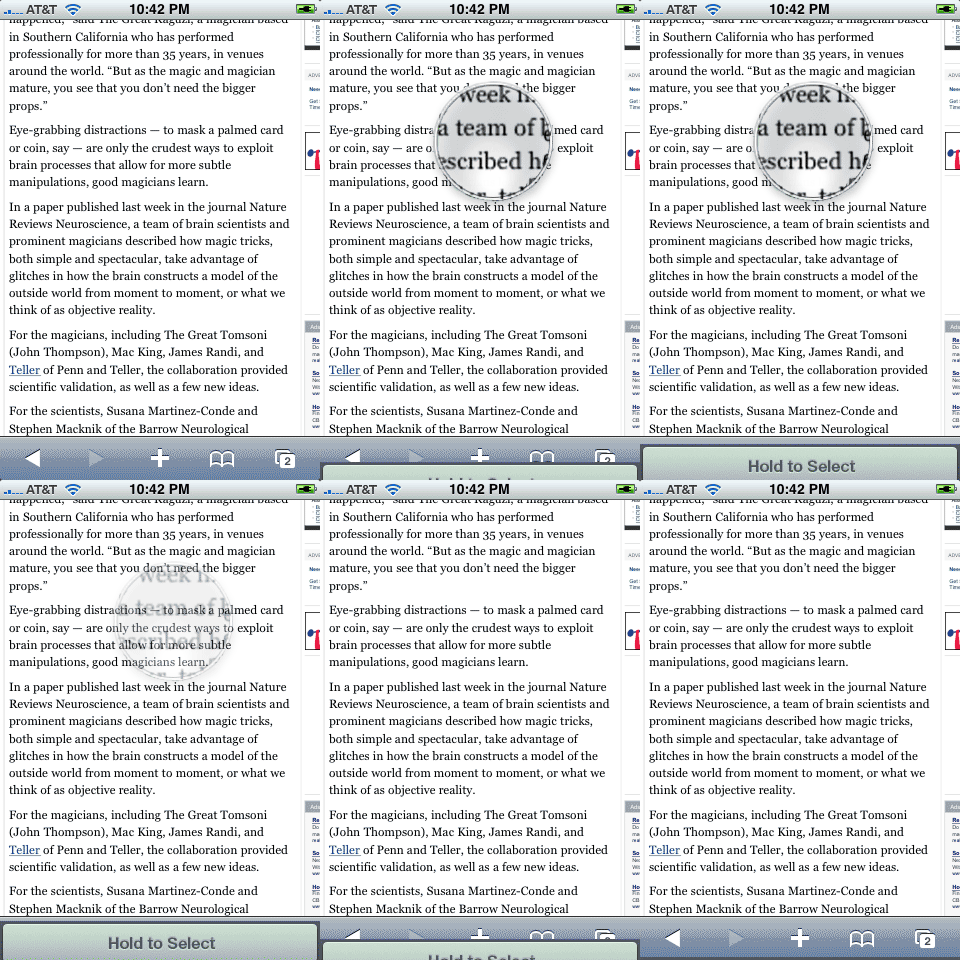
Now that I’ve had a chance to play with the iPhone for a while, I’ve come up with my own proposal. I don’t know how to make a working demo, so I’ve made some screenshots to help explain my concept. I think it feels natural, while being simple and unobtrusive.

Let’s start with some text so we have something to work with:

Holding your finger on a word currently brings up a Magnifying Glass that helps you place a cursor where you want it. My suggestion: Whenever you go into Magnify mode, the bottom row of the keyboard is replaced by one large “Hold to Select” button.

Using this button to select text should feel familiar because the action is the same as selecting text on a Macbook’s Trackpad. I normally use one hand with a Trackpad, but I find using two hands with the iPhone feels surprisingly natural because my thumb is already in a good position to press the button:

If you only move the cursor without pressing the “Hold to Select” button, the bottom row returns to normal when you let go. But if you do select text, then the “Hold to Select” button is replaced by four new buttons: Cut, Copy, Paste, and Cancel.

After you make your choice, the action is carried out and the bottom row returns to normal. I’ve selected “Cut” in this example.

When I’m ready to paste, I once again use the Magnifying Glass to place the cursor. The “Hold to Select” button comes up again but I’m not going to press it this time (although if you want to replace text, you can select a whole block of words to paste over).

If I I had nothing in my clipboard, then the bottom row would go back to normal when I release the Magnifying Glass since I didn’t select any text. But I do have something in the clipboard, so I my options are shown again.

I select “Paste” and the word in my clipboard is inserted at the cursor. The keyboard bottom row returns to normal.

In the preferences, I can decide when I want the clipboard to be cleared out. I think it makes sense to empty your clipboard every time you paste, but other options are useful in case you need to paste the same text multiple times.

This method of cut and paste also works with non-editable text where you don’t have a keyboard. If you want to copy text from Safari, for example, you hold your finger in one spot until the magnifying glass comes up. The “Hold to Select” button slides into place from below [animated gif], temporarily covering the navigation bar. Because the text is not editable, the paste and cut buttons will be inactive.

That’s the best cut/paste implementation I could think of. It doesn’t change the iPhone’s current behavior and it doesn’t get in the way. It’s clear and easy to use. What do you think?

July 21, 2008

Idea: Performance Enhanced Video Games

I don’t advocate taking performance enhancing drugs, but if I were a company making a sports video game, I would be tempted to include a hidden “Steroid Mode” where the players can enhance themselves by taking drugs which make them stronger players. It could add an interesting layer of complexity to the gameplay, reflect a real life issue, and create a buzz of controversy that could help sell the video game.
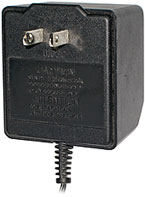
There could even be a down side to taking drugs. Maybe your player gets great strength for a while but eventually gets liver damage and becomes weaker than when he started.

Of course, the video game company would need some sort of plausible deniability once the parental outrage begins. Maybe the game doesn’t feature “drugs” at all, but thinly metaphoric “Power Potions.” Then you can say, “Power Potions are not supposed to represent performance enhancing drugs, and any similarity is completely coincidental.” If all else fails, you can claim “This baseball game is marketed for adults and is not intended for children.”

Meanwhile kids can argue over whether or not “Steroid Mode” scores should be counted on the same High Scores list as Standard Mode scores. Maybe they can compromise by being on the same list, but with an asterisk.

July 15, 2008

Idea: Palindrome road trip

It’s not unheard of for small American towns to change their name in order to get publicity. So here’s an idea for a large scale coordinated multi-state name changing scheme that’s sure to draw tourists: In every state where it’s phonetically possible, there should be a town that creates a palindrome when combined with the state name. Then the ultimate road trip would be to drive from Aksala, Alaska to Adirolf, Florida visiting every palindromic town in between… and then driving back in reverse.* So far, it looks like Saxet, Texas and Adaven, Nevada are the only ones that already exist (sorry, Zion, Illinois — close but no cigar). Visiting Apollo, PA gets you bonus points.

*I mean visiting every city in reverse order, not driving with the car in reverse.

July 8, 2008

Idea: Thsrs, The Shorter Thesaurus

Popular new social networking services like Twitter, where users write extremely short messages about whatever’s on their minds, present a challenge: How can you intelligently get across a complex thought in just 140 characters without needing to use ugly abbreviations (e.g. “w/o needing 2 use ugly abbrev’s”)?

If only there were a service that helps with the struggle of rewriting a 146-letter message to fit in a 140 character limit. Well now there is: Thsrs, the thesaurus that only gives you synonyms shorter than the word you’re looking up. Just enter one of the longer words in your message, and Thsrs will suggest shorter words to use instead.

Try out the embedded version below, and bookmark www.thsrs.com so it’s always handy when you need it.*

Thsrs

1. Enter a long word.


2. Receive shorter synonyms.


* I considered calling it Sesquipedalian but I can never remember how to spell that. Thsrs was developed using the Big Huge Thesaurus API, and coding help from my friend Jay. This is a beta version, of course, so let me know if things go wrong.

Update: Thsrs is now available as a plug-in for your browser! Check out the Thsrs page for details.

Update: I thought I’d make a note about the word source, as some people have commented that Thsrs sometimes returns surprising results. Thsrs currently uses the Big Huge Thesaurus, which is based on the Princeton University WordNet Database, and has the distinction of being the only thesaurus I found with an API. If you know of a better easily-accessible Thesaurus word source, let me know and I’ll see about switching over. In the meantime, additions to the database can be suggested by visiting the BHT, looking up a word, and using the “Suggest” form at the bottom of the results page.

June 30, 2008

Idea: Electric Outlet 2.0

The Problem:


Let’s get rid of these things once and for all.
Here we are in the 21st Century, and we’re still using electric outlets designed way back in the early 20th Century. Back then, Alternating Current beat out Direct Current as the standard in our homes partly because it travels further before losing power. But our needs have changed since then. Sure, we still plug in a bunch of things that require AC, but we also have a few dozen items in each home that require DC. So each of those items has its own power-converting brick taking up precious space on our power strips, and creating eye-sores on our walls.

Some people have gotten around the problem by coming up with creative designs for power strips. But that’s backwards thinking because it just accepts that we have to deal with these bricks and puts a bandage on the problem. We can do better.

I say it’s high time we do away with the whole mess by moving the AC/DC conversion to the other side of the wall.

The Proposal

Today, if you lose an AC adapter, you have to find a new one that converts the AC in your wall to the proper voltage DC for that particular gadget. Or, you can buy a universal AC adapter for just a little more money that you can manually set to provide whatever voltage DC your gadget requires.

I propose a new standard for electric outlets where every outlet in your home has a universal adapter built in, on the other side of the wall, where you will never see it. When you need AC, it gives you AC. And when you need DC, it automatically converts to the proper voltage DC for you. No more ugly bricks. Plugging in your phone charger, computer speakers, or router will be as elegant as plugging in a lamp.

I call this new standard “Outlet 2.0.”

How will Outlet 2.0 know what kind of electricity you need?

Simple. Outlet 2.0 compliant plugs will have key-like notches in the prongs that let the outlet know what kind of electricity is needed. For example, a “Type A” plug will have zero notches. It looks like a standard plug, and it just uses normal AC. “Type B” plugs will have one notch to indicate that they require 1.5v DC. Here are a few sample plugs to illustrate what I mean:

They are given simple letter-based names so that it’s easy to remember in the event that you need to buy a replacement cord. You just look at the bottom of your gadget where it says “Requires Type G Cord” and go to Radio Shack and buy a Type G cord (at a fraction of the cost of buying a new brick). The letter is also embossed on the plug itself, so you don’t need to worry about mixing up your cords.

Won’t this increase the cost of electric outlets?

Yes. But you only need to install your outlets once. However you may otherwise buy a hundred gadgets over your lifetime that include their own transformer brick, and the cost of that brick is built into the price of the gadget. With no brick needed, the cost of the gadget goes down. Also, the weight of the new gadget in its box with all its accessories goes down, which makes it less expensive to ship, which translates to further savings.

What about power strips? How will they work?

Outlet 2.0 compliant power strips will be plugged in with a “Type A” plug so they receive AC as usual. But they will have internal universal converters at each of their outlets so they provide the proper electricity to the devices that are plugged in. Yes, this will make them slightly larger and more expensive. But the savings will come in less expensive devices, and a much neater area under your desk where everything is plugged in.

Is Outlet 2.0 backwards compatible?

Yes. Anything you have that came with a normal plug — including power bricks you got with gadgets before the Outlet 2.0 standard — will still work. They have a normal “Type A” plug, so they will receive the AC they’ve always received.

Will new 2.0 compliant plugs work in old 1.0 outlets?

Well, once the standard is adopted, it should be relatively inexpensive to replace at least some old outlets with new ones, so hopefully it won’t be an issue for long. You’ll start to see even older hotels begin to advertise that they have Outlet 2.0 compliant rooms. But if you are going to visit a home or hotel that hasn’t upgraded yet, you can bring a simple travel-size pass-through converter. You just plug it into any 1.0 outlet, and then you can plug any Outlet 2.0 compliant gadgets into the converter. (Note that any Outlet 2.0 compliant power strip will work properly in a 1.0 outlet, converting the power as needed).

What if a 2.0 plug is plugged into a 1.0 outlet without an adapter?

This could damage your gadget, so there is a feature in the Outlet 2.0 standard that prevents this from happening. It is not shown in the plug renderings above because I haven’t worked out the details yet. It will probably take the form of an extra prong that doesn’t carry electricity, placed off center so as not to be confused with the grounding prong already present on current “three-prong” plugs. At right is a rendering of how it may appear. This not only prevents you from sticking a 2.0 plug in a 1.0 outlet, but makes the different outlets easy to recognize by sight.

Will I have to upgrade my whole house to Outlet 2.0?

No. If you’ve had the lamp in the corner plugged into the same 1.0 outlet for the past 20 years, and you never plug anything else into it, there’s no need to upgrade that outlet. Just upgrade the outlets where you will benefit from having the Outlet 2.0 standard. If you ever sell the house, you may consider a full upgrade then so you can advertise that every room is Outlet 2.0 compliant.

Conclusion

For far too long, we’ve been dealing with heavy, unwieldy, ugly power conversion bricks all over the place, and they don’t seem to be going anywhere soon. But I refuse to believe that a world that sends robots to Mars can’t figure out a way to solve this problem. So this is my proposal. Of course, I’m not an electric engineer, so I may be missing some of the finer issues. Let me know what you think, and tell me how this idea can be improved.

Update: There are few things more frustrating for me than discovering that one of my ideas has already been thought of. But in this case I’m pleased to find via the comments that a similar proposal is already being worked on called The Green Plug. It doesn’t appear that the Green Plug puts the converter on the wall side, but it does create something like the Outlet 2.0 Power Strip, so that all your devices can share the same DC converter. I fully support this.

June 23, 2008

Idea: A giant Lego made out of Legos

There are a handful of artists out there making incredibly detailed sculptures using Legos. If I had the time and the resources, I’d make one, too. I’d make one big Lego made entirely out of Legos. I’d call it the Lego Lego.
After making one Lego Lego, I would recruit a bunch of friends to help me make a few hundred more. Then they could be used to build an even bigger sculpture built entirely out of Lego Legos.

Previously: Idea: Paintings of descriptions of the paintings

June 10, 2008

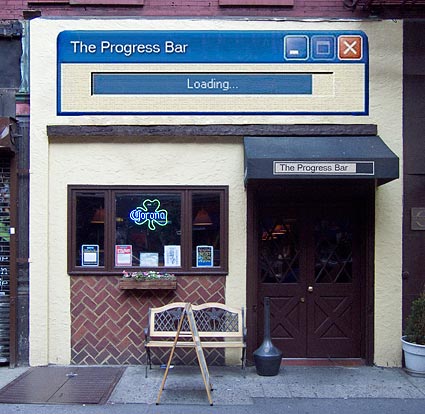
Idea: A Bar in Silicon Valley

I once decided it would be a good idea to name a bar in San Antonio “The Basement” so tour guides at the Alamo actually have an answer when jokesters ask where the basement is. But it turns out there actually is a bar in San Antonio called The Basement. This time I’ve got a name for a bar that doesn’t seem to exist already as far as my Google Search can tell (I’m sure someone will tell me if I’m wrong). This bar would probably best be located in Silicon Valley:

The Progress Bar

June 2, 2008

Idea: Corporate Artists in Residence

Many large corporations have philanthropy departments. They donate money for medical research, public television, city beautification, arts organizations, and more. But I’d like to see corporations use their philanthropy in part to spotlight individual artists through residency programs. It could give a big boost to an individual artist, and give a public face to the company’s support of the arts which may better promote arts in general.

Each company could pick one artist each year whose work exemplifies the company’s brand or ethos, provide financing for a year during which the artist develops a body of work, and then offer a performance or exhibition space — perhaps in a flagship store or corporate headquarters — to showcase the result.

For example, Apple’s first artist in residence could be a sculptor who integrates technology in his work, and they can display his pieces in select Apple stores across the country. Starbucks could pick an undiscovered singer/songwriter and finance her first album under their record label. Boeing’s artist in residence could be someone whose work is inspired by aviation, to be displayed in airport terminals.

I figure some corporations must already do this, but I was only able to find one example of a large company that has had an artist in residency program: Siemens, though its hearing aid division, has funded musicians through its artists in residence program, culminating in live performances in New York City. Are there others I’ve overlooked?

May 5, 2008

Idea: Measuring cups that look like tiny pots

Someone who manufactures pots and pans should make a matching set of measuring cups that look just like the pots they make but smaller. And with some creative design tweaks, teaspoons and tablespoons could be made that look like tiny frying pans.

Or, the items could be designed the other way around. They could make pots and pans that look like enormous measuring cups, complete with “1/4 Cup” and “1/2 Cup” written in oversize lettering. And then when you buy the set, you get the matching measuring cups included.

April 11, 2008

Idea: Tactile Feedback While Driving

Car companies are coming up with new ways of making sure you’re aware of other cars in your blind spots. Using radar and special mirrors, you will soon get audible and visual warnings when cars are approaching.

But what about tactile feedback? When I drive, my hands are already on the steering wheel, so why not take advantage of that to let me feel when a car is approaching in my blind spot?

The steering wheel could be embedded with a row of nubs that protrude under your hands when they need to alert you to another car’s presence. If a car is approaching in your blind spot on the right, the nubs raise under your right hand letting you feel the car’s presence. Likewise for the left side. And the wheel could detect where you place your hands while you drive, so if you don’t keep your hands at ten and two the nubs will be active wherever you do place your hands.

With practice, it could become second nature to use the sense of touch to gather information while you drive, just like you use sight and sound already.

March 25, 2008

Idea: The Wikroll

A Wikroll is when a person rudely interrupts an on-line conversation to provide a link that seems to have nothing to do with the topic at hand, claiming that it goes to the video for Rick Astley’s “Never Gonna Give You Up.” But the link actually goes to a Wikipedia article that adds relevant insight to the discussion.

For example, lets say I write a blog post about macaroni which prompts discussion in the comments about the origins of macaroni and the best tasting brand of macaroni. Then someone leaves this comment:

Hey, everyone. I really like that Rick Astley song “Never Gonna Give You Up” so I thought I’d post a link to the video on YouTube so everyone can watch it. Click here to check it out: http://tinyurl.com/296l7r

Did you click on the link? Snap! You’ve been Wikroll’d!

March 17, 2008

Idea: The Bulbdial Clock

I think we can all agree that sundials pretty much suck. They only have an hour hand, they don’t work at night or indoors, their accuracy changes with the seasons, and if you happen to live in the Southern hemisphere they run backwards. And yet, we all would love to be able to tell the time by looking at shadows, right?

That’s why I’ve come up with the Bulbdial Clock.

The Bulbdial Clock has no hands — just one pole in the center of the clock, and three light sources of varying heights which revolve around the pole casting shadows. In the model illustrated above, the light sources are each attached to a ring which rotates around the pole. The innermost ring rotates once per minute, casting a “second hand” shadow. The middle ring rotates once per hour, and casts the “minute hand” shadow. And the outer ring rotates once every 12 hours, casting the “little hand” shadow.

The Bulbdial Clock can be used flat like a traditional sundial, or mounted vertically on a wall. A variation on the design intended for large-scale installation (such as in a museum) involves a pole sticking up in the middle of a room, while the light sources are mounted on the ceiling, shining down on the pole as they rotate around it.

The Bulbdial Clock solves most of the sundial’s problems, but it still has a problem of its own: It doesn’t work in bright light. So the Bulbdial Clock is best suited for dim spaces such as restaurants and nightclubs.

Update: Evil Mad Scientist Laboratories has built a working model and posted several photos of the process. (4/7/09)

Previously: An Orange Clockwork

February 19, 2008

Idea: A new typography term

keming. noun. The result of improper kerning.

Update: Now available as a t-shirt.

February 18, 2008

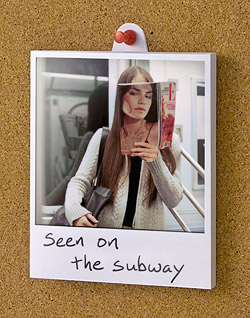
Idea: The last product Polaroid should make

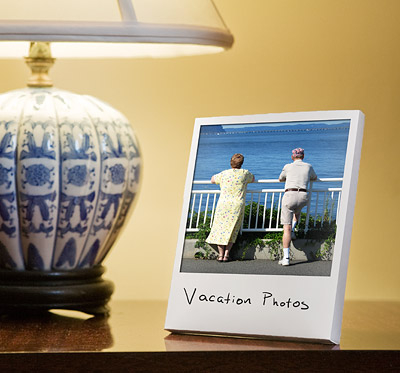
You may have heard the recent announcement that Polaroid will stop making instant film soon. They’re manufacturing just enough to last through 2009, and then they’re shutting down the factories. That gives them almost two years to develop what I think should be the last Polaroid product: a digital picture frame that makes sure the familiar look of a Polaroid photo lives on.

You just put your memory card in a slot on the bottom of the frame, and navigate using the touch screen to select whether you want to view your photos in “Standard” mode, which functions like any other digital picture frame, or in “Classic” mode, where each photo slowly fades into view over the course of a minute or so while you watch and wonder what photo is coming up. (In Classic mode, you can try shaking the frame to make the photo fade into view more quickly, but it won’t really do anything).

If you’re the sort of person who prefers to pin your Polaroid pictures to your cork board in your cubicle, you can take advantage of this innovative feature: The stand on the back of the frame can rotate to an upward position, sticking up above the top of the frame and revealing a hole for you to stick a pushpin through. The rechargeable internal battery allows you to showcase your photos that way even if you don’t want a wire dangling down from your cork board.
The bottom portion of the frame features a dry erase surface, so you can write your own title for your slideshow by hand, using a dry erase marker. Because sometimes it’s nice to preserve at least a little bit of the old way of doing things.

Previously: Idea: The Digital Jewel Box

February 11, 2008

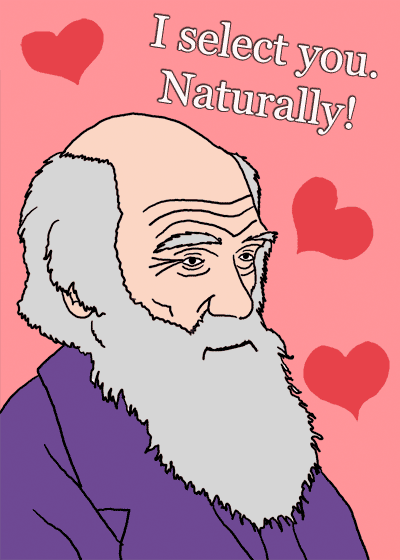
Idea: Scientist Valentines

Thursday is Valentine’s Day, a holiday where it’s customary to give a card to your loved one just to say “I Love You.” But even before the Catholic Church decided to honor one of its Saints with a holiday on February 14, this month was celebrated as a month of fertility festivals going all the way back to ancient Greece and Rome. I’ve decided to honor an entirely different group of people with this collection of romantic cards you can e-mail to your loved ones on February 14th, or any other day of the year. It’s Scientist Valentines!

You can click on these to get larger versions:


Previously: You say you want an evolution…

February 1, 2008

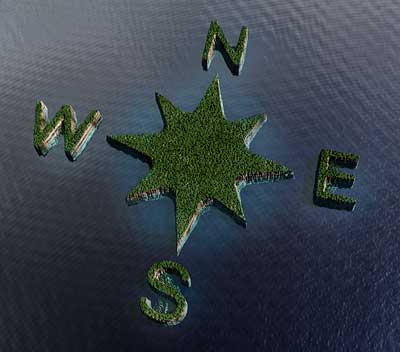
Idea: Other Custom Islands

You may have already heard about The World, a man-made archipelago currently being built off the coast of Dubai. When completed, the grouping of islands will resemble, more or less, the whole world, and each individual island can be privately purchased by a billionaire who wants to live surrounded by other billionaires..

It’s a clever gimmick. But for the truly eccentric billionaire, why stop there? For enough money, you could build your own island in the shape of whatever you want. Here are a couple more island ideas I came up with.

For the classic TV lover, the Isle of Lucy:

Isle of Lucy

Of course, the same billionaire should also build Gomerp Isle nearby. But no Gilligan’s Isle. That’s too easy.

And for the practical jokester, here’s Compass Island:

Compass Island

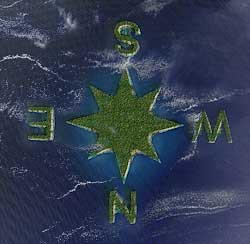
Okay, the practical joke isn’t immediately obvious. Let me show you what it looks like from space:

Compass Island

That’s right, it’s oriented upside-down. It’s sure to disorient pilots flying overhead, and confuse people who come across it on Google Earth.

The idiom-loving billionaire could build islands which spell out the phrase “NO MAN” so that, finally, No Man is an island. The person who made his or her fortune in pancreatic medicine could live on the Islets of Langerhans, in the shape of the human digestive system. Oh, the island-pun possibilities are endless.

December 27, 2007

Idea: The Gethuman Dialer Application

The website gethuman.com has created a database of phone numbers for every major company in 15 different categories (such as insurance, phone companies, banks, etc) with instructions on exactly what you need to do in order to navigate your way to a real live human. For example, if you need to talk to a live person at Priceline, the instructions say, “At prompt press 1; at prompt press 1; at prompt enter phone number #; at prompt enter phone number #; at prompt enter phone number #.”

But that still seems like an awful lot of work to get a human. Why doesn’t someone create an application that does all the work for me? Let me select what company I need to call, and then use my modem to call them and do all that number-pressing automatically. At the last step, play a sound so I know to pick up my phone. Or just turn up the speaker on my computer so I can hear when a human picks up. Of course, not everyone has a modem any more, so the program could also come as a Skype plug-in and in cell phone versions for different mobile operating systems.

The program doesn’t need any sophisticated voice-recognition technology to know when it can press the next number. It can just be programmed to pause an appropriate length in between number-presses. And by letting me set my default services, I don’t need to see the huge list of companies all the time unless I want to. I could just press the “electric company” button and be talking to a person at ConEd a few minutes later. The program would need to come with some actual spoken words pre-recorded for those phone systems that require you to say “yes” or “operator,” etc. And it could store my account numbers so it can enter them where needed.

This shouldn’t be too difficult, right? Old BBS dialer software might even be usable by loading it with Gethuman info instead of BBS phone numbers, and using Hayes Commands to handle the pauses and subsequent number presses. But that method has limitations, and isn’t as complete or elegant a solution as a dedicated Gethuman Dialer.

[This idea came about during a conversation with my friend Jay, who deserves a share of the credit on this one. Thanks, Jay!]

Update: Well that was fast. A reader named Scott points out that such a service already exists through a web-based interface called Bringo at nophonetrees.com. I suppose a desktop app would calm any concerns about divulging your phone number or other personal information to any third parties, although it should be noted that Bringo’s privacy policy looks pretty good. So until such a thing exists, I’ll definitely bookmark Bringo.

December 17, 2007

Idea: Tetris one brick at a time

Wikipedia lists dozens of variations on Tetris. I’ve played several of them, and still like the original version best. But I recently thought of a variation I haven’t seen before. It’s like a cross between Tetris and “Bubble Breaker” style games.

In this version of Tetris, which I call “Montris,” there are no falling tetrominoes (the shapes made up of 4 bricks that you’re familiar with in Tetris), and there is nothing to rotate. The shapes just drop one brick at a time, and it’s up to you to create tetrominoes when they land. When you create a tetromino, it disappears. Your goal isn’t to clear entire rows of bricks. You just clear tetrominoes. When you clear one and the bricks above it fall, this may create other tetrominoes that clear creating a chain-reaction. So thinking ahead is important.

If you drop a brick where it could potentially create more than one tetromino, you have to decide which tetromino to clear. See the animated example above for an illustration of how this could work.

Dropping one brick at a time means the well would take a long time to fill up, so there should be some other variation that keeps the game exciting. Maybe it’s as simple as a narrowing the playing field to only 5 or 6 bricks wide? Or maybe gameplay speeds up very quickly. Or maybe the next brick starts dropping when the current one is only half-way down.

One of these days, I’m going to learn enough about programming to be able to actually try my ideas.

(I call it “Montris” because it combines “mono” and “tetris.” Also, the word “montris” in Esperanto means “to show” in the past tense. That’s not really relevant, but now you know a word in Esperanto.)

November 27, 2007

Idea: Truly Crappy Statues

Poo Statue
Based on photo by FatBusinessman
Sculptors sometimes choose their medium based on how that material will change over time. When Frederic Bartholdi decided to make the Statue of Liberty out of copper, he knew that years of wind, rain, and sun would give it a nice green patina, and he must have had that final look in mind when he designed it. I think a sculptor should be brave enough to take a similar approach to another natural phenomenon that can change a statue’s color: bird poo.

Perhaps a bronze statue in homage to a historical figure who had salt-and-pepper gray hair can be erected below the branches of a tree. At that time, the sculptor’s work would be finished, but the statue would not. Only after enough pigeons have crapped on his head to give him a greater likeness to his subject would the statue truly be complete.

Or maybe a statue could be made depicting a child holding up a delicious cupcake. A nice bird crap patina on the cupcake could portray delicious frosting. Or, if he holds an ice cream cone, dripping bird poo flowing from the cone to his hands could emulate melting ice cream. Maybe the child could even be depicted as about to lick it off.

Or, even more simply, how about a statue of someone wiping bird crap off his shirt, placed somewhere that the statue is sure to be pooped on? A great work of art, depicting a modern Sisyphus.

Previously: Michelangelo’s David meets George Bush

September 27, 2007

Idea: The Histogram as the Image

Yesterday, I posted the image seen here and told you that there is another picture hidden somewhere within it. I challenged my readers to find it. After a bit of confusion in the comments, someone finally declared that they found it: “Hahahaha! Cool! It’s the NY skyline!” Another reader noted, “The first thing I did was to try to tweak the image using the Levels command. I was greeted with a surprise right there in the dialog.”

Yes, the New York City skyline is hidden in that picture’s histogram. It looks like this:

Several people have asked how I did it. So I’ll explain, but I might get a little longwinded in my attempt to be clear. Feel free to just skim and look at the pictures if you don’t want to read it all.

The idea for this project started with a question: Is it possible to create an image that depicts its own histogram? (A histogram, for those unfamiliar with the term, is a bar graph representing all the tones in an image — it typically looks something like a mountain range). I played around a little bit in Photoshop and the closest thing I came up with was this image:

…which has this histogram:

Yeah, okay. That was neat I guess. But I couldn’t come up with any other shapes that worked. But all this thinking about histograms and what they represent got me wondering if I could control what a histogram looks like by manipulating the image. Could I create something recognizable? To try it, I would need to find something that would be entirely black, horizontal in orientation, and not require any holes or vertical gaps. A skyline seemed perfect.

I did a Google Image Search for “manhattan skyline silhouette” and was tickled to see that the perfect image came up in a result from my own site! I once posted an entry about New York City as depicted in the animated film Antz. Google showed me this image from that entry on the first page of search results:

A typical 8-bit grayscale image can have 256 possible shades of gray. A histogram represents the amount of pixels at each level from 0 to 255, and is 256 pixels wide. So the first thing I did was shrink down the Antz skyline to 256 pixels wide. This meant that each vertical band of black pixels in the skyline represented a value from 0 (black) to 255 (white).

Then I created a new document. The first column of pixels in the skyline image represents value “0” and has 43 black pixels. So my new document needed 43 pixels with the value “0.” Column 2 of my skyline represents value “1” and has 46 black pixels. So my new document needed 46 pixels with the value “1.” And so forth.

Another way to think of it is to say that I took all of the “skyline” pixels from this image:

…and put them in a new document, with no other pixels. Then I rearranged all those pixels into a square from dark to light. The result was very close to perfect. The histogram looked pretty much like the skyline, but it was stretched vertically.

Normally, a histogram is scaled vertically so that whatever value has the most pixels reaches all the way to the top of the graph, and everything else is sized proportionately. In this case, it is the shade of gray which forms the World Trade Center antenna that has the most pixels. So this is roughly what the histogram looked like:

I was thrilled that it worked, but I didn’t want it stretched vertically like that. In order to prevent the WTC tower from being too tall (and everything else scaling upwards with it) I had to put extra pixels of one value in my image, so there would be more pure of that value than any other value, which would push the others down so that the graph remains proportionate. I chose pure white, because this creates a thin black line at the far right side of the histogram where you don’t notice it.

I could have added this row of white pixels at the bottom of the new image, but instead I typed my website name in white, and placed it within the image. In doing so, I copied over some other pixels, which altered the skyline. So I had to put it in a place where the “damage” to those buildings wouldn’t be that noticeable. It took trial and error, but I found a good spot. It changed the skyline on the left side a little bit (compare to the “Antz” image). But it still looks like buildings, so I accepted it. Also, this way I get some credit if the image gets passed around without attribution.

I did it all tediously by hand, but I think with a little tinkering, someone could write a program to simplify the process, taking a 256 x 100 silhouetted image and extrapolating a new image with that as the histogram. And the final image file doesn’t need to be a square with a gradient, either. Those pixels could be in any order. They could be completely scrambled. Or they could be laid out in a way that shows an image of an Apple (as in “The Big Apple”). As long as no new pixels are introduced or deleted, the histogram remains the same. But that is a lot more work than I was prepared to do.

Oh, I almost forgot: I doubled the image size so it would look a little better on the website. As long as I resized it using the “Nearest Neighbor” method instead of some other interpolation method, every pixel (and therefore every shade represented in the image) would be duplicated identically, keeping the proportions in the histogram the same.

Update: A reader has taken this idea even further!

September 17, 2007

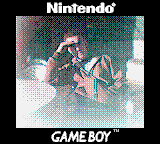
Idea: Color Photos with the Game Boy Camera

Note:I wrote this article in 2001. At the time, Nintendo had a camera add-on product for the Game Boy that took low-quality black and white pictures. Small, cheap, color digital cameras were not nearly as prevalent as they are now. I originally posted this on my photography website. There has been a link to the article from Ironic Sans in the sidebar on the front page, but I’ve decided to integrate it as a regular Ironic Sans entry and remove the sidebar link.

Background

All colors of the visible spectrum can be broken down into combinations of just three colors: Red, Green, and Blue. In fact, if you look at your computer screen under a magnifying glass, you will see that it is made up of tiny red, green, and blue lights that are varied in combinations to create all the colors you see on your screen.

Every color picture can be broken down into three separate black-and-white pictures which represent the amounts of red, green, and blue that are used to make up that picture, as in this example:

The Theory

If a color picture can be made from three black and white pictures, I could use the Game Boy Camera to take three separate black and white pictures (using filters to capture the red, green, and blue values of a scene) and then use the computer to combine them into a single RGB image. A more elaborate version of this process is commonly used in high-end digital cameras used by large photo studios, so I saw no reason why it wouldn’t also work with the Game Boy Camera. [*note: three-pass digital cameras aren’t really used as often now in 2007 but they were at the time I wrote this]

The Process

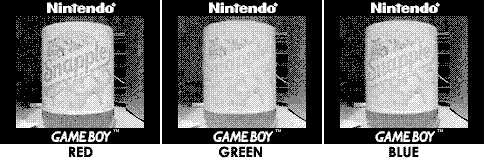
I picked a location in my apartment where I could make sure the Game Boy could sit absolutely still (so I could take three identically-posed pictures) and picked a small colorful object to photograph. One of the first objects I tried photographing was a Snapple bottle, Kiwi-Strawberry flavored, with a colorful green and pink label.

To capture only the red light reflecting off the Snapple bottle, I was going to need a red filter that I could place in front of the Game Boy Camera, so that only red light would reach the lens. I went to a local photo-supply store and obtained a free book of filter samples, containing dozens of various colored filters. I picked a red filter and held it in front of the lens and took a picture. I repeated the process with a green filter, and then a blue filter, careful not to move the camera or the bottle in between shots.

Using the Game Boy Camera PC Link from Mad Catz, Inc., [no longer available in 2007] I transferred the images to my computer, where I ended up with these three images:


I thought I had done everything right, but when I pulled the images into Photoshop to create my RGB composite from these three images, I came up with a picture that looked like this:

Problems

Obviously, I didn’t have the full color photograph I had anticipated, although there was a hint of color in the image. If my theory was correct, though, it should have worked. A little bit of research on the internet brought me to the cause of the problem. It turns out, the light-sensitive chip inside the Game Boy Camera (it’s called a Mitsubishi M64282FP chip) is sensitive to infrared light, which isn’t visible to the human eye. While I was succesfully filtering out red, green, and blue light, infrared light was still reaching the lens of the camera.

This was easily provable by pointing my Game Boy Camera at my TV remote control and pushing a button on the remote. Even though nothing seemed to happen that I could see with my eyes, I could see the front of the remote light up on the Game Boy screen! I would have to filter out the infrared light reaching the Game Boy Camera in order to get my full color photograph.

Solutions

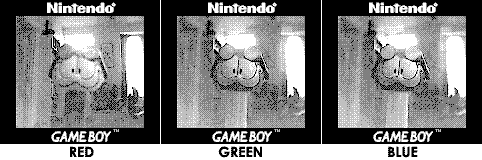
Apparantly, most digital cameras are sensitive to infrared light, but contain a built in “hot mirror” filter, which blocks infrared (something I learned through a little research on-line). So I went to my local camera shop and bought a hot mirror filter (which was more expensive than I thought it would be, but I was now determined to take color photos with my Game Boy Camera, so I bought it anyway). I held it in front of the Game Boy Camera and repeated the remote control test, and could no longer see the light of the remote light up. I had a good feeling about this. I attached the hot mirror filter to the front of the Game Boy Camera using masking tape, and picked a new test subject to photograph: a Garfield Pez Dispenser.

Repeating the three-pass process of photographing an object with the red, green, and blue filters, I came up with these images:


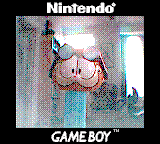
Already I had a good feeling, as these images were more in line with what I was expecting than with the previous tests.  So I again transferred them to Photoshop, created a composite RGB image, and this was the result:

The World’s First color photograph taken with the Game Boy Camera!

More Pictures

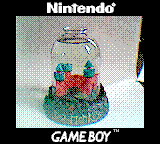
October 31, 2001 - Okay, I know that they are not the most exciting subjects, but the following photos (plus the Pez Dispenser above) are the World’s First color photos taken with the Game Boy Camera. I just shot whatever was around to be used as test subjects.


November 10, 2001 - My first outdoor attempts. First off, notice the vignetting in these images (the halo that seems to be around the pictures). This is caused by the camera itself reflecting in the Hot Mirror filter. I’ll have to use a black magic marker or something to make the GB Camera black so it doesn’t reflect (I think it wasn’t a problem indoors because the camera didn’t have such bright light on it). In the picture of the trees, the blue sky came out nicely peeking through the top. I’ll have to solve the halo problem before my next attempts.

[That’s it. I never got the motivation to shoot any others in this series, as cheap color digital cameras became more prevalent, and the novelty of taking low quality color pictures with a cheap handheld device wore off].

September 3, 2007

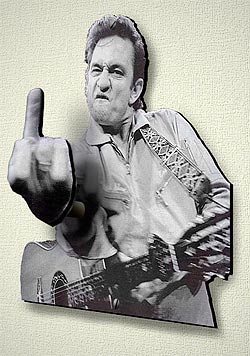
Idea: Celebrity middle finger coat hooks

Middle Finger Coat HooksI think a kitchy home accessories designer should license historic photos of celebrities giving the middle finger and turn them into 3-dimensional coat hooks. At right is an artist’s rendition of how such a coat hook might look using a famous photo of Johnny Cash.

A coat hook like this would be the perfect thing to put in your rebellious high school son’s bedroom. He’ll enjoy it so much you can be sure he won’t come home from school and just drop his jacket on the floor any more!

Other celebrities who have been caught on film giving the middle finger, making them great candidates for the coat hook conversion, include Abbie Hoffman, Willie Nelson, and, um, George W. Bush.

August 20, 2007

Idea: Give the boss a grade

In business, there comes a time in the fiscal year where the boss calls his or her employees into the office for a performance evaluation. But the only direction the evaluation flows in the workplace is from top down. Nobody asks the employees how the boss is doing. Sure, the boss has to be evaluated, too, but the view of his or her performance is only seen from above.

I think businesses should implement Boss Evaluations, similar to the Teacher Evaluations that students get to do in school. I’m sure we’ve all had similar thoughts when it came time for our own evaluations, so I know it’s not a revolutionary idea. But maybe it’s an idea that needs to rise out of the wishful thinking of the low rungs on the ladder and actually be implemented.

Of course a manager’s performance can be measured quantitatively (are sales up? is profit up?) just as test scores can be measured to judge a teacher’s success. But human relations are an important factor in a business’s bottom line, as well. When employees are happy, they stick around. While high turnover is acceptable in some industries, time and money spent training new staff may be better spent elsewhere. It benefits a company to have dedicated employees who aren’t constantly seeking a better position. It has been said that people don’t quit their jobs – they quit their bosses.

It may turn out that a division within a company is successful despite a boss that nobody likes. That is important to know, too. Employees with bad bosses may still be working hard, but they may also be more likely to steal office supplies, trade secrets, or other property.

Sure, there’s always going to be the brown-noser who gives a positive evaluation no matter what. And the employee with a grudge may give a negative evaluation to a boss who’s actually pretty good. Statisticians are better equipped than I am to suggest ways to account for that (is it as simple as throwing out the highest and lowest scores?). But a progressive company bold enough to ask the employees how the boss is doing may find itself with valuable information for running their company more effectively.

Note to my former boss at the last company I worked for: You didn’t inspire this article. Don’t worry.

August 14, 2007

Idea: Breed a “Mickey” Mouse

Mickey MouseWalt Disney should add a new division of scientists (biological imagineers) to its company with the goal of breeding “Mickey” mice — real mice, selectively bred for their big round ears and black facial coloring which makes them resemble a certain famous cartoon mouse. Then they can sell them as pets in pet stores.
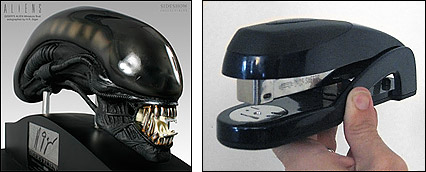

If they start now, this could be the next big craze come Christmas.

July 11, 2007

Top 5 Remainder Ideas

I’m off to the Galapagos Islands, so I won’t be posting anything or replying to e-mails for the next two weeks. Try not to make a mess of the place while I’m gone. Hopefully the Spambots won’t take over.

To give you something to talk about, I’m leaving you with my Top 5 “Remainder” Ideas. These are just a few of the many ideas I’d jotted down in the past but decided weren’t worth fleshing out into full posts for one reason or another. Since they will probably remain that way, I figure they’re better off posted here than wallowing in obscurity. It may be more obvious why some never made it to full posts than others.

Remainder Idea #5: Bring back the Ford Prefect

I had this thought one day that Ford could make it big with Science Fiction fans by introducing a new car in its defunct Prefect product line. Then I actually looked at the old Ford Prefects, and wondered if maybe there was a good reason the Ford Prefects aren’t around anymore. I don’t know how you’d give that old car a modern feel.

Remainder Idea #4: The World’s Mildest Salsa

Salsa companies always brag that they have the world’s hottest salsa. But what about people who just want flavor? Why doesn’t anybody market a product as the world’s mildest salsa? I think there’s a missed opportunity here.

Remainder Idea #3: “The Short Con”

In the con artist’s world, a “long con” is a term referring to an elaborate and drawn out scam where the victim actually hands over his money repeatedly, going back to the ATM (or his home, or office) for more and more money. A “short con” refers to a quick scam where the goal is simply to get whatever money the victim has at the moment. Well, I thought “The Short Con” would make a great name for a movie about a con artist who happens to be really short, and who specializes in short cons. Somehow, he gets involved in a long con. Naturally, he would be played by Danny DeVito. I didn’t get much further than that.

Remainder Idea #2: My Amazon “Don’t buy me this” List

On Amazon.com, you can create a Wish List of items you want, and rank them by priority so people know what to get you for your birthday. Not long ago, the lowest ranking you could give an item was labeled “Don’t buy me this.” I wondered why on Earth anybody would bother putting something on their “Wish” list and then rank it “Don’t buy me this.” So I put together a whole list of only things I didn’t want people to buy me on Amazon, and ranked them as “Don’t buy me this.” I don’t remember what was on the list anymore except for a few things like some earrings that looked like chewed gum, a talking Ann Coulter doll (for which my comment was something like, “I’d rather have a bag of dirt”), and an actual bag of dirt. Shortly after I put together my list, Amazon changed the Wish Lists so the lowest priority rank no longer says “Don’t buy me this.” It just says “lowest.” And then my list wasn’t funny anymore. To the contrary, it suggested that I kinda wanted a talking Ann Coulter doll and a bag of dirt, but just a little bit.

Remainder Idea #1: Webstr

This was my idea for a Web 2.0 site for people who want to adopt orphan sit-com boys (the one for adopting orphan sit-com girls is called PunkyBrewstr of course, and they’re both in perpetual beta). I even went so far as to make a Webstr logo, using the old Webster TV show font in Flickr logo colors. But then I decided it wasn’t funny enough, and I set it aside until I could come up with a better idea for what a Web 2.0 site called Webstr would be. That never happened.

Interesting note: While working on Webstr, I realized that adopted kids were a big theme in 80s sit-coms. Punky Brewster was adopted. Webster was adopted. Arnold and Willis were adopted. Ricky Stratton was adopted. Well, reunited with his long lost father, anyway. Close, though. Any others?

Bonus remainder idea: The Top 10 Reasons Phil Donahue Should Be President

One day I realized that I think Phil Donahue is a pretty level-headed guy and I mostly agree with his politics. I thought it would be funny to put together a list of the Top Ten Reasons he should be President. Unfortunately, I only thought of one, and it’s probably only funny to hardcore Phil Donahue fans, and that’s not enough for a good post. So let’s just pretend I’ve come up with 10 reasons, and you’ve just read reasons 10 through 2, and they were very funny, so I can go ahead and tell you the one funny reason I came up with. Ready? “And the Number 1 reason why Phil Donahue should be President is…. That First Lady!”

See you all in a couple weeks!

July 5, 2007

Idea: The Alien Stapler

I recently rewatched the Alien movies. I must still have Aliens on my mind because today I got a little creeped out by my stapler (it’s the one on the right):

Alien Vs. Stapler

All this leads me to the thought: They should make a stapler shaped like the Alien. And it should have one of those staple trays that reloads by extending outward, instead of having to open the top.

Previously: Yip-Yip Martian Binder Clips

June 14, 2007

Idea: Lolcatvertisements

The way I see it, companies have about a week or so left in the life of the lolcat meme to come up with some clever ads that use the lolcat format. I think for the most bang for their advertising dollar, the campaign should probably appear in college newspapers or someplace else where the fewest people possible will be scratching their heads in confusion.

Take a pizza and burger joint, for example. They could start with a picture of a pizza delivery guy, with the caption “I’M IN YOUR NEIGHBORHOOD, DELIVERING YOUR PIZZA” or it could have a picture of a burger and fries with the caption “YES YOU CAN HAS CHEEZBURGER.” Okay, they could probably come up with something more clever than that. But it would give me a chuckle to see a company incorporate an on-line meme into their ads without referencing where it came from. It would be sort of an inside joke among the internet savvy.

June 7, 2007

Idea: The Sensory Deprivation game

Note: Do not play the game described below if you are in any potential danger of hurting yourself or others, or if you are near traffic, or anywhere that you aren’t positive it can be played safely. Play at your own risk.

That’s got you curious, huh? What’s the Sensory Deprivation game that’s so dangerous it requires a disclaimer? It’s something I found myself doing one day in college as I was walking across the busy campus and saw a blind student walking in the opposite direction with a walking cane. I wondered what it’s like to confidently walk around, even while unable to see. Blind people seem to do it okay. Could I?

I had my sunglasses on, so I figured nobody would notice if I suddenly closed my eyes. First I looked out at the ground ahead, the people walking around, and figured that if I just kept walking straight I would avoid all of them, and the lamp post. How many steps could I take before I had to open my eyes again? I decided to find out. Without changing my stride, I closed my eyes.

The answer was only around 6 steps. I had no confidence in my ability to navigate at all. I felt like at any second I would smash into something or someone. I must be veering one way or the other, right? When I opened my eyes, I realized that I had been walking straight after all and was actually doing pretty well. So I tried it again. After another 6 steps, I couldn’t bear it.

Why was I only able to take 6 steps? How many would I have been able to take if I’d had a walking cane before I freaked out about bumping into things? How long does it take the newly-blind to be able to get around confidently? Is it faster to learn with a cane, with a guide dog, or with echolocation?

I haven’t really played the game since then. Do I dare, here on the busy streets of Manhattan? Do I get bonus points if I play while wearing my iPod? How many steps can you take?

May 27, 2007

Idea: The Hamburdog

It’s Memorial Day weekend, so I thought I’d share a little something I came up with after one of my Memorial Day BBQs a few years back.

HamburdogYou know how hot dogs come in packs of 10, but hot dog buns come in packs of 8? This pretty much assures that there will be leftovers of one or the other at the end of the day. Hamburgers on the other hand can be spread out a little more evenly because you can control the size of the patties you make with your ground beef. But one year I ended up with too much ground beef, and too many hot dog buns.
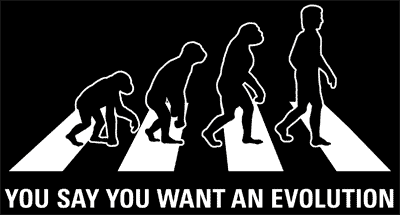
That’s when it occurred to me: Nobody says that hamburgers can’t be shaped like hot dogs. Thus the Hamburdog was born. Just roll up the ground beef into tube shapes, grill as usual, and place on a hot dog bun. Add your normal hamburger condiments, and voila! It goes against everything you think you know about picnic meats, but it sure is tasty.

May 23, 2007

Idea: You Say You Want An Evolution (T-Shirt)

Today I had an idea for a t-shirt. Here’s the artwork I came up with:

Evolution Road

I decided to make it available with or without the caption, in designs suitable for dark t-shirts or light t-shirts. I like it both ways:

Evolution Road

It’s Charles Darwin meets Liverpool and it’s available now in dozens of styles and colors for men and women in the Ironic Sans store!

May 14, 2007

Idea: “12” — a spinoff of “24” for kids

12FOX should make a spinoff of “24” for kids. They should call it “12” and the main character should be twelve years old. Each of the 24 half-hour episodes covers 30 minutes in the life of Brad Bauer (or whoever). The first season could start at 7:00 a.m. on his twelfth birthday as he prepares to head to school, and end at 7:00 PM when he gets home. In between, Brad gets wound up in some crazy adventure and manages to save the day, while he tries to keep up with his classes, celebrate his birthday, and impress that girl he likes in algebra class.

Previously: What George Bush and Jack Bauer have in common

April 27, 2007

Idea: Uncensor the Internet with Greasemonkey

Uncensor the InternetThere’s an article on-line from Money Magazine called “50 Bulls**t Jobs.” That’s right. Bulls**t. With those two asterisks in there. Come on. We know what word they mean. So why not just say it? If they think we’re adult enough to be reminded of the word, why don’t they think we’re adult enough to see the actual word? (The article is based on a book by the same name, but without the asterisks)

Oh, I know. It’s the kids. They might be reading. Sh*t. I didn’t f*cking think of that. It would be terrible if they would see the word “Bulls**t” in print, but it’s okay for them to see it with the asterisks, right? They’ll have no idea what that means. And I’m sure they have no idea what “the F word” is, so let’s just keep calling it that.

But what about us adults who can decide for ourselves whether we want to see foul language or not? Is there a way for us to avoid all this f****ng unnecessary self-censorship littering the internet?

There is now. I’ve created the “Uncensor the Internet” script for Greasemonkey (a Firefox plug-in that lets you add all sorts of useful functionality to your web browser, available here). If you’re running Firefox with the Greasemonkey plug-in, just install this script, and see all the foul language that people are pretending they don’t use.

It’s also available as a standalone plug-in for those of you who aren’t running Greasemonkey. Right-click on the link to save it to your desktop, and then drag it into your browser window.

To see an example of the script in action, reload this page after you’ve installed it.

Previously: The CNN Fortune Cookie Greasemonkey script. It automatically adds the phrase “in bed” to the end of CNN.com headlines.

Update: I’ve fixed the script so it knows the difference between “a whole” and “a**hole,” and it knows the difference between “batch,” “botch,” “butch,” and “b*tch.”

April 9, 2007

Idea: The Digital Jewel Box

I love having my music on my hard drive or iPod, but one reason I still buy CDs and then rip them is that I enjoy holding the jewel box in my hand and reading the liner notes while the music plays. I just hate how much space all those jewel boxes and liner note inserts take up.

Digital Jewel BoxSo how about making a Digital Jewel Box? Here’s how it would work: The DJB sits next to your stereo or computer in its charging dock. Similar to a digital picture frame, it syncs wirelessly to your home network via WiFi, syncing itself with iTunes or whatever digital player you use. When a new song comes on, the DJB’s screen shows the album cover art for that song.

At any time, you can take the DJB out of its dock, sit on the couch with it, and use the controls on its side to flip through the rest of the liner notes, including track listings, lyrics, song credits, acknowledgments, and whatever else is included in the paper version. The pleasure of flipping through liner notes doesn’t need to go away just because CDs do.

You can also use the DJB as a remote control, as long as your media player supports it. The DJB has an infrared transmitter, and the charging dock has an IR receiver. So if you’re sitting on your couch flipping through your favorite album’s liner notes and you decide you’d rather be listening to a different track, you can skip forward or back by pressing buttons on the DJB itself. If you want to hear a different album entirely, use the DJB’s menu to flip through your music. The songs themselves aren’t stored on the DJB, but the track listings are.

When you’re not playing music, you can set your DJB to turn off completely, or double as a digital picture frame, displaying your personal pictures.

Here’s another mock-up of what the DJB might look like, but probably with fancier transitions than these:

Digital Jewel Box

March 29, 2007

Idea: Develop an F-Bomb

The term “F-Bomb” is used often these days to describe what we used to simply call The F Word (mp3). Specifically, it describes the F Word when it’s used unexpectedly. For example, if a caller on a radio show uses the F Word, the host might chastise him for “dropping the F-Bomb.”

F BombWith that in mind, I think that if I were an evil dictator in a country developing a nuclear weapon, I would name my new weapon “The F-Bomb.” Then I’d get a little giggle every time it was reported in the news that my country is threatening to drop the F-Bomb. As in, “Ironicsansistan tested a long-range missile today, heightening fears that it will follow through on its threats to drop the F-Bomb on South Ironicsansistan.”

March 26, 2007

Idea: The Kotter Family Tree

Kotter Family TreeNearly every episode of the 1970s sitcom Welcome Back, Kotter began or ended (sometimes both) with the main character Gabe Kotter telling a really corny joke about a family member. It usually started with him and his wife sitting around, and he asks, “Did I ever tell you about my Uncle So-and-so?” When I was a kid, I loved this show. I found it hilarious. Now, not so much. But I’d still like to see a definitive list of Kotter family members and the situations they found themselves in. I think there’s a Wikipedia article somewhere waiting to be written. I’ve done a little bit of research, and here’s what I’ve come up with so far:

Uncle Carl was a hunter out hunting game. One day, he shot a beautiful girl in the woods because she told him that she’s game. (Season 2, Episode 11)

Uncle Max was a barber. He once hired a private investigator to follow a man who kept coming in the barber shop, asking how long the wait was until the next haircut, and leaving. The investigator followed the man and reported back to Max that the man was going to Max’s house every day. (Season 2, Episode 11)

Aunt Brenda believed in reincarnation. After Uncle Sidney died Brenda went to a seance where Sidney’s ghost revealed that in the afterlife he has a lot of sex before and after every meal. He explained that he is not in heaven — he has been reincarnated as a bull in Montana. (Season 3, Episode 5)

Uncle Eddie was a thief. He used bricks to break windows of stores so he could steal precious items for his girlfriend. When she got too annoying about all the things she wanted, Eddie asked her if she thinks he’s made of bricks. (Season 3, Episode 5)

Uncle Julian was raised by wild dogs. Eventually he was brought to civilization and became a mailman. He was fired for biting himself on the leg. (Season 3, Episode 24)

Uncle William was a pharmacist. He was fired for trying to fit bottles into a typewriter in order to type information on the labels. (Season 3, Episode 24)

Uncle Milton was a famous spiritualist who held seances every Friday night. One night Milton felt the presence of a spirit named Max who in life made a living as a waiter. Milton asked Max’s spirit to come closer to the table. Max refused, as Milton was not at one of Max’s tables. (Season 3, Episode 25)

An un-named uncle went to an Italian restaurant where he noticed a Chinese waiter who speaks perfect Italian. He asked the restaurant owner why. The owner explained that the waiter has only been in the country for two months and is under the impression that the owner is teaching him English. (Season 3, Episode 25)

Uncle Melzer was a navigator. He once removed a thorn from an elephant’s foot in Africa. The elephant was so grateful that he picked Melzer up in his trunk and placed him in his second floor hotel room. A year later, at the circus in Pittsburgh, the elephant picked up Melzer in its trunk and flung him into the balcony, breaking his legs. It was a different elephant. (Season 4, Episode 3)

Uncle Nezbit had no friends, but he brought his dog everywhere, including to the movie theater. The dog enjoyed a particular movie, which surprised Nezbit, because it hated the book. (Season 4, Episode 4)

When Gabe was young, his father told him that the local bully Tommy O’Shaughnessy was a coward. So Gabe told Tommy that, prompting Tommy to beat up Gabe’s father. (Season 1, Episode 2)

Young Gabe’s mother told him to ignore kids who made fun of his big head. But when she sent him on an errand to the supermarket, she suggested he could carry all the groceries home in his hat. (Season 1, Episode 2)

Anyone have more to add?

March 6, 2007

Idea: Joost’s missing feature

INTRODUCTION
Joost LogoI’ve been participating in the beta test of a hotly anticipated new program called Joost. It’s essentially a video-on-demand service from the people who brought you Kazaa and Skype, which uses proprietary technology to make high quality video over the internet as instant as your TV. Unlike video sharing sites such as YouTube, you won’t get to upload your own videos to Joost. They will provide the content through contracts with various TV and movie companies, and show the programs in appropriate Channels. For example, they might have an NBC Channel where you can catch up on episodes of Heroes. Or you might go to the Warner Brothers Movie Channel to watch the movie Batman.

While still in beta, the content is pretty limited. I can watch some National Geographic documentaries, a few episodes of the World’s Strongest Man competition, some Canadian music video programming, and that’s about it. But while Joost is working on adding new content and improving the video technology, I’m still left wondering where the feature is that will make me want to watch video on demand with Joost instead of with, say, my local cable company or other on-demand service. Is it enough that the video starts in 5 seconds instead of 5 minutes like with other high-quality streaming video services? Maybe. But my cable box is even more instant than that. There’s a real opportunity here to make Joost something different and better than television, instead of something that’s as close to TV as possible. That’s where my idea comes in.

I imagine a feature that combines all the best elements of social websites like Digg, the humorous style of Mystery Science Theater 3000, the educational aspect of DVD commentary tracks, the user-contributed spirit of a Wiki, the format of Pop-Up Video, and integrates it all with Joost. It could make even the dullest content interesting and fun to watch, and make the best programming even better. Here’s how it works:

HOW IT WORKS
If I have the yet-to-be-named feature turned on, I can choose to use Joost in one of three modes: Writer Mode, Voter Mode, or Viewer Mode.

Writer Mode
Joost Writer ModeIn Writer Mode, whenever I pause the program I’m watching, a window pops up that I can type in. Joost uses a time stamp to remember where I was in the program when I wrote this comment, and also remembers where on the screen I’ve put the window. Then I can type in any comment I want. Preferably, it’s either informative about the particular scene (e.g. “This scene was filmed at Maine North High School in Chicago”), or it’s a funny comment on the scene. I can tag it appropriately as “funny” or “informative” so Joost knows how it’s intended.

Voter Mode
Joost Voter ModeIn Voter Mode, I watch the movie with a window overlaid in which all the comments people left scroll up automatically. I get to vote every comment up or down based on whether I agree that it’s funny or informative or neither of the above. In my illustration, all the comments are white, but perhaps they would be different colors to specify funny or informative. If there are too many comments to reasonably vote on so quickly, I can tell Joost to not show me every comment so that it’s more manageable. I can set the pace myself. Or I can just vote on the ones that jump out at me, ignoring the others.
Viewer Mode
Joost Viewer ModeIn Viewer Mode, I can watch a program or movie with comments turned on. They will show up where and when the commenter specified, and then disappear after a few seconds. Because people read at different paces, I can control how many pop-ups I want per minute. If I say I want 12 per minute, only the 12 highest rated pop-ups will be shown in each minute of the program. I can specify if I want to see just the funny comments, or just the informative comments, or both. I can choose to read the highest-rated comments of all time, or just of the last month or week or day. I could watch the same program week after week and experience it with a whole new set of commentary. And at any time, I can switch to a different mode if I think of a new comment to add or if I want to vote down a lame comment I just read.
It’s possible that someone might have written a highly-rated comment that only makes sense if you’ve read a particular earlier comment that isn’t as highly rated and may not be shown. To make sure this doesn’t happen, the writer can indicate his comment is a “reply” to a specific earlier comment. In this way, a “reply” comment with enough votes to be shown automatically bumps up the earlier comment so it’s also shown.

CONCLUSION
This could be a lot of fun. Imagine watching a show like Heroes once, and then watching it again with comments turned on to see what other people caught that you missed. Also, this has potential to make programs appealing that people wouldn’t otherwise watch. Joost could worry less about making deals with content providers, because even free content like old copyright-expired movies become entertaining in a whole new way. So much of what makes Web 2.0 great is the community-generated content, and right now Joost offers no new way for the community to interact with its product except passively.

Sure, it does have an integrated chat window, but that’s nothing new that I can’t already do with any of a dozen IM programs. And because Joost offers video on demand (as opposed to live broadcasts), it’s unlikely that I’d be watching in sync with anyone else in a chat room anyway, which limits the usefulness of channel-specific chat. This idea could solve the problem of commenting in real time, and makes sure all the best comments rise to the top.

February 12, 2007

Idea: Simultain-O-Vision

Okay, imagine this. You go to a movie with your friend Pete. It’s an alien invasion movie about some lizard creatures from another planet who kill and oppress Earthlings. For the sake of our example, let’s just say it’s a remake of the 1988 movie They Live, and that it stars former wrestler The Rock. When you pick up your ticket at the box office, you’re asked if you sympathize with the aliens or the humans. You decide to sympathize with the humans, and you’re given a special pair of sunglasses. Pete picks the aliens, and he’s given a different pair of sunglasses.

Simultain-O-VisionYou sit down and watch the movie, each of you with your glasses on. A few minutes into the movie, there’s a scene with a couple sitting on their couch watching TV. As you watch, you hear the sounds of the TV show they’re watching. It’s a nature program. They make some comments to each other about the show. All of a sudden, out of nowhere, two aliens jump in and attack, killing the humans.

Meanwhile, Pete has been sitting next to you with his pair of glasses, watching the same screen. But he’s seeing a very different visual. He’s seeing the scene from the aliens’ perspective. He still hears what you hear — the TV on, the couple’s comments to each other — but he sees the aliens climb in through the window, sneak up on the couple, and finally jump in and attack, killing the humans.

Later on in the movie, the aliens begin putting subliminal messages on billboards that only their fellow aliens can plainly see. You, with your human-sympathizing sunglasses on, see billboards advertising computers and such. But Pete, sitting next to you and watching the same scenes, sees the word “OBEY” on the billboard. He sympathizes with the aliens, so he gets to see what they see.

As The Rock wanders through the film, passing average citizens of his fair city, little does he know that some of them are actually aliens. You of course have no idea, either. But Pete, sitting next to you with his special glasses, is able to see which people are really aliens because they have hideous alien faces.

At some point in the film, The Rock gets his very own pair of Alien Sunglasses, and he’s able to see for himself who the aliens are and who the humans are. Action ensues, and The Rock saves the day.

How does it work? Rather simply. It uses the same technology as 3-D movies, but in a different way. In a traditional 3-D movie, two slightly different images — each representing what your right or left eye would see — are projected onto one screen through different filters. To avoid being too technical, we’ll just call them filter A and filter B. To get the 3-D effect, your right eye needs to see only what’s projected through filter A, and your left eye needs to see only what’s projected through filter B. So you wear special sunglasses with different lenses over each eye which filter the corresponding images. Filter A over your right eye makes sure it only sees what’s projected through a “A” filter. Filter B over your left eye makes sure it only sees what’s projected through an “B” filter.

In Simultain-O-Vision (that’s what I call it), there are two different images projected on the screen, only this time they are not representing what each eye sees. They are representing what each Sympathizer sees. Human Sympathizers get sunglasses with two “A” filters and no “B” filters. So they will only see the image projected through an “A” filter. Alien Sympathizers get sunglasses with just “B” filters. So they will only see the images projected through a “B” filter.

In practice, the “A” and “B” filters are actually polarized lenses set at certain angles. This means that if an audience member tilts his head even a little bit — or if the glasses aren’t made to an exacting standard — the angle of the lenses isn’t quite right, and he will see both visuals simultaneously and probably get a nasty headache. But some people will have more problems than others.

As a bonus, the “Sympathizer” aspect of the movie can be retained when the movie comes out on DVD. It can take advantage of the rarely-used “angle” button on your remote control so you can switch back and forth between Human and Alien perspectives while you’re watching the movie.

February 5, 2007

Idea: An Orange Clockwork

An Orange ClockworkHi hi hi there, droogs. This weekend, oh my brothers, I, your humble blogger and narrator, had a thought in my rasoodock to create this orange clockwork. Viddy well this malenky clock which you can hang in your domy for just a little pretty polly. Perhaps your pee and em, or some other veck or soomka you know would find this clock real horrorshow.

Now available in the Ironic Sans store.

January 24, 2007

Idea: Paintings of descriptions of the paintings

Painting Information

If I had the time, the means, and the resources, I’d make a series of large paintings of those little cards that describe paintings in museums. They would be paintings of the cards that describe themselves. For example, I’d do a painting in oil on canvas that describes itself as being an oil painting on canvas. Then I’d hang it in a gallery next to a little card that’s identical to the painting, but is actually there to describe the painting. I’d do a whole series, with different materials. Oil on canvas, Acrylic on wood, etc. See the photo illustration above for an idea of how it might look.

January 23, 2007

Idea: “CNN Fortune Cookie” Greasemonkey script

[Note: This entry has been re-written for clarity]

You remember when you were a kid, and someone taught you that trick where you add “in bed” to the end of a fortune cookie fortune and hopefully make it funny? So a fortune that says “Your great imagination will serve you well” becomes “Your great imagination will serve you well in bed.” You get the idea.

Well, I’ve written a Greasemonkey script that only does one thing: It adds “in bed” to the end of the main headline at CNN.com. Just install it, visit CNN.com, and wait for the entire page to finish loading. Then read the headline. I haven’t decided yet whether or not it’s funny, but it sure amuses me.

I call it The CNN Fortune Cookie script. (Link goes to the script).

For those who don’t know what Greasemonkey is, here’s the scoop. The Firefox web browser allows people to write plug-ins to make it more useful. One of those plug-ins is called Greasemonkey, which allows people to write short scripts that make specific websites more useful, or slightly changes the web browsing experience, without writing a full plug-in. Greasemonkey doesn’t do anything on its own without a script installed. You can see what kinds of scripts are available by visiting userscripts.org. Some of them are pretty nice.

Caveat: I’m not much of a scripter, so I can only hope this works.

January 11, 2007

Idea: Fun with facial recognition

A few years ago at Superbowl XXXV in Tampa Bay, police set up digital cameras at strategic points in the stadium, and used computers to compare everybody’s faces to a database of known criminals on the loose. The city of Tampa used the same system to scan faces on the city streets for the same purpose. The system was unsuccessful and no arrests were ever made, according to an ACLU press release, but a controversy arose over whether or not it was an invasion of privacy to subject everyone to a virtual police lineup.

Between a poor success rate and the controversy over privacy, facial recognition software got a bad rap.

Facial RecognitionBut maybe that could have been ameliorated if the technology had been used for entertainment purposes. What if the cameras scanned the crowds at the Superbowl and built a new database as it went, instead of using a database of known criminals, to find the two people in the audience who looked the most alike? It would be interesting to see, in a crowd of 100,000 people, how close a match can be found among strangers. Then, at halftime or during breaks in the action, the Jumbotron could showcase the closest matches in a series of “Separated at Birth?” moments.

How cool would that be to find your dopplegänger sitting just a few sections away at the Superbowl?

January 8, 2007

Idea: Word balloons as quotation marks

I noticed the other day that word balloons have the same basic shape as quotation marks. It’s interesting because both are used to convey that a person is speaking. That got me thinking of an instance where word balloons could be used as quotation marks, as a design element.

Word balloons as quotation marksIt would probably be weird to have them as part of a font set, but maybe it would look neat used for a pull quote in an article about comic books. It seems like every three years or so there’s another article about how graphic novels are finally getting respect as literature, so maybe the next time one of those pieces runs they can try out my idea.

For the example above, I thought it looked weird with open word balloons, so I made them solid black. And double-quotes looked odd to me, too. I decided a solid single-quote word balloon worked best. For actual use, a typographer or graphic designer could probably play around and find other variations that work even better.

December 26, 2006

Idea: A virtual slide projector

Virtual Slide Show
Some of my photos, as they might look with the Virtual Slide Projector. For now, you’ll just have to imagine the sound effects.
As a professional photographer, I’ve occasionally been asked to speak with photography students about commercial photography, and invited to show some of my work. While putting together a digital slide presentation for a talk I gave not long ago, I realized that I missed the sounds of an old slide projector. The laptop and digital projector have completely replaced the carousel and trays of yore, and we no longer have that satisfying click-and-whir of the mechanical projector.

Surely, I thought, someone out there must make slide show software that mimics the look-and-noise of a real slide projector. I would love to have those noises coming from my laptop, leaving people in the back of the room wondering, “He’s not really using an old fashioned slide projector, is he?” But despite my searching I found nothing. I wanted to write such a program before my lecture, but it’s beyond my programming abilities. Heree are the features I imagined it might have, all of which could be disabled or varied from an “Options” menu:

  • A constant low-volume whir, recorded from an actual slide projector.
  • The mechanical noise a projector makes when advancing to the next slide, with a brief blackout in between the images, as though there really were a slide tray progressing to the next slide.
  • Random upside-down, backwards, or blank slides. I don’t think I ever sat through a slide show that didn’t have occasional screw-ups. The “Options” menu should allow you to control the frequency of these screw-ups, or turn them off completely. And after every screwed up slide, there should be a blank slide and then the same slide displayed correctly, as though someone manually fixed it.

It could have a very simple interface. Just let me browse to the directory with my images, and start the show.

December 18, 2006

Idea: A “Flying Wiimotes” Screen Saver

Flying WiimotesThe news lately has been full of reports of people’s Wii Remotes (aka “Wiimotes”) flying out of their hands and smashing into their television sets during heated gameplay with the new Nintendo Wii. Every time I hear reference to Flying Wiimotes, I keep thinking of that old Flying Toasters screen saver from the “After Dark” series that was so popular on people’s computers in the early 1990s.

So it got me thinking. Someone should combine the nostalgia of that old screen saver with this modern bit of technology history and make a Flying Wiimotes screen saver to commemorate this gaming snafu. It strikes me as a simple thing to do, but it’s just slightly beyond my programming expertise (or lack thereof). Anybody want to try their hand at it? There’s even an open source clone of the flying toasters screen saver as a starting point.

December 4, 2006

Idea: A building shaped like Godzilla

Godzilla Building
The Godzilla Building - Artist’s Rendition
The people of Tokyo should construct a giant building shaped like Godzilla. Imagine what it would do to the city’s skyline, and to the tourism industry. People would come from all over to take pictures. His eyes could flash red so airplanes don’t hit him. There could be an observatory in his mouth so people could look out over Tokyo. One of his arms could house a bar, and the other arm a restaurant. They could serve drinks called Mothra Martinis and dishes like Grilled Gamera Steaks, with a side of Mashed Potatoes.

Godzilla Building
The Godzilla Building - Artist’s Rendition
Conversations could take place like this one (translated from Japanese):

“Hey, I just got a new job!”

“Oh, really? Where do you work?”

“You know the Godzilla Building? I’m just a couple blocks South of there.”

Or maybe it could be partially residential. And then people could talk about that famous artist who used to live in the Godzilla Building in the apartment right above Godzilla’s left nipple. And then they could argue over whether or not Godzilla even has nipples.

Godzilla Building
The Godzilla Building - Artist’s Rendition
Monster Movie conventions could be held in the building’s grand ballroom. A concert hall could be built between his legs. The Tokyo Philharmonic could call it their home. Season Ticket holders could get discounts at the Godzilla Gift Shop. There could even be a park at the bottom of the building, with Godzilla’s tail circling around it. They would call it Godzilla Park, naturally. And it could have a fountain in the shape of his footprint.

November 27, 2006

Idea: Commemorative T-shirts for Fictional Events

A friend of mine recently went to a convention for ventriloquists, and he brought me back a t-shirt from the event. It’s a nice enough shirt, but I feel weird about wearing it. I feel like I’m lying to everyone who sees me when I wear a shirt from an event I didn’t actually attend. Doesn’t wearing a shirt from an event make an implied statement that I was there?

Well, that got me thinking. What if I came up with t-shirts for events that never really happened? What if there were t-shirts for conventions, expos, gatherings, parades, and celebrations that don’t really exist? What implied statement does that make, exactly?

Well, now we can find out. I made a long list of imaginary events, and came up with t-shirt designs for nine of them. When I have time, maybe I’ll add some more. The ones I came up with are all available on t-shirts in the Ironic Sans store. So now you can wear a commemorative t-shirt from the following events that never really happened:

Events

Events

Events

Events

(Children’s Sizes Only)

Events


Events

Events

Events

Events

November 14, 2006

Idea: Use “apparent” when it’s not simply “alleged.”

In America, a person is considered innocent by the law until he is proven guilty. When the media cover a case where someone has been accused of a crime but not convicted, they follow the same guideline. And they should. If the news calls someone an arsonist, for example, but he is later determined to be innocent, the news could get in trouble for defamation or slander. So the word “alleged” is used.

Dictionary definition of alleged: “Asserted without proof or before proving.”

That’s great. The media shouldn’t go around convicting people before they’ve had their day in court. But what if there is proof, but the legal process hasn’t yet taken its course? What if the suspect was caught red-handed? Sure, there might be circumstances not yet known that would shine a completely different light on the situation. But when there is known evidence, maybe “alleged” isn’t the right word. I propose “apparent.”

Apparent vs AllegedDictionary definition of apparent: “manifest as true on the basis of evidence that may or may not be factually valid.”

Let’s look at some stories in the news. In Orange County, Florida police have arrested a man for running an “alleged pot-growing operation.” News footage shows a dozen or so large marijuana plants found in his home. Now, sure, I suppose it could turn out that they’re plastic plants and nobody realized it. Or that someone else put them there to frame him. But given the evidence on hand, I think it’s weak to call this simply an alleged pot-growing operation. It looks like an apparent pot-growing operation to me. This acknowledges that the evidence still may be shown to be invalid, but it calls the situation what it actually is.

In Elmira, New York, an “alleged bank robber” is on the loose. A man approached two people making a deposit at an ATM, pushed them to the ground, and took their money. And he hasn’t been caught. Sure, it’s possible the victims made the whole thing up (the article doesn’t say whether or not the ATM’s camera caught all the action). But it seems to me that there is an apparent bank robber on the loose.

[Note: This paragraph not for the squeamish] And in Hong Kong, tragedy struck a woman who had previously reported domestic violence. This time, she didn’t survive. According to reports, she called emergency services, screaming that there had been a murder, and then she got cut off. Police arrived in her home to find her and two others hacked to death. The article headline calls this an “alleged murder.” Surely it’s safe to call it an “apparent murder,” isn’t it?

I understand the need to err on the side of caution. But the word “alleged” has an actual meaning. It’s not just a catch-all word to keep you out of trouble. There is another word that is just as cautious, and is often more appropriate. Apparently, not everyone sees it that way.

November 1, 2006

Idea: Another commercial I’d like to see

A guy is showing his girlfriend his brand new flat screen TV. He’s beaming with pride showing it off. “Honey, this is the best flat screen TV money can buy. It’s a 1080p HDTV with dual HDMI inputs, and digital audio output. It’s got a 1200 to 1 contrast ratio. It has four different memory card expansion slots for viewing digital photos or playing MP3s, and it auto-uprezzes from 480 and 720 sources with bicubic interpolation. The blacks are ink black. The whites are paper white. And the color is as vivid as real life. Baby, I’m telling you. This is the Cadillac of televisions.”

Then we see the Cadillac logo, and their latest fancy car rotating slowly against a black background. “Cadillac. We set the standard.”

This could be a whole series of commercials like this featuring different luxury products. Clocks. Fine wines. Pianos. Each one would have a person — maybe the product’s owner, or a salesperson, etc — extolling the virtues of the product, and finally calling it “the Cadillac of” whatever it is. Everyone knows that “The Cadillac of…” is frequently used to express that an item is at the top of its class. So why shouldn’t Cadillac capitalize on that? I’m surprised they haven’t already.

Previously: A battery commercial I’d like to see.

October 16, 2006

Idea: The Mr. T Virtual Playset

I saw a poster the other day advertising Mr. T’s new talk show on TV Land called I Pity The Fool. It got me thinking. Mr. T has had basically the same look for the entire time he’s been in the public spotlight. What if he shaved his mohawk? What if he shaved his beard? What would he look like?

After having trouble imagining it, I decided I might as well use Photoshop to help. A little cutting and pasting and — Wow. He sure looks different without the beard. Of course, once I had Mr. T without any facial hair, I found myself wondering what he would look like with different kinds of hair.

What would he look like with a pompadour? Or a handlebar mustache? Or a John Bolton mustache? What if Mr. T was wearing a hardhat and big goofy sunglasses? And so, with apologies to Mr. T, the Mr. T Virtual Playset was born.

Mr. T Virtual Playset

Click the image above to launch. Make sure JavaScript is enabled.

October 13, 2006

Idea: The Wii Workout

The upcoming Nintendo system, called the “Wii” (pronounced “We”), knows how you’re moving the controller. In fact, some games are controlled without pushing buttons at all, but by simply moving the controller. In a tennis game, for example, you literally swing the controller like a tennis racket, and your character on-screen mimics your move.

Wii WorkoutSo I’m thinking: Someone should come up with a game that uses a dumbbell accessory allowing you to attach the controller to your dumbbell. The game could have several component. There could be a section that’s just a normal workout, that just gives you training advice and lets you workout along with an on-screen trainer, and it tracks your progress because it knows how many reps and sets you’re doing by tracking your movement. And there could be actual games that incorporate your workout with the game. Maybe every time you raise the dumbbell over your head, you shoot an alien. Or punch an alien. Or pick an apple. Or something like that. I’m not a game designer, but I think it’s got potential.

I wouldn’t be surprised if something like this is already in the works. Maybe I should have foregone that gym membership in favor of the much less expensive Nintendo Wii.

October 10, 2006

Idea: College Admissions reality show

I think there could be a very interesting reality show based around college admissions. I don’t mean a reality show where people are voted off or put in contrived situations. I mean a show like “The Hill” or “Tabloid Wars” on Bravo, which were each just a few episodes long, and shot like a documentary. This program would ideally be aired during the time of year when kids are applying to college.

It would follow half a dozen high school students all applying to the same high-end (Ivy League perhaps) college. Maybe theres a kid with Straight As who seems like a sure thing to be accepted, but may not be able to afford it if she gets in. Then there’s the really smart kid who seems like he could be a straight A student, but he was so bored by high school that he didn’t get very good grades, which puts him in danger of not being accepted to college. Maybe there’s the kid who really wants to go to this school specifically, and the kid for whom this is his third choice. A good cross section of kinds of students, and kinds of people, would be best.

The series would also show the admissions board. We’d follow them as they consider each student. What do they consider? Do they weigh certain issues more than others when it comes to certain students? Do they have disagreements about any of the students? How much do those low SAT scores matter for a kid who got good grades? Just how much do those extra-curricular activities come into play? What exactly do they consider most?

Seeing inside the process would be fascinating, and learning about these kids would give viewers a more vested interest in finding out who gets in and who doesn’t.

I think I would find the show really interesting. But when I mentioned it to someone who actually works in the Reality TV industry, he said that without putting people in contrived situations, the college admission process might end up just being really boring.

Perhaps I need to re-tool the idea, then. Maybe it should be a reality show about admission to clown college. Hmm…

October 9, 2006

Idea: Approve of more than just “this message.”

Daisy - ApprovedSince Congress passed the Bipartisan Campaign Reform Act in 2002, candidates for federal office must state their approval of campaign ads. Most frequently, we hear the phrase, “I’m [candidate’s name] and I approve this message.” Sometimes, to make it less awkward, the statement is lengthened along the lines of, “I’m [candidate’s name] and I approve this message because it’s time to stop playing around in Congress, and time to start getting things done.”
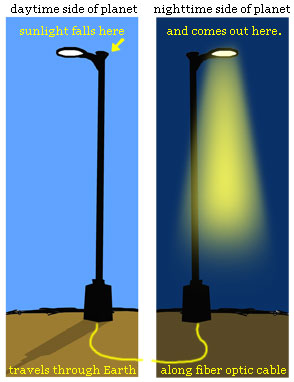
Well I think an effective ad could be made that goes a step further and really embraces the “I approve this message” line as part of its campaign. It could go something like this:

“I’m John Candidate and I disapprove of the message this administration is sending the world by staying in Iraq. I disapprove of a the way the President is dealing with terrorism. And I certainly disapprove of the way Republicans are spending money with no regard as to who will pay the bills. It’s time to change the direction this country is headed. It’s time to remind the world through our actions that America is a noble country, a leader in ethics, economy, and education.

I approve of a plan to bring American kids back to school where they will recieve a top level education. I approve of getting health care where it’s needed most. I approve of helping Iraq get back on its feet and bringing our troops home. I approve of actions that send a message to the world that America is prouder, stronger, and safer than it ever has been.

I am John Candidate. And I approve this message.”

Of course, all those glittering generalities would be replaced by meaningful specifics and substance, but you get the idea.

September 25, 2006

Idea: Fiber Optic Streetlights

I can think of several reasons why this would never work. And there are probably more reasons I’m not thinking of. But as a concept, I like it.

What if every streetlight had a corresponding streetlight on the other side of the planet, with fiber optics connecting them to each other? Instead of using lightbulbs, sunlight shining on one streetlight would be gathered through a lens, travel through the Earth along fiber optic cable, and come out its corresponding streetlight on the other end. Like this:

Fiber Optic Streetlight

I’m sure it would be enormously expensive to set up a system like this. But imagine never having to provide electricity for a streetlight ever again. Surely it would pay for itself in the long run, right?

Of course it’s not enough to just have a corresponding streetlight on the opposite East or West hemisphere, but it would have to be on the opposite North/South hemisphere, also. Not just the “other” side of the planet, but the true “opposite” side of the planet. This would make sure that long days on one side of the planet are providing light during the long nights on the other side. But then this presents a new problem because it would require a one-to-one relationship of streetlights on opposite sides of the planet, and I’m pretty sure there’s more need for streetlights on the Northern Hemisphere than Southern Hemisphere, so that wouldn’t work out evenly.

But maybe that problem could be solved with giant “sunlight gathering centers” set up on the sunlit sides of mountains in the middle of nowhere, providing sunlight to the streetlights on the opposite side of the planet via fiber optics.

Another problem: it would be difficult to keep these things maintained, with Earthquakes and other wear and tear that would damage the fiber optic cables. And when new roads are developed, they would need new streetlights, and it’s probably tough to keep setting up fiber optic streetlights every time you build a road.

Yeah, I know. Impractical in reality. But still. I like the idea.

September 18, 2006

Idea: “Hello My Name Is John Jacob Jingleheimer Schmidt” name tag shirts

I was thinking about those “Hello my name is…” name tags the other day (doesn’t everyone?), and somehow that led me to this idea:

Hello My Name is John Jacob Jingleheimer Schmidt

That way, if someone else was wearing the same name tag, then I could shout, “Hey! His name is my name, too!” And if I’m the only one wearing it, then people can shout, “Hey, there goes John Jacob Jingleheimer Schmidt!”

And then I thought, people probably wouldn’t walk around with that written on a name tag. But maybe it would be funny on a t-shirt. So I came up with a couple variations. The t-shirt is now available in authentic name-tag size versions, worn where you would expect to find a name tag like this, and bigger more graphic versions centered on the shirts. Like these:

Hello My Name Is John Jacob Jingleheimer Schmidt

Want one? Visit my shop to make a purchase.

Previously: Pre-pixelated clothes for Reality TV

September 14, 2006

Idea: Dunder Mifflin branded paper

Dunder Mifflin PaperI was recently shopping for paper at Staples when I had this thought: NBC should really license the “Dunder Mifflin” name to some paper company, and put it on real reams of paper. I don’t have brand loyalty when it comes to 8.5” x 11” paper, so it’s not like I can’t be persuaded to buy one ream over another. If I were buying paper at Staples and I saw the Dunder Mifflin brand name on a ream of paper, I’d totally get it. Just because it’s funny. Even if it cost a few cents more than the other brands.

They could even co-brand, for those people who haven’t heard of Dunder Mifflin or are afraid to try new things. The reams could say, “Staples [or some reputable paper company] presents Dunder Mifflin Paper” or something like that. And they could put a one-sheet ad for “The Office” in the packaging.

(Dunder Mifflin, for those who don’t know, is the fictional paper company whose day-to-day goings on are documented in the TV show The Office)

September 12, 2006

Amp’d Mobile’s “Li’l Bush” seems strangely familiar

Lil BillBack in the winter of 2002, while I was cocooning in my home after 9/11 like so many Americans, I conceived of a cartoon series all about grade-school versions of the various Clinton Administration characters. I called it “The Adventures of Li’l Bill & Hill and Friends.” There was Li’l Bill, and Li’l Hill, and Messy Monica, and Al, and Ken, and George, and Linda, and Janet, and Socks the Flying Cat (because every cartoon needs an anthropomorphic animal). I built a website for it that was partly a parody of Saturday Morning Cartoons, and partly a send up of the Clinton administration, and partly a parody of obsessive fan websites.

It was a big hit. Cory Doctorow at BoingBoing said, “This. Is. Amazing” (emphasis original). The Detroit Free Press called it “The work of a genius, albeit a warped one.” I got so much positive feedback that I even pitched it as a TV series to Comedy Central. But they didn’t bite. I guess the Clintons weren’t timely any more.

So of course I considered doing a version with Bush. But it was too early in the Bush administration to really know who the players would be that would make good characters, and what their personalities would be like.

Well, this morning, as I drank my coffee from my Li’l Bill & Hill Coffee Mug (seriously), I read an e-mail from a friend pointing me to this New York Times Article about a comedy writer named Donick Cary who recieved an offer from Amp’d Mobile to develop his own video project for wireless phones:

The result is a raunchy cartoon called “Lil’ Bush,” concerning the adventures of a grade-school version of President Bush and his pals, a heartsick Lil’ Condi, a raging Lil’ Rummy and a Lil’ Cheney reminiscent of the Frankenstein monster.

Yes, that’s right. Amp’d Mobile customers can watch the animated adventures of Lil’ Bush on their cellphones (and anyone can watch on-line). It’s essentially the same idea I had five years ago. But with George Bush. I had recently revisted this idea, even drawing some preliminary sketches of my version of “Li’l Bush” as a naive kid ready for adventure in his flight suit. But I didn’t have the time to develop it further.

Lil BushWell it’s bittersweet to see that someone else has done it. Did Donick Cary see my Li’l Bill website? It’s possible. It got a fair amount of publicity, mentions on talk radio, that sort of thing. And it’s linked to on the right side of the main page on this site, which has also gotten enough publicity that it’s concievable he’s seen it. But it’s probably not such a novel idea that I could prove he stole it from me. I think the law would say that he could have come up with it on his own. Which he may have. And you can’t copyright an idea, anyway, just the execution of the idea, and I guess his execution is different enough from mine except for in the obvious ways (setting it at the White House, etc). But still, I can’t help but feel like I’ve been ripped off a little bit, even though it’s nice to see Cary’s version has come to fruition. Great minds and all that.
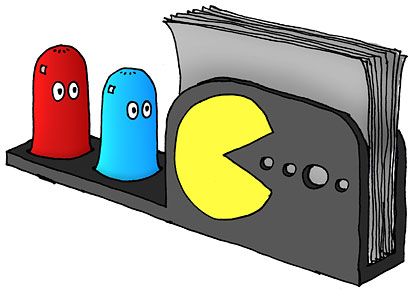

September 7, 2006

Idea: Pac-Man napkin holder with Ghost salt and pepper shakers

I’ve had this design floating around my head for the past few days:

Napkin Pac-Man

Idea: The iZod

It’s the iZod: an Izod branded series of bendy-style stands for your iPod, in preppy poses, wearing Izod shirts. There could be a Golfer iZod, and a Tennis iZod, and a Country Club iZod, and an iZod for, well, whatever else preppy people do.

The iPod iZod

August 23, 2006

Idea: The “O Fortuna” Short Film Festival

In 1981, the movie Excalibur used an exciting piece of music from Carl Orff’s 1937 cantata Carmina Burana called “O Fortuna”. Even if you’ve never seen the movie, you’ve heard the music, because it has since become a cliché wherever exciting music is needed. Movies including The Doors and Natural Born Killers used it. HBO Boxing Specials used it. Those Capital One commercials with the vikings used it. I think I even heard it used on an episode of Everybody Loves Raymond once. The dramatic piece of music has become so pervasive that it almost parodies itself at this point.

So I thought it would be fun to have an on-line O Fortuna Short Film Festival, and invite people to set that song to whatever visuals they wanted, and for whatever effect they wanted — comedy, drama, action, etc — with a few simple rules: 1) The film may be about absolutely anything. 2) You don’t have to use the entire song, if you want to edit it to a shorter version, but keep in mind rule 3 which is: 3) Your movie may only be 20 seconds longer than the song. For example, if you use 3 minutes of O Fortuna, your movie may be up to 3 minutes and 20 seconds long (not including credits). This way, most of your movie is set to the music, but if you need a little bit of set up or something, you can do it.

I began planning a short film of my own for this blog entry, to introduce the idea of an O Fortuna Short Film Festival, but when I began searching on-line for a public domain recording of the music to use in my film, I realized that O Fortuna is not yet in the public domain and won’t be for some time. And apparently, the rights owners are sticklers about who they’ll license the music to. It seems Capital One and Ray Romano are worthwhile, but marching bands aren’t. I’m sure that’s what Orff had in mind when his will stipulated creation of a foundation to “preserve the artistic estate of Carl Orff and to maintain the legacy of his spirit.”

So we’ll have to wait. The copyright of works created in 1937 should expire in 2032. So check back then and we’ll get that film festival going.

[Note: This isn’t a call to arms to violate anyone’s copyright. Please respect the rights owners. But if you can get them to grant you a license for an on-line short film, let us know.]

August 14, 2006

Idea: “CSI: Drive Time”

These days, everyone wants your ear. You’ve got Sirius, XM, terrestrial radio, podcasts, CDs, MP3s, and your cell phone all competing for your attention while you’re in your car. For advertisers, “drive time” is the most important time of day. That’s when most people are listening to their radios, and it’s when advertisers spend the most money hoping you’ll hear their ads. But if you’re listening to anything other than terrestrial radio, the major advertisers are losing out.

But who’s listening to terrestrial radio anymore? According to Bridge Ratings, the company that measures radio audiences, people are listening to terrestrial radio less and less in favor of their MP3 players and podcasts. So how can terrestrial radio get those listeners back? They’ve tried new music formats and talk formats, flipping stations from one to the other and back, but they’re still losing listeners.

So I suggest a new format. Well, an old one, really. Why not revisit the golden age of radio, when the airwaves were filled with comedy and drama, and people were captivated by their radios?

CBS owns lots of radio stations. They also own one of the most popular TV franchises running, CSI. So how about producing a radio-only version of the show? Call it “CSI: Drive Time.” If it’s compelling, people will sit through commercial breaks to hear the resolution. Detective shows were big on radio back in the day. They could be again today.

Sure, you run the risk of people trading episodes on-line with the commercials cut out, like they do today with TV shows. But old time radio had entire shows sponsored by particular products, and so can modern radio. “Johnson’s Wax Presents CSI: Drive Time” isn’t too long a name, is it? And commercial breaks can be done by the radio program stars, just like they used to, integrating the commercial into the program.

“CSI: Drive Time” could be followed by last night’s Late Show with David Letterman. It’s already been recorded. Why not replay it for people who missed it? The production cost there is pretty much zero.

ABC Radio could have special radio-only episodes of LOST, which is owned by ABC. These episodes could feature characters on the island that we don’t see on the TV program, but whose stories would intertwine with that week’s episode. LOST has so many fans, they would surely stay tuned in through the commercial to hear what happens next.

And then there’s the old standby, the Sitcom. Radio-only sitcoms would be great. They could even be performed live in front of an audience, just like in the old days. If it’s a big hit, you could probably even make the leap from radio to television, having a built-in audience of fans who listened to the radio show.

As someone who grew up listening to recordings of old time radio, wishing I had been around at a time when I could have listened to them as they were broadcast, I would absolutely tune in to a station like this.

August 9, 2006

Idea: Take “jowlers” to the next level

JowlersHave you seen Jowlers.com? It’s a website featuring pictures of people captured while shaking their heads back and forth really fast. It makes me laugh out loud every time I see it. They encourage people to shoot their own “jowler” photos using point-and-shoot cameras and send them in. I love it.

So I was thinking, what if I took jowler photos with more just a point-and-shoot camera? What if I set up lighting and a backdrop and treat them like more formal photos? Do they work just as well when they’re this stylized, or does the spontaneous look of a point-and-shoot camera work best? Well, it turns out that I can’t stop laughing when I shoot them, and I think they look absurdly great when they’re done.

Jowlers Jowlers
Jowlers Jowlers

But I need more volunteers. So naturally, I turned to Craig’s List in my search. But for the first time ever, Craig’s List let me down. I once used Craig’s List to get rid of a used bag of dirt (someone came to get it in less than an hour), but I couldn’t find anybody willing to pose for a Jowler photo. So I now turn to the blogosphere. If you are in New York City, and are willing to stop by my place for 10 or 15 minutes for an extremely silly project, drop me a line and we’ll set up some time for one of these weekends. I’ve got ideas for more elaborate jowler setups if you have even more time. You’ll find my e-mail address on the right side of this page.

August 7, 2006

Idea: The Ant Desk

The Ant Desk

What do you get for the eccentric executive who has everything? How about the Ant Desk? It’s part desk, and part Ant Farm. How creepy is it to work at your desk while hundreds of ants scurry all around you? Is it distracting? Fascinating? Did some of them get out? Do you think you feel them crawling on your legs? It’s the ultimate desk for nature lovers, bug lovers, and, well, other people who want a weird desk.

The Ant DeskHow does it work? It begins with a thick layer of glass or clear plastic. This protects you from the ants, and protects the ants from you. Below the glass is an open space with a thick layer of dirt, allowing the ants to crawl in, out, and around their tunnels, caves, and hills. This all rests on top of a sturdy base layer, which doubles as the bottom of the desktop. Small holes around the sides of the desk provide air, while being too small for the ants to escape.

Hundreds of ants will live happily for months, with just a little food and water periodically inserted through the feeding portals. For cleaning, the base layer can be built to slide out on casters like a large drawer, or the glass top may be hinged to open. I haven’t worked that out yet.

And when you get home, you can cuddle up with your loved one in front of the TV and rest your wine glasses on your Ant Coffee Table. The perfect oddity for any living room.

August 6, 2006

Plane in a Snake

Plane in a SnakeRecently announced in partnership with CafePress.com, New Line Cinema is encouraging anyone and everyone to become an official licensee of merchandise for the upcoming movie Snakes on a Plane (which, if you haven’t heard by now, promises to be exactly the sort of movie you think it will be based on that title). Most of the movie’s buzz has already come from movie fans on the internet resulting in a flurry of free publicity for the film, and there are tons of unofficial products already out there. So it makes sense that New Line continues to take advantage of the hype with this promotion that lets you say you’re an “official” licensee.

Well, this weekend I had some blank paper and some art supplies and a little free time, so news of the CafePress deal inspired me to join the bandwagon and come up with my own Snakes on a Plane inspired design. I call the resulting picture “Plane in a Snake.”

I wasn’t sure I would actually do anything with it — I’m not generally a “join the hype” type — but as it turns out I like how it looks on the shirts. I think my favorite product might be the baby bib featuring the Plane in a Snake. But even if you don’t have a baby in need of a bib, check out the store anway, where you can find the drawing on a variety of stylish shirts and other fine products like these:

Plane in a Snake

July 31, 2006

Idea: Wear your DNA on your sleeve

DNA ShirtThe other day I thought I saw someone wearing a shirt with a DNA pattern. When I got closer, I realized that the shirt just had little drawings of trees all over it. But then I got to thinking, why not? These days it’s not too expensive to get your “DNA fingerprint” made, right? Several companies, like DNA Artistry and DNA11 will already create custom artwork from your DNA, so why not take the technology in a different direction and make shirts? Having a pattern created from your DNA should be a simple step.

Okay, it might end up being an expensive shirt, but look at that pattern. It’s futuristic, yet retro. It’s 1970s meets 2070. It’s pret-a-porté meets your DNA. And they make perfect gifts. Nothing says “I love you” better than your DNA on your loved one’s clothes, right?

Previously: Pre-pixelated clothes for Reality TV

July 19, 2006

Idea: A “Critical Thinking” section on the SAT

The College Board, which administers the SAT test, periodically makes changes to the SAT format. Most recently, they eliminated the analogies section and added an essay section. Well, I have an idea for a change that I’m very excited about. It would have profound implications, I think, if the College Board added a “Critical Thinking” section to the SAT.

Critical Thinking skills are among the most important skills a person can have, but they aren’t taught very much in school. I’ve racked my brain trying to think how Critical Thinking could be made more important to students and educators. Making it an SAT category would go a long way.

Every university would want students that score high in that section. And it would fit perfectly in test prep courses, too, because the types of questions on the test would be easy to study for. Just learn the basic forms of valid arguments and common fallacies, and learn to identify them in context. And as an added bonus, if you study well enough to answer the Critical Thinking questions on the test, you can apply Critical Thinking to real life, too.

I’ve come up with a few examples to illustrate how I imagine the section. Different kinds of questions would test a student’s knowledge of basic argument and fallacy forms, and their ability to identify them. I’m not a test writer, and I’ve never taught Critical Thinking, so there may be problems with these examples from either perspective, but this is the basic idea:

1) If Tom is a cat, he is a mammal. Tom is a cat. Therefore, Tom is a mammal.

This statement follows the argument form:

a) modus ponens
b) modus tollens
c) straw man
d) begging the question
e) none of the above

2) In a double-blind study of 2000 men, 60% found Brand X medicine effective in alleviating their headaches.

This statement shows:

a) Brand X is effective because a majority of men’s headaches were alleviated when they used it.
b) Brand X is ineffective because 2000 people are not statistically significant
c) Brand X is effective because double-blind studies are always accurate
d) Brand X is ineffective because only men were tested
e) There is not enough information to know whether Brand X is effective

3) On the planet Syllo, there are Frebats and Lidgemonts. It is well known on Syllo that all Frebats are Twacklers. Betty lives on Syllo. Betty is a Twackler. Therefore, Betty is a Frebat.

The conclusion “Therefore, Betty is a Frebat” is logically sound.

a) True
b) False

4) The “false dilemma” fallacy is sometimes called:

a) the black or white fallacy
b) the bifurcation fallacy
c) the false dichotomy fallacy
d) all of the above
e) none of the above

July 11, 2006

Idea: A new slogan for New Jersey

Have you heard about all the problems New Jersey has been having coming up with a motto to attract tourists?

New Jersey mottoFirst, the state paid $260,000 to a consulting firm to come up with a slogan. They came up with, “New Jersey. We’ll win you over.” It was quickly rejected. Then the state held a contest to come up with a new slogan. The big winner was “New Jersey. Come see for yourself” submitted by Jeffrey Antman of Passaic, New Jersey. Well, a couple months ago they scrapped that one too after realizing that other states have used it in the past.
The consulting firm was on the right track in recognizing that many potential tourists have a negative view of New Jersey, and a good slogan could help people get over that hump. But “We’ll win you over” doesn’t convey that there’s anything good about the state. It almost reinforces the idea that it’s overrun by mobsters who will get you to like the state one way or another.

So I’ve come up with a slogan for New Jersey that I think captures the spirit of the state, and may entice people to visit who wouldn’t consider it otherwise. Imagine a whole campaign showing the lush vegetation, beaches, concerts, quaint little towns, and, well, whatever else they have there across the Hudson. And the slogan reads:

“New Jersey. It’s not what you expect from New Jersey.”

You like that one, New Jersey? Okay, so maybe off the bat you think it’s not positive enough. Now imagine it said in a really upbeat tone by someone like George Clooney. You like it now, huh? Well, you can have it for the low price of only $25,000. And I guarantee that no other state has used it.

June 21, 2006

Idea: A new TV show gimmick

The TV industry is worried about people swapping their TV shows on-line. So they’re trying to preempt the pirates by making several popular TV shows legitimately available, either for pay or ad-supported. Meanwhile, programs like LOST are experimenting with on-line puzzles which take people deeper into the world of the show by making you visit different websites, etc.

What if a TV show embraced both concepts, and did something like this:

A TV show where the East Coast and West Coast see slightly different versions of the same episodes. Just a few key scenes would be different. Some clues would appear on the East Coast version, and different clues would appear on the West Coast version. You could watch just the version for your part of the country and follow the program just fine, but in order to get the complete picture, you’d have to go on-line and swap files (or watch legitimately) to see what the other coast saw.

Or at TV show where the East Coast and West Coast see entirely different versions. Maybe a show like 24 could have an integrated spin-off. Imagine if CTU Los Angeles had to stop a terrorist attack, but they can’t do it all themselves, so they work in conjunction with CTU New York. First, the East Coast would watch CTU New York, and then in real-time the West Coast would see the next hour at CTU Los Angeles. They would each have their own stand-alone storyline, but also have a crossover story. If written correctly, the programs could then swap at the end of the season — the East Coast could air CTU Los Angeles, and the West Coast could air CTU New York.

I’m sure there are a dozen reasons why this isn’t real practical. But I like the idea.

Related: Idea: A new movie gimmick

Idea: A new movie gimmick

I’ve had this idea for a while. I imagine it’s not practical, but I like the concept.

Imagine a movie campaign that doesn’t show you any scenes from the movie. It doesn’t even tell you the genre. It just features respected people from the world of entertainment telling you that, while they can’t tell you much about the film, they can highly recommend it. But they’re afraid to give anything away, so you’ll just have to trust them.

So you go see it. It’s about a bank heist gone wrong (or whatever). And it’s intense and scary and suspenseful. And then you mention it to your friend. She saw it also, but she didn’t find it scary at all. To the contrary, she thought it was hilarious.

“What do you mean hilarious? That scene where he holds his own mother hostage while the snipers are about to shoot him had me on the edge of my seat!”

“The edge of your seat? No way. That was one of the funniest scenes in the whole film!”

Turns out that there are actually two separate movies made with the same cast, same sets, and same basic plot and key scenes. But one is written for suspense, and one is written for comedy. Which version you see depends entirely on what movie theater you ended up in. The fun comes once people realize this. Then hopefully they’ll go out to see the version they missed.

Of course, the success relies on a lot of unlikely circumstances: Will people see a movie they know nothing about? Will both versions of the movie be good? Will the secret stay a secret long enough for people to be surprised? Can the logistics and cost of making two movies simultaneously be justified? Like I said, it’s probably not real practical. But I like the idea.

Related: Idea: A new TV show gimmick

June 19, 2006

Idea: A five dollar “skip” button on jukeboxes

Jukebox SkipI’ve heard “Margaritaville” about 500 times too many on jukeboxes in bars. It might be worth five bucks to me to be able to skip that song the next time someone plays it. Someone should make a jukebox that features a big “SKIP” button and charge five bucks to use it. I think five dollars is just the right amount. It’s high enough that someone won’t keep skipping songs just to be a jerk, but low enough that I can afford to skip that one song that I really just can’t stand to hear one more time.

What’s that song for you? Brown Eyed Girl? Sweet Home Alabama? Paradise by the Dashboard Lights? Hotel California? You know there’s a song out there that would get you to use this feature. It further monetizes the jukebox for the bartender, and makes the bar a much better place in which to hang out. At least for me, anyway.

June 14, 2006

Idea: Under-the-seat carry-on boarding first

A recent entry at the website 43 Folders highlights some tips on packing light when you travel, suggesting among other things that you pack only one carry-on item when you fly. It reminds me of an idea I had after reading a recent article in Wired about how airlines use computer models to figure out the fastest way to get people on airplanes. From the Wired article:

[Scientists] looked at interference resulting from passengers obstructing the aisle, as well as that caused by seated passengers blocking a window or middle seat. They applied the equation to eight different boarding scenarios, looking at both front-to-back and outside-in systems. “Ultimately, the issue America West needed to address was time… We figured a system that reduced interference between passengers would also cut boarding time.”

So I’ve been thinking. It seems to me that a lot of passenger interference is caused by people blocking aisles to put things in the overhead bins. So why didn’t they run computer models which factored in boarding people by whether or not they have anything for the overhead bin?

What if the check-in kiosk, which already asks you how many bags you have to check, also asks, “Do you have anything to go in the overhead bin, such as a bag or jacket?” and considers your answer when assigning you a boarding group?

I don’t know where in the order these people should go for fastest boarding (first? last? interspersed?) but the computer can figure that out. I expect that people with nothing for the overhead bin will get in their seats faster than people with large carry-ons, and the plane can get off the ground much sooner.

Related: Idea: Advertisements on the Overhead Bins

June 7, 2006

Idea: Two functions in one button

Okay, this one’s so simple that I shouldn’t even have to say it. It should have been done already.

The new Macbook still has just one button for clicking. A right-click is simulated by holding down control while you click. Or you can use the convoluted right-click shortcut where you put two fingers on the Trackpad while you click the Trackpad button with another finger. Yikes.

So to Apple I suggest the following solution. It merges the functionality of two buttons with the look and feel of one button:

onebutton.jpg

Yes, it’s that simple. One button that you can click on either side of. And for people who don’t like this new style of button pushing, let them go to their Preferences and turn off two-button functionality, restoring their computer to the old fashioned single-button style they’d gotten used to. This way, instead of debating over what method of right-clicking works best, people can have all the options available and decide for themselves.

Apple can make music players that know where they’re being touched. They make a mouse that knows where it’s being touched. They can make a Trackpad that knows where it’s being touched. Why can’t they make a single button that knows where it’s being touched?

June 5, 2006

Idea: A new mental disorder diagnosis

scream.gifMany people are already familiar with the disorder known as Munchausen Syndrome by Proxy. This is a form of mistreatment where a caregiver, usually a mother, pretends that a child has an illness, and the child is subjected to all sorts of unnecessary testing and treatments, just so the mother can get some attention.

But what about a child who pretends that his mother has Munchausen Syndrome by Proxy, just so he can get some attention? I submit that this child shall be diagnosed as having Munchausen Syndrome by Proxy by Proxy.

Look for it in the DSM-V.

May 31, 2006

Idea: Lexidiem, the word of the day.

Why isn’t there a word that means “Word of the day?” Well now there is.

Lexidiem. n. sing. lek-si’-dee-im. (preferred) lek-si-dee’-im (altern. accepted) 1. Word of the day. [Modern American English, from Greek lexis (word) and Latin diem (day), reflecting the hodgepodge of international roots that make up Modern American English words].

Example 1: “Lexidiem will probably be this blog’s only lexidiem.”
Example 2: “Dictionary.com features a lexidiem section.”
Example 3: “Webster’s Dictionary on-line has a lexidiem section, too.”

May 24, 2006

Idea: The Correlation Project

I want to see a website that lets me keep track of something simple for a set period of time, and then compares it to a database to search for correlations. For example, over the course of a week or month or year, or even on an ongoing basis, it could ask, “What did you have for breakfast today?” or “What color shirt did you wear today?” or “How many calls did you get on your cell phone today?” Maybe a daily e-mail would remind you to log in with the answers.

Then it would compare the answers to other things that are already tracked such as the stock market, phases of the moon, sports scores, etc., and spit out some correlations.

It could tell you “On 93% of the days on which you ate eggs for breakfast, the stock market went up.” Or, “When the moon is waxing, you are 88% more likely to wear a green shirt than when it is waning.” Or, “On days when you get more than 7 phone calls, the Yankees win their games.”

Or, if you opt in to share your information with others, it could tell you, “For the past year, you’ve been on the same Green Shirt Schedule as Joe Shmoe of Hackensack, NJ, who has worn a green shirt every day that you did.”

There would need to be a notice reminding people that there is no causation implied by these findings, just correlations. People have a tendency to apply too much meaning to these sorts of things, and think they are evidence of paranormal phenomenon or conspiracy. But I think it’s interesting just to look at these things for the sake of seeing how easy it is to find coincidental correlations retrospectively. If such a project existed, maybe it could show people just how common coincidence really is with an experiment they can participate in themselves.

May 15, 2006

Idea: A parking lot compass

Maybe this idea is obvious enough that somebody is already developing it, but I did a quick search and didn’t see anything. So I submit the following.

parking lotWhy doesn’t someone make a compass to help you find your car in the parking lot? This should be an optional accessory for every GPS-enabled car. You should be able to get a keychain or purse-sized device that will point to your car so you can find it when you come out of the mall, grocery store, etc.

Obviously, this presents a small problem because if someone finds your keys they can find your car and drive away with it. So maybe there’s a keypad on the device so you can type in a password. Or, if it can be done cheaply enough, there can be a thumbprint scanner attached, to make identification even simpler.

May 1, 2006

Idea: A remake of “Fred Ott’s Sneeze”

OttIt seems these days that Hollywood scrapes the bottom of the barrel for movie material. Of the movies opening this summer, 7 are sequels and 17 are remakes or adaptations.

Well I’ve decided to do Hollywood one better. I’ve gone back further than anybody ever has before to remake a movie. I’ve remade one of the earliest known movies, an 1894 film called Edison Kinetoscopic Record of a Sneeze, also known as Fred Ott’s Sneeze, starring Thomas Edison’s assistant Fred Ott. You can view the original film here, courtesy of the Library of Congress.

My remake is more of a re-imagining, really, than a remake. I’ve decided not to make a period piece, but instead to modernize the story of one man’s struggle to remove an irritant from his nostril, setting it in the present day in a small apartment in New York City.

Here is my film, simply called Ott. Enjoy.

Bonus: Watch the extended Director’s Cut of Ott.

April 24, 2006

Idea: Another commercial I’d like to see

Remember the last commercial idea I had? Well I like this one even better. Okay, picture this:

The commercial begins with a shot of a bedside alarm clock. There’s a cell phone next to it. The alarm clock turns from 6:59 to 7:00 and the alarm goes off. A woman’s hand turns off the alarm, and the cell phone immediately rings. The hand grabs the phone. We hear her sleepy voice. “Yes.” Pause. “Yes.” Pause. “Yes.” Pause. Cut to…

The woman brushing her teeth, still holding the phone to her face while she brushes. As she brushes, she’s talking into the phone. “Yes.” Pause. “Yes.” Pause. Cut to…

Cell Phone GirlThe woman goes about her day. She’s making breakfast while she talks. “Yes.” Pause. “Yes.” Pause.

She’s shopping for groceries. Still talking. “Yes.” Pause. “Yes.” Pause.

She drops some letters in a mailbox. “Yes.” Pause. “Yes.” Pause.

She does various other daily routine activities, all while talking on the phone. “Yes.” Pause. “Yes.” Pause.

Her day comes to an end. She’s back at home. It’s evening. She sits down on her living room couch to watch TV. She still has the phone to her ear. “Yes.” Pause. “Yes.” Pause.

We can see a big window behind her over her shoulder. It looks out onto her front yard. “Yes.” Pause. “Yes.” Pause.

Outside her window, the Verizon Wireless Guy steps into view. We hear him ask into his phone, “Can you hear me now?”

The woman answers into her phone, “Yes.”

Verizon Wireless Guy takes a step. “Good. Can you hear me now?”

She turns and waves at him through her window. “Yes.”

Verizon Wireless Guy waves back, takes a step. “Good. Can you hear me now?”

“Yes.”

Tagline: “Verizon Wireless. Keeping calls clear for both sides of the conversation.”

Or something like that. You can thank me at the Clio Awards, Verizon!

April 18, 2006

The Google Maps Guide to Ghostbusters

NOTE: After two years working just fine, the map is having problems. I’m trying to fix it. Sorry for the inconvenience.


Click to launch map in new window
Hey! There’s a Ghostbusters symbol in my Google logo! What’s going on? One’s a movie, and one’s a search engine. Next thing you know, fish will be flying, trees will be swimming, cats and dogs living together — mass hysteria!

Welcome to the Interactive Google Maps Guide to Ghostbusters. You can click the Google logo above or the map image below at any time to launch the map in a new window, or read on for more info.


Click to launch map in new window
I’ve created a mashup of Google Maps and every New York City location used in filming the movie Ghostbusters and its sequel Ghostbusters 2 that a person might be likely to visit on a trip to Manhattan. It’s my first time using the Google Maps API, but I think I’ve come up with a slick way to use it. But still, let me know if anything doesn’t work right.

Also, if you’d like to link to the map, please link to this entry’s permalink instead of the map itself. Thanks.

Ready? Check it out! The map will open in a new window.

April 3, 2006

Idea: The Pacifist Chess Set

Pacifist Chess

Chess is a game of war. So for those who disapprove of war, I’ve come up with the Pacifist Chess Set. The concept is illustrated above.

At first glance, it looks like you could play a legitimate game of chess with this set. But once you start playing you realize that you can’t play for very long — at least not very easily. As you play, and your pieces get closer to your opponent’s pieces, it becomes apparent that one side’s pieces are indistinguishable from the other side’s pieces. They are all the same color.

It’s not really a functional chess set. It’s more of an art or conversation piece. It makes the statement that, no matter what side of the battle we’re on, we have in common that we are all human.

[I got this idea while wandering through the Imagery of Chess Revisited exhibit at the Noguchi Museum in Queens. The exhibit is only around for two more weeks, but if you get a chance I highly recommend a visit. It features works by Man Ray, Marcel Duchamp, Max Ernst, Alexander Calder, and others. A book is also available, in case you miss the show.]

March 31, 2006

Idea: “Less is.”

The phrase “Less is more” has become ubiquitous enough that, in keeping with the spirit of the expression, I think it should be shortened to simply, “Less is.”

March 29, 2006

Idea: The Ishihara Triptych

The Ishihara Triptych

Remember when you were in third grade and the school nurse gave you that test to see if you’re color blind? The one where she shows you a circle made up of smaller colored circles and asks you what number you see? That test is the Ishihara Test of Color Vision.

I’m fascinated by perception, especially by the uncommon traits that make some people’s perception different than the rest of us — color blindness, tetrachromatism, synesthesia, monocular vision, etc. I also enjoy original art. I decided to combine the two interests by making a triptych out of three Ishihara color vision test plates.

At greater expense than I anticipated, I obtained a set of Ishihara color vision test plates. I picked out three plates that I felt looked good together, and blew them up to a size suitable for framing. The entire finished triptych, seen above, hangs above my bed. I think it makes a compelling piece of art.

It’s titled “57-74-8, or 35-21-3”

Want to make your own? Click each thumbnail below to download a high-res image you can download, print out, and frame.

LeftMiddleLeft

March 28, 2006

Idea: “What’s your AIM Name?”

Did you know that AOL’s recently launched slogan for AOL Instant Messenger is “I AM”? Aside from being offensive to oversensitive religious people, it’s really, really lame.

I suggest a new slogan: “What’s your AIM Name?”

It’s so easy. It’s simple. It rolls off the tongue. It rhymes. It’s fun to say. It’s a sentence people will find themselves actually using in real life. Imagine a whole ad campaign revolved around “What’s your AIM Name?” Ads can show people meeting each other in bars, at school, in business meetings, etc., asking each other, “What’s your AIM Name?” It works in a million different scenarios. Then the announcer or ad copy can ask the viewer, “What’s your AIM Name?”

What's your AIM Name?People will think of the ad when they’re meeting new people. They’ll swap information. They’ll ask for your phone number and your AIM Name.

It can even be reinforced by the product itself. Logging on to AIM right now, it just asks for your “ScreenName.” But the product itself can ask “What’s your AIM Name?” when you log in.

Now if only I can find a use for all those free AOL CDs…

March 27, 2006

Idea: Design for a WTC Monument

I know, designing your own WTC memorial is so 2002. But it’s been years since the World Trade Center Site Memorial Competition, and there’s been next to no progress on actually building anything. Last week, some dirt was moved around and people got angry about it. So I’ve been thinking again about my own monument design that I came up with a few years back, but never actually rendered. It’s nice to finally get it out of my head and on paper. Er, pixel.

WTCWhen viewed from one direction, my memorial resembles the original towers. It stands tall and proud. It’s big and bold. Its height depends aesthetically on where it will be placed — in a memorial park, I assume — but I imagine it being really tall, the tallest thing in the park, peaking out above the tallest trees, or (since the tallest trees will eventually grow) in the middle of a clearing. The names of the September 11 victims who lost their lives are engraved in lines on the faces of the towers, like the lines of windows on the buildings.

WTCSo viewed from one direction, it looks like the towers themselves. But when viewed from another direction, the monument becomes an empty shell. It’s a reminder of how fragile the towers were, and of the empty space they used to occupy. It’s very, very simple. Hopefully it’s also poignant.

In my original vision, these were as big as the original towers, becoming part of the city’s skyline in the same way the original towers were. Viewing Manhattan from one side, you’d see the towers’ silhouette and the skyline looks just like it used to. Viewing from another direction you’d just see the outline of where they were. It’s a grandiose vision. But probably not realistic, so I shrunk it down to a size suitable for placement in a park.

To get the best view of the monument, and really convey how it looks, I’ve put together an animated fly-around that shows it from all sides.

And for those who might be interested, a note about how I created these images and the animation is after the jump.

A note about how I created these images.

I used a program called SketchUp. I loved it enough to heap the following unsolicited praise.

I’d never heard of SketchUp before I read last week that Google acquired them. And neither, apparently, had the Google Toolbar spellchecker, which thinks I’m writing about ketchup.

Anyway, when I came up with this monument idea several years ago, I drew sketches of it, but none of them really did the idea justice the way a 3D rendering could. But I knew nothing about CAD and the learning curve seemed steep. I considered building an actual 3D model, but what would I do with it once I’d made it? I have no room for such a thing in my apartment. But after viewing SketchUp’s demo on their website, I realized I’d found a tool even I could use. SketchUp makes 3D rendering easier than sketching. Seriously. I downloaded the free trial version (fully functional for 8 hours), watched the tutorials for about 15 minutes, and put all this together in about an hour. None of my sketches of this concept ever looked this good. It’s a cool product. I congratulate them on their recent successes.

March 23, 2006

Idea: Advertisements on the overhead bins

The overhead bins

Look, I didn’t say it’s a good idea. I admit that it’s ugly as sin. Every bit of empty space in our lives is slowly being taken over by ads, so why would I want even more? Well, have you noticed how expensive your airplane tickets are getting? Airlines are filing for bankruptcy protection, seats are getting less comfortable, and you’re asked to pay $6 for a box of stale crackers on a flight.

I was on a plane yesterday, and I noticed that with all the ads they were showing us on the overhead TVs, and all the ads crammed into the in-flight magazine, there was all this prime advertising real estate overhead that wasn’t being used. You already see overhead ads on the subways, on buses, in taxis, and on trains. Sometimes you’re even glad it’s there so you have something to look at to avoid eye contact with the person sitting across from you. So what’s a little more advertising on another mode of transportation?

I’m not even sure I should file this under “Ideas.” Maybe I need a category called “Predictions.” This seems sort of inevitable to me.

March 22, 2006

Idea: An album of Misirlou covers

(This entry’s alternate title: What do a surfer, a belly dancer, and a Rabbi all have in common?)

MisirlouIn January, I heard an incredible story on NPR about the song “Misirlou.” You know the one. You heard it during the opening credits of Pulp Fiction. It’s the surf-guitar song by Dick Dale. It goes “Dow di-di-dow-dow dow di-di-dow-dow di-dowwwwww…” Yeah, that one.

Well if you didn’t already know (I sure didn’t) Misirlou is actually even older than Dick Dale (no offense, Dick). It’s been recorded in different manners, with different instruments, and different tempos, by dozens of people over the years. It’s a Rabbinical chant, an old Greek tune, a belly-dancer’s song, and eventually a surfer hit.

You owe it to yourself to listen to the Weekend Edition story and hear snippets of different versions. And you can even hear Dick Dale explain how and why he turned that song into the surfer classic it’s become.

I wanted to hear more. So I put together an iMix in iTunes with every version that wasn’t just like the one before it. So here, for your listening pleasure, an album of Misirslou covers (iTunes required).

March 21, 2006

Idea: A website for reviewing restaurants in airports

I do a fair amount of travelling, and I don’t always have time to eat before I leave for the airport. Sometimes I get stuck in terminals for hours due to layovers or delays. And one thing I’ve learned is that there is an enormous inconsistency in food quality at airport restaurants.

airport cafe
Photo: tspauld / flickr
Most of them are just awful. Everything’s greasy, undercooked, overcooked, or just plain tastes bad. There’s butter slathered on everything. But every now and then I eat at an airport restaurant that’s delicious. I might as well be eating at my favorite restaurant, that’s how delicious it is. I’ve been to airport restaurants that served as test kitchens for famous restaurants. And I never would have known about them if I hadn’t stumbled upon them.

So why doesn’t someone build a website that reviews restaurants in airports? That way when I’m taking advantage of the terminal’s wi-fi connection and I realize I’m getting hungry, I can hop on-line at whatever.com and see what the best restaurant in my terminal is. Or if I know I’ll have a big layover in Chicago, I can look up the restaurants before I go and see what gets the best reviews?

Unfortunately, I really do have air travel to do this week, and I can predict I’ll be in a rush getting to the airport and won’t have time to eat first. Can anybody recommend a good restaurant at Miami International?

Idea: A poster for a dorm room.

unclesamfinger.jpg

No statement about war intended, so don’t read too much into it. He just looks so much like he’s daring me to do it…

March 20, 2006

Idea: Pre-pixelated clothes for Reality TV shows

Pixelated ClothingI don’t watch much Reality TV, but I’ve seen enough of it to notice an on-going phenomenon: Someone wears a garment with a trademarked logo or artwork on it, and the producers have to pixelate it beyond recognition in post-production. Of course no Reality TV star wants their shirt, which displays their well-chosen article of self-expression, senselessly pixelated so nobody can see it. But no Reality TV producer wants to deal with the headache of removing said article of self-expression to avoid trademark violations. The pixelation process seems like an awful lot of trouble to go through for something that could have been avoided with a little pre-planning.

Pixelated HatSo I’d like to introduce my new line of pre-pixelated clothing for Reality TV shows. If you’re going to be on a Reality TV show, you can buy one of these fine products and save someone a lot of headaches later. In fact, if you live in an area where a reality TV show is taping, you should think about getting one of these shirts in case you get caught in the background of a shot. And if you’re heading to audition for a Reality TV show, maybe you should wear one of these shirts to the audition so they know that you’re really serious about Reality TV.

Available here in these and other fine styles:

Update: Hey, this little post has become popular! So now I get to say, “As seen on: TVGasm, MSNBC, USA Today, Wired, Entertainment Weekly, Defamer, Fark, Digg, Kottke, Consumerist, the Morning News, Boston.com, C|Net, and about a hundred other blogs.” Thanks!

Update: And now I’ve made the New York Magazine Approval Matrix!

March 15, 2006

Balabananza, the Convention for Bob Balaban Fans.

BalabananzaThere should be a convention for Bob Balaban fans called Balabananza. Imagine:
People show up dressed as their favorite Bob Balaban character. “Look, I’m dressed like Enid’s Dad from Ghost World!” “Hey, check out that guy who’s dressed like Bob’s character Ted Marcus from that episode of The West Wing that he guest starred in during the 2000 season.” “Woah, that guy has every detail perfect from Bob’s costume in Gosford Park!”

There could be panel discussions with topics like:

  • Warren Littlefield vs. Russell Dalrymple - An examination of how one actor plays two NBC executives

  • The Wallace Shawn Controversy - Was it right for Bob to play William Shawn in Capote, when his own son Wallace Shawn is such an accomplished character actor?

  • My Boyfriend’s Back - What went wrong?

costume
Bob’s costume from Close Encounters on display at Balabananza 2005
Celebrity guests on the panels could include people Bob’s worked with, like Brian Sawyer, director of Tex the Passive-Aggressive Gunslinger and that guy who played Guffman in Waiting for Guffman who I can’t picture for some reason right now (not Paul Benedict).

And there could be a whole area for vendors. You know, companies that sell Bob Balaban merchandise. Vendors like Balabanana Republic — the finest purveyor of octagonal-framed glasses — and Elmerson Entertainment, the video game company whose long-awaited terrorist-hunting game “Balaban vs. Taliban” is scheduled to finally hit stores.

It would be great. I can’t wait to go.

Update: Merchandise from Balabananza ‘96 is now available as part of the “Merchandise from Events that Never Happened” series.

March 14, 2006

Idea: A commercial for batteries

A commercial I’d love to see, using borrowed footage from the movie “Say Anything…” with new footage integrated. Picture this:

battery adIone Skye is upstairs sleeping in her bedroom. Outside, John Cusack stands below her window with a boombox held up high over his head. He’s blasting “In Your Eyes” by Peter Gabriel. Ione wakes up. “…the light, the heat (your eyes), I am complete (your eyes)…” Where’s that music coming from?
Down below, the batteries die in John’s boombox. He can’t believe it. Now, of all times! The camera pans over to a shorter, geekier guy standing a few feet away, holding a boombox over his head, too. It blasts, “Nothing’s Gonna Change My Love For You” by Glenn Madeiros. We see that it’s powered with [whatever brand] batteries. Ione goes to her window and sees geeky kid down below. His boombox blares. “One thing you can be sure of, I’ll never ask for more than your love…” She swoons.

[Whatever brand] batteries. Nothing lasts longer.

February 19, 2006

Idea: Ironic Sans

Thinking about different fonts one day, I decided that “Ironic Sans” would be a good name for a serif font. Maybe one day I’ll get around to designing it. In the mean time, I think it makes a good name for my blog.

“Ironic Sans,” the blog, is a place for me to write about art, culture, technology, law, politics, current events, critical thinking, and other topics that appeal to me. I will have a number of regular features on this site, and various articles long and short as they come to me. I hope you enjoy.