Filed under “Favorites”

February 11, 2008

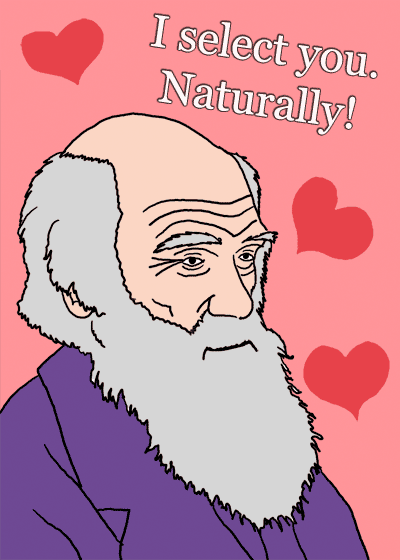
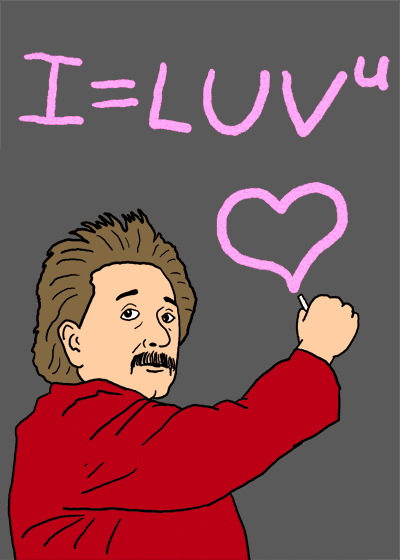
Idea: Scientist Valentines

Thursday is Valentine’s Day, a holiday where it’s customary to give a card to your loved one just to say “I Love You.” But even before the Catholic Church decided to honor one of its Saints with a holiday on February 14, this month was celebrated as a month of fertility festivals going all the way back to ancient Greece and Rome. I’ve decided to honor an entirely different group of people with this collection of romantic cards you can e-mail to your loved ones on February 14th, or any other day of the year. It’s Scientist Valentines!

You can click on these to get larger versions:


Previously: You say you want an evolution…

November 1, 2007

Halloween on the Upper West Side

Every Halloween, West 69th Street closes to traffic, and thousands of kids go trick or treating from building to building. This year, I set up my camera in one building’s lobby and photographed some of the kids in their costumes. I thought I’d share a few of the shots (I particularly liked the little girl named Dalia who was dressed as the “Dalia Lama”):

September 27, 2007

Idea: The Histogram as the Image

Yesterday, I posted the image seen here and told you that there is another picture hidden somewhere within it. I challenged my readers to find it. After a bit of confusion in the comments, someone finally declared that they found it: “Hahahaha! Cool! It’s the NY skyline!” Another reader noted, “The first thing I did was to try to tweak the image using the Levels command. I was greeted with a surprise right there in the dialog.”

Yes, the New York City skyline is hidden in that picture’s histogram. It looks like this:

Several people have asked how I did it. So I’ll explain, but I might get a little longwinded in my attempt to be clear. Feel free to just skim and look at the pictures if you don’t want to read it all.

The idea for this project started with a question: Is it possible to create an image that depicts its own histogram? (A histogram, for those unfamiliar with the term, is a bar graph representing all the tones in an image — it typically looks something like a mountain range). I played around a little bit in Photoshop and the closest thing I came up with was this image:

…which has this histogram:

Yeah, okay. That was neat I guess. But I couldn’t come up with any other shapes that worked. But all this thinking about histograms and what they represent got me wondering if I could control what a histogram looks like by manipulating the image. Could I create something recognizable? To try it, I would need to find something that would be entirely black, horizontal in orientation, and not require any holes or vertical gaps. A skyline seemed perfect.

I did a Google Image Search for “manhattan skyline silhouette” and was tickled to see that the perfect image came up in a result from my own site! I once posted an entry about New York City as depicted in the animated film Antz. Google showed me this image from that entry on the first page of search results:

A typical 8-bit grayscale image can have 256 possible shades of gray. A histogram represents the amount of pixels at each level from 0 to 255, and is 256 pixels wide. So the first thing I did was shrink down the Antz skyline to 256 pixels wide. This meant that each vertical band of black pixels in the skyline represented a value from 0 (black) to 255 (white).

Then I created a new document. The first column of pixels in the skyline image represents value “0” and has 43 black pixels. So my new document needed 43 pixels with the value “0.” Column 2 of my skyline represents value “1” and has 46 black pixels. So my new document needed 46 pixels with the value “1.” And so forth.

Another way to think of it is to say that I took all of the “skyline” pixels from this image:

…and put them in a new document, with no other pixels. Then I rearranged all those pixels into a square from dark to light. The result was very close to perfect. The histogram looked pretty much like the skyline, but it was stretched vertically.

Normally, a histogram is scaled vertically so that whatever value has the most pixels reaches all the way to the top of the graph, and everything else is sized proportionately. In this case, it is the shade of gray which forms the World Trade Center antenna that has the most pixels. So this is roughly what the histogram looked like:

I was thrilled that it worked, but I didn’t want it stretched vertically like that. In order to prevent the WTC tower from being too tall (and everything else scaling upwards with it) I had to put extra pixels of one value in my image, so there would be more pure of that value than any other value, which would push the others down so that the graph remains proportionate. I chose pure white, because this creates a thin black line at the far right side of the histogram where you don’t notice it.

I could have added this row of white pixels at the bottom of the new image, but instead I typed my website name in white, and placed it within the image. In doing so, I copied over some other pixels, which altered the skyline. So I had to put it in a place where the “damage” to those buildings wouldn’t be that noticeable. It took trial and error, but I found a good spot. It changed the skyline on the left side a little bit (compare to the “Antz” image). But it still looks like buildings, so I accepted it. Also, this way I get some credit if the image gets passed around without attribution.

I did it all tediously by hand, but I think with a little tinkering, someone could write a program to simplify the process, taking a 256 x 100 silhouetted image and extrapolating a new image with that as the histogram. And the final image file doesn’t need to be a square with a gradient, either. Those pixels could be in any order. They could be completely scrambled. Or they could be laid out in a way that shows an image of an Apple (as in “The Big Apple”). As long as no new pixels are introduced or deleted, the histogram remains the same. But that is a lot more work than I was prepared to do.

Oh, I almost forgot: I doubled the image size so it would look a little better on the website. As long as I resized it using the “Nearest Neighbor” method instead of some other interpolation method, every pixel (and therefore every shade represented in the image) would be duplicated identically, keeping the proportions in the histogram the same.

Update: A reader has taken this idea even further!

August 30, 2007

The Beetlejuice House

EXT. THE MAITLAND HOUSE - DAY

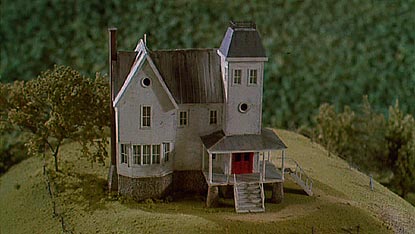
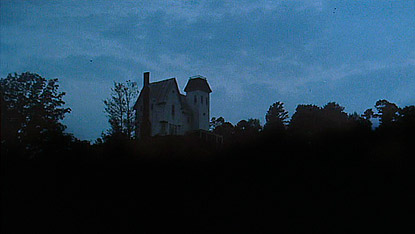
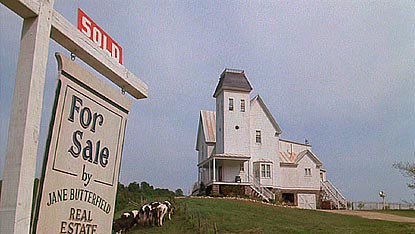
Beetlejuice HouseThe Tim Burton movie Beetlejuice takes place mostly in one location — a house in Connecticut where Adam and Barbara Maitland lived, and which the Deetz family moved into after the Maitlands died in a horrible car accident. The house is also featured prominently on the poster. But a story that takes place in one location doesn’t present very many options for establishing shots throughout the film. How many ways are there to shoot the same house?

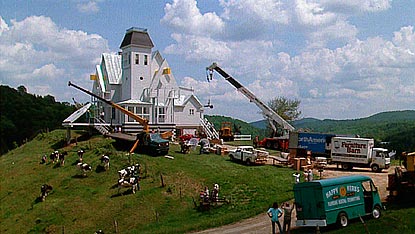
It turns out, there are at least ten ways, including the opening shot of the Maitland House as a miniature. A subplot in the movie about a hideous remodeling of the Maitland home by its new residents lends variety to the shots of the house as construction progresses throughout the film.

Here are the 10 different establishing shots, in chronological order:

Beetlejuice House

Beetlejuice House

Beetlejuice House

Beetlejuice House

Beetlejuice House

Beetlejuice House

Beetlejuice House

Beetlejuice House

Beetlejuice House

Beetlejuice House

The movie takes place in Connecticut, but was filmed in East Corinth, Vermont. The house shown in these shots is not a real house; it’s just a facade built for the movie.

August 22, 2007

Dog Day Anniversary

Update 9/23/09: Google just made a large collection of old LIFE Magazine issues available for viewing on-line. You can now read the original article that inspired Dog Day Afternoon in its entirety on-line.

35 years ago today, a couple guys named John Wojtowicz and Sal Naturile held up a Chase Manhattan bank in Brooklyn at the corner of Avenue P and East 3rd Street. At the time, New York City was experiencing one or two bank robberies per day. But before it was over, this one became the hottest thing on TV. The police were alerted, hostages were taken, and 12 hours later the ordeal finally came to an end after several strange turns.

dogday09.gifI don’t want to go too much further into what happened, because the story was turned into the excellent 1975 movie Dog Day Afternoon, starring Al Pacino and directed by Sidney Lumet, and some of you may not have seen it before. I don’t want to spoil it. I highly recommend it as a great movie to watch during these dog days of summer.

The movie was based on a Life Magazine article about the holdup called “The Boys in the Bank.” I dug up the original article, by PF Kluge and Thomas Moore, and was amazed to discover that the photos of the event looked surprisingly similar to stills from the movie. I knew that Lumet had strived to achieve a realistic look to his film, but there were many details that were nearly identical to the real events.

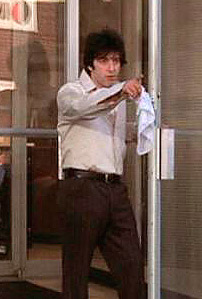
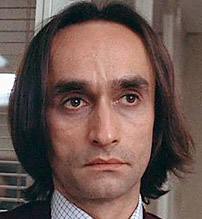
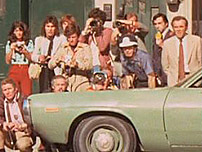
Here are some side-by-side comparisons. On the left, we have photos from the actual crime scene. On the right, we have images from the movie.

John (called “Sonny” in the movie, played by Al Pacino) talks to cops outside the bank:

dogday01.jpg dogday02.jpg

Ernest (called “Leon” in the movie, played by Chris Sarandan) arrives at the scene:

dogday03.jpg dogday04.jpg

Sal (called “Sal” in the movie, played by John Cazale) was actually 18 when the events took place. I think Cazale looks quite a bit older. But I can forgive them. Because it’s John Cazale.

dogday07.jpg dogday08.jpg

Cops (called “cops” in the movie, played in part by James Broderick) huddle behind a car across the street with reporters, watching events unfold:

dogday05.jpg dogday06.jpg

I should have an original copy of the magazine coming my way soon, and when it does I’ll try to add a couple more side-by-side comparisons using more photos from the story. In the meantime, as further encouragement for you to watch this movie, here’s a famous scene (that’s relatively spoiler free) to tease you. Enjoy.

August 1, 2007

Photos from the Galapagos Islands

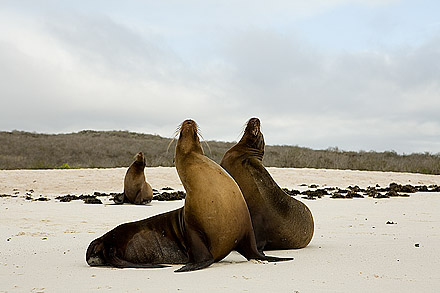
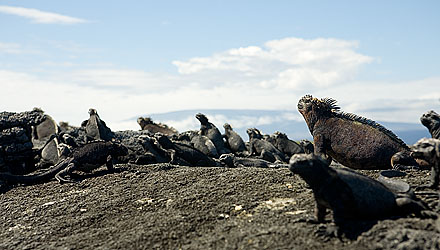
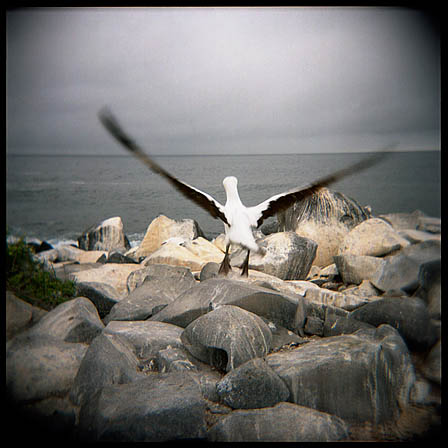
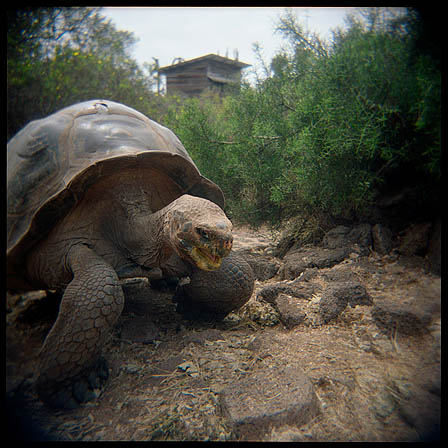
By now you may have seen my 60 Second Videos from the Galapagos Islands. As promised, here is a sample of photos from the trip. The rectangular photos were shot by me, and the beautiful ethereal square photos were shot by Ellen. I think several of her photos, which she shot with a $23 Holga camera, are far more beautiful than mine, which I shot with equipment that cost a hell of a lot more. You can see more of both our photos in slide-show form here.

Marine Iguana
Marine Iguana

Trees
Trees on North Seymour Island

Sea Lions
Sea Lions

Flightless Cormorant

Isabela Island
A Darwin Bush grows through the lava on Isabela Island

Marine Iguanas
More Marine Iguanas. I love these guys.

Santa Cruz Island
Scalesia trees on Santa Cruz Island

Soccer Break
The crew from our boat plays soccer on Floreana Island

Blue Footed Boobies
Blue Footed Boobies

Bartolome Island
Bartolome Island

Nazca Booby
Nazca Booby

Waved Albatrosses
Waved Albatrosses

Tuff Cone
A tuff cone lava formation

Giant Tortoise
Giant Tortoise

Back to the Beluga
Back to our boat, the Beluga

You can see more of both our photos in slide-show form here.

May 23, 2007

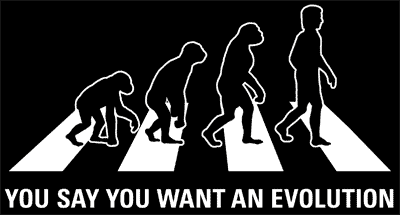
Idea: You Say You Want An Evolution (T-Shirt)

Today I had an idea for a t-shirt. Here’s the artwork I came up with:

Evolution Road

I decided to make it available with or without the caption, in designs suitable for dark t-shirts or light t-shirts. I like it both ways:

Evolution Road

It’s Charles Darwin meets Liverpool and it’s available now in dozens of styles and colors for men and women in the Ironic Sans store!

April 27, 2007

Idea: Uncensor the Internet with Greasemonkey

Uncensor the InternetThere’s an article on-line from Money Magazine called “50 Bulls**t Jobs.” That’s right. Bulls**t. With those two asterisks in there. Come on. We know what word they mean. So why not just say it? If they think we’re adult enough to be reminded of the word, why don’t they think we’re adult enough to see the actual word? (The article is based on a book by the same name, but without the asterisks)

Oh, I know. It’s the kids. They might be reading. Sh*t. I didn’t f*cking think of that. It would be terrible if they would see the word “Bulls**t” in print, but it’s okay for them to see it with the asterisks, right? They’ll have no idea what that means. And I’m sure they have no idea what “the F word” is, so let’s just keep calling it that.

But what about us adults who can decide for ourselves whether we want to see foul language or not? Is there a way for us to avoid all this f****ng unnecessary self-censorship littering the internet?

There is now. I’ve created the “Uncensor the Internet” script for Greasemonkey (a Firefox plug-in that lets you add all sorts of useful functionality to your web browser, available here). If you’re running Firefox with the Greasemonkey plug-in, just install this script, and see all the foul language that people are pretending they don’t use.

It’s also available as a standalone plug-in for those of you who aren’t running Greasemonkey. Right-click on the link to save it to your desktop, and then drag it into your browser window.

To see an example of the script in action, reload this page after you’ve installed it.

Previously: The CNN Fortune Cookie Greasemonkey script. It automatically adds the phrase “in bed” to the end of CNN.com headlines.

Update: I’ve fixed the script so it knows the difference between “a whole” and “a**hole,” and it knows the difference between “batch,” “botch,” “butch,” and “b*tch.”

April 9, 2007

Idea: The Digital Jewel Box

I love having my music on my hard drive or iPod, but one reason I still buy CDs and then rip them is that I enjoy holding the jewel box in my hand and reading the liner notes while the music plays. I just hate how much space all those jewel boxes and liner note inserts take up.

Digital Jewel BoxSo how about making a Digital Jewel Box? Here’s how it would work: The DJB sits next to your stereo or computer in its charging dock. Similar to a digital picture frame, it syncs wirelessly to your home network via WiFi, syncing itself with iTunes or whatever digital player you use. When a new song comes on, the DJB’s screen shows the album cover art for that song.

At any time, you can take the DJB out of its dock, sit on the couch with it, and use the controls on its side to flip through the rest of the liner notes, including track listings, lyrics, song credits, acknowledgments, and whatever else is included in the paper version. The pleasure of flipping through liner notes doesn’t need to go away just because CDs do.

You can also use the DJB as a remote control, as long as your media player supports it. The DJB has an infrared transmitter, and the charging dock has an IR receiver. So if you’re sitting on your couch flipping through your favorite album’s liner notes and you decide you’d rather be listening to a different track, you can skip forward or back by pressing buttons on the DJB itself. If you want to hear a different album entirely, use the DJB’s menu to flip through your music. The songs themselves aren’t stored on the DJB, but the track listings are.

When you’re not playing music, you can set your DJB to turn off completely, or double as a digital picture frame, displaying your personal pictures.

Here’s another mock-up of what the DJB might look like, but probably with fancier transitions than these:

Digital Jewel Box

April 1, 2007

New species of falcon named after Millennium Falcon

Millennium Falcon Press ReleaseAs a Star Wars fan, I was excited to read this e-mail from my friend Hugh who’s doing an apprenticeship studying birds in Madagascar. The lab he’s working at recently discovered a new species of falcon, and they’ve decided to name it the “Millennium Falcon.” From his e-mail:

The scientific name is falco milleannus which means Millenium Falcon. How cool is that! The “official” explanation has nothing to do with Star Wars, but we’re all getting a good laugh out of it here because of the double meaning. My boss came up with the name. Check out the press release, they even quoted me at the end!

Huey

You can read the whole press release here. Very cool.

February 27, 2007

50 States in 10 Minutes

50 States in 10 MinutesOccasionally during downtime on a particularly slow photo shoot, I’ve played this game with my assistants. Everyone takes out a piece of paper, and numbers it from 1 to 50. Then you get 10 minutes to write down every state you can remember. Finally, you compare it to the master list and see who got the most answers. 10 minutes seems like more than enough time to remember a list of 50 items, right? And yet somehow I’ve never managed to get more than 48 of them.

Well, you don’t need to get out a piece of paper or a timer. I’ve put together an on-line version of this game. It’s a bit low-tech [see update below for high-tech version], but it works.

Have a go at it and then post your score in the comments.

Update: Thanks to reader Erik Wannebo, we now have a nifty interactive version which keeps track of your progress as you go and tallies your score for you. Check it out!

January 24, 2007

Idea: Paintings of descriptions of the paintings

Painting Information

If I had the time, the means, and the resources, I’d make a series of large paintings of those little cards that describe paintings in museums. They would be paintings of the cards that describe themselves. For example, I’d do a painting in oil on canvas that describes itself as being an oil painting on canvas. Then I’d hang it in a gallery next to a little card that’s identical to the painting, but is actually there to describe the painting. I’d do a whole series, with different materials. Oil on canvas, Acrylic on wood, etc. See the photo illustration above for an idea of how it might look.

January 22, 2007

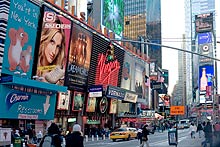
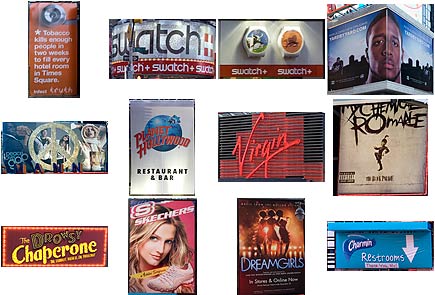
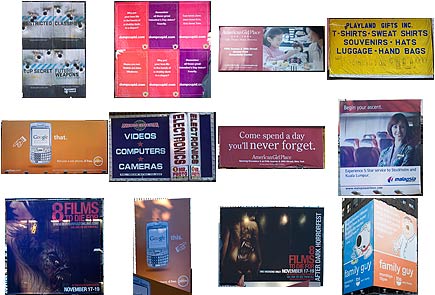
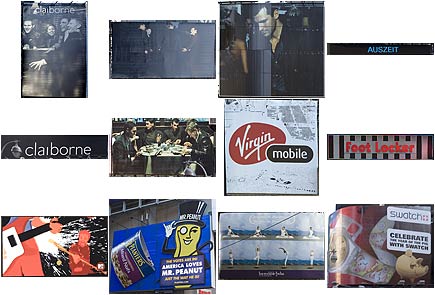
Every ad in Times Square

[Update: All the photos are now available in larger sizes on flickr.]

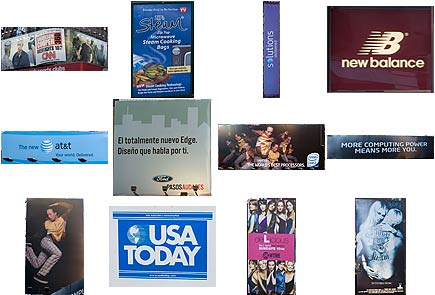
Times Square AdsSometimes I get dangerous thoughts in my head, like “I wonder what it would look like to see every ad in Times Square all on one page.” So when I knew I’d be passing through Times Square this weekend, I made sure I had my camera. For the purposes of this nearly purposeless project, I considered storefront signs the same as ads if they were flashy and glitzy like Times Square ads tend to be.

I’m sure I missed a few, and there may be some I got more than once. I do know that some appear to be duplicates, but are actually similar billboards in different spots. Also, if an ad took up more than one billboard, I usually shot each billboard separately, unless it was a wraparound billboard on a corner, in which case I tried to get it in one shot.

So without further ado, here is every ad in Times Square. More or less.

Times Square Ads

Times Square Ads
Times Square Ads
Times Square Ads
Times Square Ads
Times Square Ads
Times Square Ads
Times Square Ads
Times Square Ads
Times Square Ads
Times Square Ads
Times Square Ads
Times Square Ads
Times Square Ads
Times Square Ads

Right now, you’re probably thinking one of two things. Either you’re thinking, “Does that ad really say that there’s a musical version of Legally Blonde coming to Broadway?” or you’re thinking, “Someone has too much time on his hands.” Well, I can tell you, it took about 20 minutes to take the photos, and about 2 or 3 hours to crop the images while I was listening to the pundits on Sunday morning TV. It wasn’t as bad as I feared.

And yes, there is a Legally Blonde musical coming to Broadway. I don’t know what they’re thinking, either.

January 17, 2007

The Astoria Notes

[Update: Be sure to read the surreal follow-up in which a high-school class in Florida gets involved.]

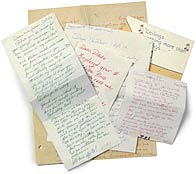
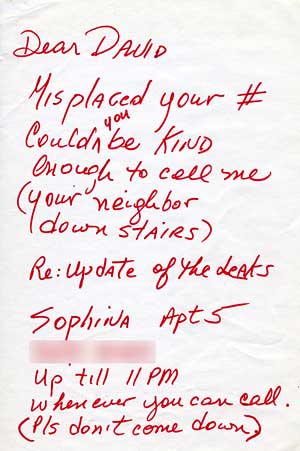
The Astoria NotesMy first year in New York, I lived on the top floor of an old building in Astoria, Queens, with rotted wood floors that creaked every time I took a step. I didn’t mind so much, because my schedule was so hectic I was rarely home. I got up early every day to get to my job by 9:00 a.m. I was happy to work in a photo studio, but it didn’t pay enough to survive in this town. So at 5:30 p.m. each day I left the studio and went to a bookstore across town, where I worked until 12:15 a.m. in order to make ends meet (and another 8 hours on Sundays). By the time I got back to Queens every night, hopefully before 1:30 a.m., I was beat. I’d take an hour to wind down before finally going to bed, getting a few hours sleep, and starting over.

One night, I came home to find the first in a series of notes slipped under my door. Small writing filled both sides of a sheet of loose leaf paper. I didn’t know what to make of it. The note began, “Dear Neighbor. When you arrive late every night, you are probably concentrating on your chores and don’t realize that this building, this street, the traffic, the people are all very still, very quiet.” The care and craftsmanship that went into writing this note was beyond anything I’d ever heard of from an angry neighbor. I continued reading.

Click the images below to see them larger for easier reading:

The Astoria Notes

The Astoria Notes

Wow. I had no idea I was keeping them up. But what could I do? I had to come home at that hour, and it wasn’t my fault the floor was squeaky. More importantly, who bothers to write such a long and detailed letter just to say “Keep it down up there?” It seemed like every word was carefully chosen, written, re-read, and reconsidered. I tested the floor in different areas, trying to find the creakiest spots so I could avoid them when I walk, and made an effort to be quieter when I came home from work.

Months passed. Then one night, I found a greeting card slipped under my door. A greeting card. They took the time to shop for the appropriate card to say exactly what they wanted to say.

The Astoria Notes

I opened it. Inside it read:

The Astoria Notes

Wow, that’s touching. They picked out the card, and even went through the trouble of using White Out to make it more relevant to the situation. Who does that? Who were these people? How did they know my name? After all this time, I’d still neither met them nor seen them. Well, I was sorry to hear that I was still keeping them awake, but I was honestly doing everything I could possibly do within reason to minimize my noise.

Several more months passed with no notes about the noise. I guess all my extra efforts to be quiet were paying off. Then this arrived, slipped under my door:

The Astoria Notes

A leak? That’s much more serious than just some noise. I called the number on the note and left a message, explaining that I’d been having no plumbing problems, and no water was pooling in my bathroom or kitchen, so the water must be coming from somewhere else. I don’t recall exactly what I said, but I must have put forth some specific theory about water condensation and the shower, because later this note was slipped under my door:

The Astoria Notes

Woah. Not only was I still too noisy for them, but they were taking advantage of my noise to entice an unwanted guest to leave. And that was so sweet of them to comment on my health. I guess they could hear that I was hacking up a lung when I had that cold. Well, at least the leaks had stopped. Or so I thought. A few weeks later, there was another note:

The Astoria Notes

The Astoria Notes

A waterfall? Coming from my apartment? Please! I’d had enough of this. No more notes. No more phone calls. It was time to march downstairs, knock on Apartment 5, and have a real conversation with these people face to face. I went downstairs and knocked. The door opened about 2 inches, and an eyeball stared at me. We had a brief conversation that way, through the crack in the door. I confess that I couldn’t pay attention to the conversation very much because I suddenly found myself wondering what it was that this woman didn’t want me to see. I remember she said something about her privacy and her beliefs being nobody’s business, and she didn’t want me to see what her apartment looked like. Okay. I told her I had no idea what the cause of these leaks were, and suggested she bring it up with the building manager to see if they can figure it out. I went back upstairs to my apartment.

It wasn’t long before I received another note:

The Astoria Notes

That was the last note I ever received from Apartment 5. A few weeks later, I moved.

Update: This story now has a very interesting and surreal follow-up, which you can read here.

January 4, 2007

Celebrity Patents

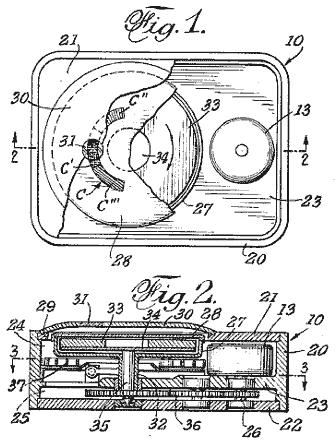
Harry Houdini patentLast month, Google introduced its new Patent Search feature (in beta), allowing users to dig through 7 million US patents from 1790 to mid-1996. On-line patent searching has already been possible through the US Patent and Trademark Office website, but Google makes it fast and easy using their already familiar interface.

So, inspired by Google’s new easy-to-use patent search, I decided to dig up some of the celebrity patents that have been issued over the years. The following 18 20 patents are all by celebrities not usually known for being inventors. You can follow the links to the actual patents to learn more about each one.

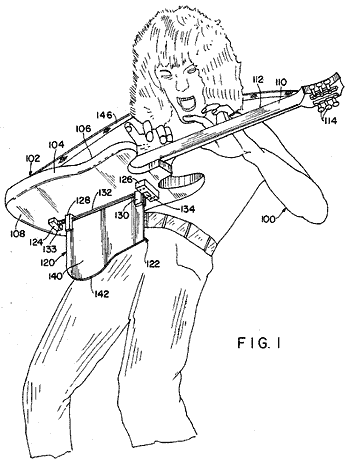
1. Eddie Van Halen, Musician.
Patent #4,656,917 — Musical instrument support

Eddie Van Halen patent

2. Zeppo Marx, Actor/Comedian.
Patent #3,473,526 — Cardiac pulse rate monitor

Zeppo Marx patent

3. Harry Connick, Jr., Musician/Actor.
Patent #6,348,648 — System and method for coordinating music display among players in an orchestra

Harry Connick Jr patent

4. Penn Jillette, Magician.
Patent #5,920,923 — Hydro-therapeutic stimulator (for, um, sexual stimulation)

Penn Jillette patent

5. Michael Jackson, Singer.
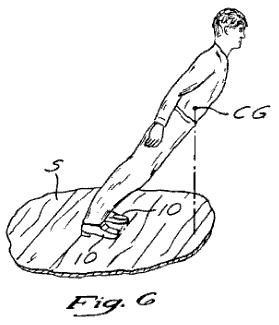
Patent #5,255,452 — Method and means for creating anti-gravity illusion

Michael Jackson patent

6. Abraham Lincoln, President.
Patent #6,469 — [Method of] Buoying vessels over shoals

Abraham Lincoln patent

7. Julie Newmar, Actress (“Batman” TV Show).
Patent #3,914,799 — Pantyhose with shaping band for cheeky derriere relief

Julie Newmar patent

8. Marlon Brando, Actor.
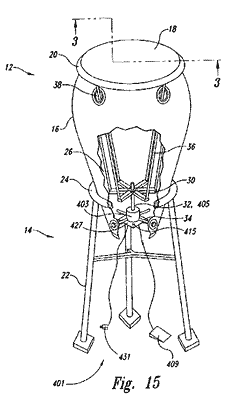
Patent #6,812,392 — Drumhead tensioning device and method

Marlon Brando patent

9. Lawrence Welk, Musician/Bandleader.
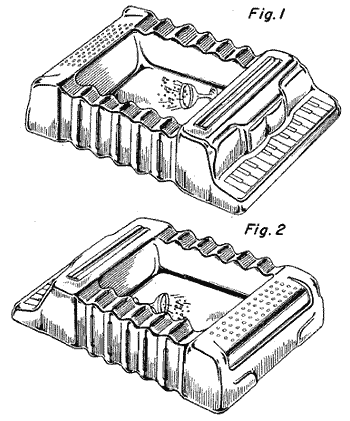
Patent #D170,898 — Welk ash tray (design)

Lawrence Welk patent

10. Jamie Lee Curtis, Actress.
Patent #4,753,647 — Infant garment

Jamie Lee Curtis patent

11. Gary Burghoff, Actor (Radar on “M*A*S*H” TV Show).
Patent #5,235,774 — Enhanced fish attractor device

Gary Burghoff patent

12. Mark Twain, Author.
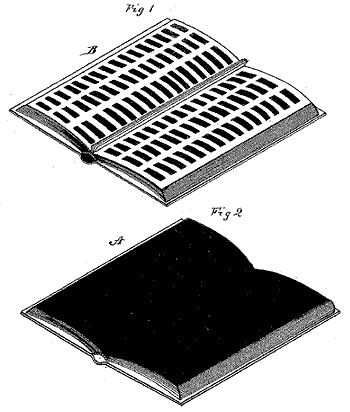
Patent #140,245 — Improvement in scrap-books

Mark Twain patent

13. Hedy Lamarr, Actress.
Patent #2,292,387 — Secret communication system

Hedy Lamar patent

14. Walt Disney, Animation Innovator.
Patent #2,201,689 — Art of animation (method of filming animation cells with a shadow on the background)

Walt Disney patent

15. Harry Houdini, Magician.
Patent #1,370,316 — Diver’s suit

Harry Houdini patent

16. Danny Kaye, Actor/Singer/Entertainer.
Patent #D166,807 — Blowout toy or the like (design)

Danny Kaye patent

17. George Lucas, Director.
Patent #D265,754 — Toy figure (design)

George Lucas patent

18. Charles Fleischer, Actor (voice of Roger Rabbit).
Patent #4,219,959 — Toy egg

Charles Fleischer patent

UPDATE: Here are two more celebrity patents, courtesy of comments on this blog and others:

19. Prince, Musician/Singer.
Patent #D349,127 — Portable electronic keyboard musical instrument (design)

Prince patent

20. Paul Winchell, Ventriloquist.
Patent #3,097,366 — Artificial Heart

Prince patent

December 19, 2006

Receipts of Unusual Size

K Mart ReceiptHow many customers do you think it takes before K-Mart goes through a mile of paper in cash register receipts? It may not be as many as you think.

On Sunday, I found myself needing to purchase a cheap lamp. So I went down to my local K-Mart and picked one out. I also bought a light bulb. Upon checkout, along with the merchandise, I was given this ridiculously long receipt. I measured it. It’s 21 inches long. I bought two items and got a receipt that’s 21 inches long. Is wasting that much paper really necessary?

I couldn’t even get the whole thing to fit on my scanner. I had to scan it in pieces and then stitch it together in Photoshop.

I did a little math. If every customer purchases exactly two items (an underestimation, I’m sure), then K-Mart goes through approximately one mile of paper every 3,017 customers. Only the top 6 inches of the receipt contains information relevant to the purchase: the date, items purchased, price, store number, etc. The remaining 15 inches contains ads for things I could have purchased if I’d known about them before I went to the register, and also a list of store hours. I don’t know about you, but when I want to know a store’s hours or what they sell, I never dig out old receipts to find the answer. I never even glance at that information. Are there people who read their old receipts? It seems like a big waste of paper to me. 15 wasted inches of paper per customer. That comes to one mile of paper wasted every 4,224 customers.

How many miles of paper must K-Mart waste every day?

I wasn’t going to attempt to answer that question, but then I realized that once I had my receipt scanned in and resized and placed alongside the text on this page, the image was longer than the text. And that was messing up the layout of this page, causing my browser to do some weird things. So I decided to do some more digging and see what I could learn. K-Mart’s corporate website has all sorts of information about the number of stores they have, but not the number of customers. The most recent data I could find was in a BusinessWeek article from 2000, where K-Mart’s CEO referenced K-Mart’s “30 million store customers a week.” By now, many of those store customers are probably shopping on-line in greater numbers than before, and the number of K-Mart stores has surely changed since they filed for bankruptcy in 2002, but even if only half as many people still shop in the stores, that comes to 507 miles of paper wasted by K-Mart every single day in useless cash register receipt ads.

I think I see an easy way for K-Mart to become a bit more eco-friendly.

December 4, 2006

Idea: A building shaped like Godzilla

Godzilla Building
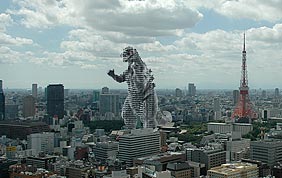
The Godzilla Building - Artist’s Rendition
The people of Tokyo should construct a giant building shaped like Godzilla. Imagine what it would do to the city’s skyline, and to the tourism industry. People would come from all over to take pictures. His eyes could flash red so airplanes don’t hit him. There could be an observatory in his mouth so people could look out over Tokyo. One of his arms could house a bar, and the other arm a restaurant. They could serve drinks called Mothra Martinis and dishes like Grilled Gamera Steaks, with a side of Mashed Potatoes.

Godzilla Building
The Godzilla Building - Artist’s Rendition
Conversations could take place like this one (translated from Japanese):

“Hey, I just got a new job!”

“Oh, really? Where do you work?”

“You know the Godzilla Building? I’m just a couple blocks South of there.”

Or maybe it could be partially residential. And then people could talk about that famous artist who used to live in the Godzilla Building in the apartment right above Godzilla’s left nipple. And then they could argue over whether or not Godzilla even has nipples.

Godzilla Building
The Godzilla Building - Artist’s Rendition
Monster Movie conventions could be held in the building’s grand ballroom. A concert hall could be built between his legs. The Tokyo Philharmonic could call it their home. Season Ticket holders could get discounts at the Godzilla Gift Shop. There could even be a park at the bottom of the building, with Godzilla’s tail circling around it. They would call it Godzilla Park, naturally. And it could have a fountain in the shape of his footprint.

November 13, 2006

Interview: Louis Klein, audience member of nearly every episode of Saturday Night Live

(The fourth in a series of occasional interviews with people I find interesting or who work on interesting projects.)

Fifteen years ago, I spent a Friday night camped out on the mezzanine level of 30 Rockefeller Center, hoping to get one of the standby tickets to Saturday Night Live that are handed out on Saturday mornings. The line forms at around 8:00 Friday night. That’s when I met Louis Klein, the SNL fan who had seen almost every episode of Saturday Night Live in person, going back to the very first episode.

Last Friday, I decided to go back to the SNL Standby Line and see if Louis was still waiting in line to get his ticket. In the years since I camped out there, the line had moved from the warmth of the indoor mezzanine to the chill of 49th street, but Louis was still there, right behind a group of teenagers who beat him to the first spot (one of the teens asked about my website, “Ironic Sans? Does it have anything to do with Horatio Sanz?”). When Louis stands in line these days, he is accompanied by his wife Jamie, whom he met on-line around six years ago. And by “on-line” I mean on the internet, not the standby line.

I spoke with Louis about his SNL Standby hobby.

When Saturday Night Live started, nobody knew it was going to be a big hit. Why did you go to the first episode of a new show that nobody really knew?
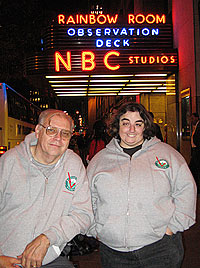
Louis Klein
Louis Klein with his wife Jamie
Prior to SNL, I was going to a lot of game shows. Like, I watched the game show called Jackpot, which was done in Studio 8H prior to SNL. It ended its run in the summer of ‘75, hosted by Geoff Edwards. I was also going to the Pyramid — any one of them, whether it was 10, 20, 25, 100 thousand, 2 cents, you know, whatever it was. I went to all of them over at TV-15 which doesn’t exist anymore. Any game shows that were done here, if any, I went to them also. So I was notorious as far as NBC was concerned. They knew who I was because I went to all the shows.

Then in April of ‘75 I found out that the show SNL was coming up, so I went to the Guest Relations department and said I hear you’re doing this show. They said, Well, they want 500 people in 8H. They want to do a show that’s going to be a run through for sound purposes. We’re going to have an audience for that, and you can float around the building and find somebody who’s going to give out standby tickets. So I come over here right after work, and I found the standby ticket and I got it and I went inside and I stood in line.

I got upstairs. I saw a full fledged comedy routine by George Carlin. I saw a full fledged comedy routine by Billy Crystal. I saw performances by Janis Ian and Billy Preston. I saw comedy by the Not Ready for Prime Time Players including Jon Belushi and Gilda Radner among others. Now that’s three and a quarter hours of pure entertainment for free. And I could come back tomorrow night. And I did. And I got in a second time. I came back the following week and I didn’t get into the second show but I wasn’t going to give up at this point. This is a great thing to do on a Saturday night. I went to the third show, I got in, and in the first 5 years I’ve seen 59 out of 106 [episodes].

At what point did you realize it was turning into something you were making a regular routine?

I never really thought of it that way at that particular time. It was just something to do on a Saturday night. I just came over. If I got in, I got in. If I didn’t, I went home.

My memory from meeting you 15 years ago was that you had seen every episode live except for a few. But I guess you’ve missed more than that.

In the first 5 years I’d seen 59 out of 106. So I missed 47 shows then. To date I’ve missed I think 83. That means in the last 27 years I’ve missed 36 shows.

How many have you seen?

This is my 528th show.

The original producer, Lorne Michaels, is still with SNL. But he left the show for a few years in the middle. So is there anyone who outnumbers you in the number of shows attended?

Don Pardo. He only missed one year. It was the ‘81 season.

How come after all this time you still have to wait in the Standby Line? Why don’t they just give you season tickets?

They do. I’ve had season tickets since 1990.

But you just enjoy the Standby?

When they gave that to me, they asked me to do Standby anyway, just in case the tickets didn’t come through. So I have the standby tickets to back it up. However I never needed them, and now I just walk in. But I still do standby because I’m helping NBC out watching this, make sure people don’t jump and things like that. It helps them out. If something goes wrong they know that I’ll take care of it. And then I give the details to them later in the evening. If they have to do something about it they’ll do something.

What’s the worst thing you’ve seen go wrong while on standby?

Jumping the line, and having people join the line. That’s a no-no, because basically the people who are joining are jumping the line. Once somebody tried to get me off the line. This was for the Soundgarden and Jim Carrey episode. We were all standing inside because there was nobody out here, and then all of a sudden somebody let me know that somebody was out here and so I came out, and he was standing over by the pole over here, two guys, and I said all the standbys are inside. He said, Oh, I’m sorry. This is where the line is and I’m going to be number one and two. Well I said, No, I’m number one. He says no, we’re going to be number one. And he argued with me all night at this pole. And I was a little perturbed about it because they weren’t really nice about the whole thing. Well when they didn’t take any standbys for the dress rehearsal, these two guys nearly blew their top to NBC. They said, A standby got upstairs! So NBC checked to see if any standby tickets were upstairs, but I went up on my regular ticket. Little did they realize, I went to the party that night!

Do you get to go the after-party often?

Only the season finale, if they ask. Sometimes they do, sometimes they don’t.

When I was here 15 years ago, the line was inside. When did they move it outside?

‘93. Letterman was still here at the time, and according to what I’ve heard, somebody did damage to the building inside in the mezzanine. So Rockefeller Center said no you can’t be up here anymore, because they have to protect their tenants. And as a result all the lines were put outside. The line started at that time on this side of the building. And then NBC put it on the 50th street side because the Rainbow Room was complaining that we look like homeless people. Now we’re back on this side. We’d love to be inside the building again. They’ve got plenty of room on hand. But that’s not going to happen.

I seem to remember that 15 years ago you told me Tim Kazurinsky mentioned your name during a Weekend Update segment.

No, no. Not Weekend Update. It was in a sketch that he did. The Guru sketch. His name was Havnagootiim Vishnuuerheer [pronounced “havin’-a-good-time wish-you-were-here”]. What he was doing was he was answering Unanswered Questions of the universe. So he invited everybody in the country to write in unanswered questions that they had, and he picked one of mine, and all of a sudden I’m at dress rehearsal and he says, “Louis Klein from Ridgewood New York wants to know, does God wear Pajamas when he sleeps?”

And what was the answer?

The Guru says, “No he doesn’t. All he wears is a t-shirt. and on the t-shirt it says I created the universe and all I got out of it was this lousy t-shirt.” That was a Flip Wilson show in December ‘83.

Did they mention your name on any other episodes?

Yes, they did. And Jamie too. This was in April of 2004. Will Ferrel was the host. And he was doing the Pepper Sketch, where Will was putting pepper on Will Forte’s salad. And the character’s name was Dr. Louis something, and his wife Jamie. In honor of my 500th show.

Who was the writer that wrote you into the script?

Will Forte.

Have you seen “Studio 60” and Tina Fey’s new show “30 Rock”?

I have.

What do you think?

They’re both great.

Which do you like better?

Oh I don’t know. I love Tina. I love Tracy [Morgan], too. And I relate more to 30 Rock than I do Studio 60 because of that. But I definitely like both shows.

Do you get to know the SNL cast members?

They all know me. They all come and say Hi. I’ve met most everybody. I was invited to the 25th anniversary show, and I went to that. I had to ask for a ticket, and they said that they already have a ticket for me. I was fairly shocked.

Do you have a favorite season of SNL? Or a least favorite season?

That’s a hard question. A favorite season? You know, I don’t remember what all the hosts and musical guests are, and it’s hard. I love them all. I mean, yes, you’re going to have somebody that doesn’t do too well, especially sports figures. I mean, if you want a show that I thought the host was terrible, okay, um… uh… there was… uh… I can’t even say that. I mean, I don’t want to hurt anybody’s feelings.

Thanks, Louis! As I packed up my notes and my recorder, Louis pointed out that he would be there for several more hours if I had any further questions. And if you have any questions, I’m sure you can find Louis exactly where I did, near the front of the Standby Line outside Rockefeller Center on Friday nights.

[The preceding transcript has been edited for space and clarity].

October 16, 2006

Idea: The Mr. T Virtual Playset

I saw a poster the other day advertising Mr. T’s new talk show on TV Land called I Pity The Fool. It got me thinking. Mr. T has had basically the same look for the entire time he’s been in the public spotlight. What if he shaved his mohawk? What if he shaved his beard? What would he look like?

After having trouble imagining it, I decided I might as well use Photoshop to help. A little cutting and pasting and — Wow. He sure looks different without the beard. Of course, once I had Mr. T without any facial hair, I found myself wondering what he would look like with different kinds of hair.

What would he look like with a pompadour? Or a handlebar mustache? Or a John Bolton mustache? What if Mr. T was wearing a hardhat and big goofy sunglasses? And so, with apologies to Mr. T, the Mr. T Virtual Playset was born.

Mr. T Virtual Playset

Click the image above to launch. Make sure JavaScript is enabled.

September 27, 2006

Interview: Seetharaman Narayanan

This is the second in a series of occasional interviews with people I find interesting or who work on interesting projects.

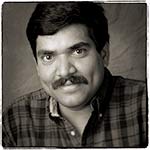
Seetharaman NarayananBy now, you either recognize the name, or you’re wondering who Seetharaman Narayanan is, and the difference probably depends on what you do for a living. If, like me, you have a job where you launch Photoshop on a daily basis, then maybe, like me, you can’t stop staring at this guy’s name on the Splash Screen every time it launches. Seetharaman Narayanan. It’s hard to look away. Sure, other people worked on Photoshop. But nobody else has a name like Seetharaman Narayanan.

If you too have been unable to look away from his name as you open Photoshop, you may be thinking, “I thought I was the only one!” Take comfort in knowing you’re not alone. Back in 2004, a simple comment was posted on the ConceptArt.org forum. It said, “Every time I open up photoshop I am mezmorized by this guy’s name. It’s all I can look at. Don’t know why…” Six pages of “Me, too!” responses followed.

He has gone on to inspire a Seetharaman Narayanan fan club group on Flickr, and being unable to get his name out of your head has been recognized as a sign of Photoshop addiction.

So I decided to find out just who this mysterious Seetharaman Narayanan is. What does he do? What does he think of his notoriety? And what’s interesting about him other than his name? Mr. Narayanan, who goes by the much shorter name “Seetha,” was nice enough to answer these questions and more.

When did you become aware of the fascination with your name among Photoshop users?

Jeff Schewe [Photographer] sent me an e-mail sometime in the fall of 2005 about the existence of Seetha’s fanclub thread from ConceptArt.org.

What do you think about it?

I thought it was funny and was amazed at the amount of free time people had at their disposal. I always thought that I was fortunate in getting hired by Adobe at the right time since any Tom, Dick or Harry would have done the same thing I did and perhaps better than what I did. They may not have become famous unless they had some weird last name that is almost un-pronouncable.

How long have you been at Adobe?

I have been with Adobe for 15 years to date. I joined Adobe as a peon on Photoshop 2.5 on September 23, 1991. Peter Merrill (who now works on Acrobat and is still with Adobe) was the lead engineer on the task of making Photoshop run on Windows 3.1 and I was his deputy in the early days. Peter is one of the brightest engineers I have ever worked with in my 20 year career (he may just be the smartest of all!). I still remember the interview I had with Peter before I got hired at Adobe. Peter had this toy application (that later became Photoshop) with ugly Icons and Cursors he showed me and mentioned to me that he had that code ported over from the Mac and he could even open an image (Flower.psd which by the way, shipped as a sample file with Photoshop 2.5) on Windows. I had previously worked at CrystalGraphics and we had just ported over Crystal’s TOPAS over to the Mac platform just weeks prior to my interview with Adobe and I was totally under whelmed by Peter’s demo of Photoshop on Windows. In spite of my lack of enthusiasm, Peter hired me anyway and the rest is history.

What are you responsible for in Photoshop?

Lots of things. I joined Adobe as an engineer responsible for making the Windows port happen. After laying the foundation for the Windows effort, one of the first things I did for the product was to make it multi-threadable. Those days, Mac did not support multi-threading but Windows NT did. In my spare time, I wrote the multi-threading plug-in that took advantage of multiple processor in Photoshop. Peter was of immense help here. When I was re-writing the image processing algorithms in the plug-ins, he pointed to me that there was no need to do any image processing in the plug-in since the plug-in need not know about algorithms and it would be sufficient to just split the tasks and call the functions that knew how to do image processing. It just shows how stupid I was and how much of a genius that Peter was in pointing me to that simplicity. After we shipped 3.0, the Mac and Windows teams got merged and I worked on several things in the core product. Since the team always viewed me as the Windows guy, it would be interesting to note that I was one of the key persons responsible for the Photoshop port to Mac OS/X.

What is your professional background?

I have a Bachelor’s degree in Mechanical Engineering from Regional Engineering College, Tiruchirapalli, India. I came to the U.S to pursue my Masters in Engineering at the Southern Illinois University at Carbondale. Since that place was so much fun (Playboy’s number one Party School in 1987), I decided to get another Masters from there in Computer Science. I joined CrystalGraphics (I think they are still around) as an engineer on Crystal TOPAS and after a few years at Crystal, I joined Adobe.

Do people express fascination with your name in the real world? Or is this just an on-line phenomenon?

Not really. I had to spell my name a few times before they get it. I got used to it now.

Are there other names on the Splash Screen that you think deserve more credit and get overlooked because people can’t stop staring at your name?

Every one of the engineers and QE deserves as much credit as I do. But I took the cake because of my long name. Too bad Joe Ault, Chris Cox and Scott Byer don’t have the long names as I do.

Are you working on any new projects we can look forward to seeing your name on in the future?

I worked on Bridge 1.0 (I had the opportunity to work on that since I championed the cause for the FileBrowser in Photoshop 7.0 and CS) and am currently working on getting Adobe Lightroom ported to Windows. But Photoshop is always my home.

Everyone knows about your interesting name. What’s one interesting thing about you that people don’t know?

I bike to work every day, rain or shine. My bike route is 20 miles round-trip and I have been riding to work for the past 10 years. I even influenced my mentor Peter Merrill into biking to work. Since Peter is a maniac, he is now doing double-centuries on weekends.

Thanks, Seetha!

Previously: Interview with illustrator and author Adam Rex

September 14, 2006

Idea: Dunder Mifflin branded paper

Dunder Mifflin PaperI was recently shopping for paper at Staples when I had this thought: NBC should really license the “Dunder Mifflin” name to some paper company, and put it on real reams of paper. I don’t have brand loyalty when it comes to 8.5” x 11” paper, so it’s not like I can’t be persuaded to buy one ream over another. If I were buying paper at Staples and I saw the Dunder Mifflin brand name on a ream of paper, I’d totally get it. Just because it’s funny. Even if it cost a few cents more than the other brands.

They could even co-brand, for those people who haven’t heard of Dunder Mifflin or are afraid to try new things. The reams could say, “Staples [or some reputable paper company] presents Dunder Mifflin Paper” or something like that. And they could put a one-sheet ad for “The Office” in the packaging.

(Dunder Mifflin, for those who don’t know, is the fictional paper company whose day-to-day goings on are documented in the TV show The Office)

August 29, 2006

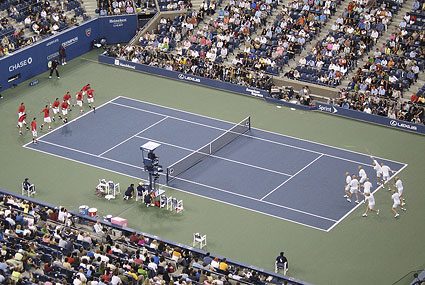
Agassi vs. Pavel vs. Agassi vs. Pavel…

Last night at the US Open…

Versus

Click for larger version. Details here and here.

Update: Lots of people have asked me how I did this, so I’ve agreed to put together a little tutorial for Photojojo in the next few weeks. I’ll announce it on this site when it’s done, so keep an eye out.

August 9, 2006

Idea: Take “jowlers” to the next level

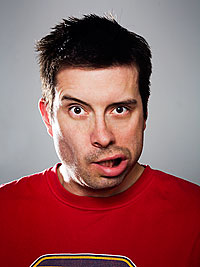
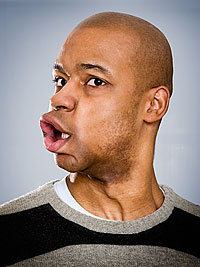
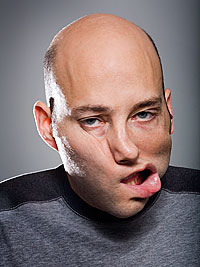
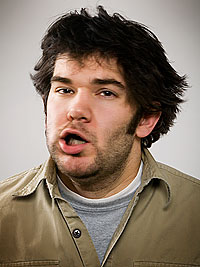
JowlersHave you seen Jowlers.com? It’s a website featuring pictures of people captured while shaking their heads back and forth really fast. It makes me laugh out loud every time I see it. They encourage people to shoot their own “jowler” photos using point-and-shoot cameras and send them in. I love it.

So I was thinking, what if I took jowler photos with more just a point-and-shoot camera? What if I set up lighting and a backdrop and treat them like more formal photos? Do they work just as well when they’re this stylized, or does the spontaneous look of a point-and-shoot camera work best? Well, it turns out that I can’t stop laughing when I shoot them, and I think they look absurdly great when they’re done.

Jowlers Jowlers
Jowlers Jowlers

But I need more volunteers. So naturally, I turned to Craig’s List in my search. But for the first time ever, Craig’s List let me down. I once used Craig’s List to get rid of a used bag of dirt (someone came to get it in less than an hour), but I couldn’t find anybody willing to pose for a Jowler photo. So I now turn to the blogosphere. If you are in New York City, and are willing to stop by my place for 10 or 15 minutes for an extremely silly project, drop me a line and we’ll set up some time for one of these weekends. I’ve got ideas for more elaborate jowler setups if you have even more time. You’ll find my e-mail address on the right side of this page.

August 7, 2006

Idea: The Ant Desk

The Ant Desk

What do you get for the eccentric executive who has everything? How about the Ant Desk? It’s part desk, and part Ant Farm. How creepy is it to work at your desk while hundreds of ants scurry all around you? Is it distracting? Fascinating? Did some of them get out? Do you think you feel them crawling on your legs? It’s the ultimate desk for nature lovers, bug lovers, and, well, other people who want a weird desk.

The Ant DeskHow does it work? It begins with a thick layer of glass or clear plastic. This protects you from the ants, and protects the ants from you. Below the glass is an open space with a thick layer of dirt, allowing the ants to crawl in, out, and around their tunnels, caves, and hills. This all rests on top of a sturdy base layer, which doubles as the bottom of the desktop. Small holes around the sides of the desk provide air, while being too small for the ants to escape.

Hundreds of ants will live happily for months, with just a little food and water periodically inserted through the feeding portals. For cleaning, the base layer can be built to slide out on casters like a large drawer, or the glass top may be hinged to open. I haven’t worked that out yet.

And when you get home, you can cuddle up with your loved one in front of the TV and rest your wine glasses on your Ant Coffee Table. The perfect oddity for any living room.

July 17, 2006

The Art of 1010 WINS

1010 WINSThe radio station 1010 WINS is for New York City what CNN Headline News is for cable television. It’s just nonstop headlines, weather, and traffic, repeating every 22 minutes. Their slogan is, “You give us 22 minutes, and we’ll give you the world.” Their website, 1010WINS.com, features local headlines and news stories mixed in with syndicated newswire stories.
But for me, the real treat is the unintentional art gallery at 1010WINS.com. Sometimes, 1010 WINS uses photos from the newswire. But often, some Photoshop Whiz Kid Artist at 1010 WINS smashes together some stock photos with a Photoshop filter and makes some of the greatest image mashups on the internet.

So I now present a small gallery of artwork from 1010 WINS that I call, “You give us 22 news stories, and we’ll give you bad art.”

The Featured Exhibit

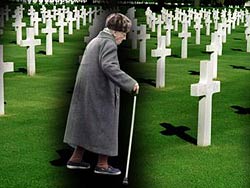
1. Peace Grannies on Trial for Times Square Protest

1010WINSThe crown jewel of the 1010 WINS Art Collection is Peace Grannies on Trial for Times Square Protest. For a story about a group of senior citizen war protesters, the artist placed a black shadow behind one of the so-called “Peace Grannies,” representing the plight of the protester during a deadly war, even while she herself is heading to her grave. The cane represents the narrow band of freedom on which we all lean, while her hat signifies oppression from above. Her coat, of course, is the cloak of dignity. A powerful image indeed.

2. Man Charged with Having Crack in Sundae

1010WINSIt’s a classic struggle for every artist. How do you illustrate a news story about a man caught smuggling two rocks of crack cocaine in an ice cream dessert? Well, the artist at 1010 WINS found a creative way to solve that problem, using photos of crack cocaine and an ice cream sundae. By superimposing them both on a pile of powdered substance — representing both the popular drug and the sweet sugar used in making delicious desserts — he unifies the images thematically, while the black background represents the health problems implicit in too much of either substance.

3. Forecast Predicts Another Rough Hurricane Season

1010WINSThe influence of conceptual artist Barbara Kruger is obvious in this piece, which uses imagery and words in montage. When the AccuWeather Hurricane Center predicted a strong hurricane season, the 1010 WINS artist chose to ironically juxtapose two simple sandbags hurricane warning flags with the power of one giant hurricane, representing the futility of man against nature. The disproportionate scale of the flags represent mankind’s desire to hold back the winds, even as they overtake us. The label “2006 Hurricane Season” acts as a forecast, but may in the future be seen as an accurate description of what the image depicts.

4. Final Moments on Tape. Family Hears WTC Call

1010WINSNearly five years after the tragic events of September 11, 2001, audio tapes were released featuring conversations between 911 operators and people trapped in the World Trade Center. For the event, the 1010 WINS artist created this commemorative work. On the day the tapes were released, a cell phone was so clearly important — a modern technological luxury but also an icon of this day in history — that it seemed like an object as large as the towers themselves. Or perhaps slightly larger, in black and white, looking a bit like it was photocopied and then faxed a few times before being scanned in for a montage.

5. Rockland County Joins Gas Sales Tax Capping

1010WINSThe ashy, veiny hand reaches out, gas pump nozzle in hand, a stream of “S”es pouring forth from its spout like precious drops of gasoline. Together, the hand and pump give off an eerie glow as Honest Abe looks onward, his gaze obstructed by an exaggerated dot screen. George Washington is barely visible, shrouded by an orange shadow of depression. The message is clear: Rockland County joins gas sales tax capping.

The Extended Gallery

6. Fatal Shooting in Brooklyn

1010WINS

7. Murders on the Rise in NYC

1010WINS

8. Untitled

1010WINS

9. Westchester Law Locks Down Wireless Networks

1010WINS

10. Jury — Merk Liable for Vioxx Users Heart Attack

1010WINS

11. Subway Stabbing in Brooklyn

1010WINS

12. NJ University Drops SAT Scores, Gains Applicants

1010WINS

13. Conn. Officials - Lyme Disease up 26 Percent

1010WINS

14 & 15. The “Police Line” Diptych.

1010WINS 1010WINS

Individually titled, “1 Killed, 4 Injured, in Parkway Crash (Blue)” and “5 People Struck in Hit and Run (Red).”

16. FBI Commish Orders Review of 911 Tapes

1010WINS

17. Strong Earthquake Strikes Central Indonesia

1010WINS

18. Quick Thinking Student Saves Teacher with CPR

1010WINS

19. Rockland County Woman Arrested for ID Theft

1010WINS

20. Fatal Car Crash in Brooklyn

1010WINS

21. NYC HDC Earmarks $179m for Apt’s

1010WINS

22. Study - Less Time, Passengers Reduce Teen Crashes

1010WINS

June 12, 2006

You got your picture in my logo

I’ve been noticing logos lately that have replaced letters with pictures. I think it’s fascinating how the brain just fills in the blanks, whether or not the pictures actually resemble the letters they replace. Various studies have shown that we don’t look at the letters which make up words as much as we look at the shapes of the words as a whole. In fact, it deosn’t mttaer in waht oredr the ltteers in a wrod are, the olny iprmoetnt tihng is taht frist and lsat ltteer is at the rghit pclae. The brain just takes care of the rest.

Here are examples where the letter isn’t completely gone, but a picture is formed by stylizing and embellishing a letter:

PictureLogo PictureLogo

PictureLogo

And here are examples where the letter is totally gone, completely replaced by a picture that resembles the missing letter:

Sopranos Signs
Tarzan Empire
YellowPages
LiveandletDie
Littlejohns
SeaWorld SouperBowl
SoupMan

It probably helps that the picture in the word is often a representation of the word itself. Something like the Stroop Effect may be going on here (or maybe the opposite of the Stroop Effect, whatever that would be called. The Poorts Effect?). Take this example, for instance:

PictureLogo

The strawberry doesn’t look anything like the letter “a” but we know what letter is supposed to go there because we recognize the rest of the word, and after all, it is a picture of a strawberry.

This is one of my favorites:

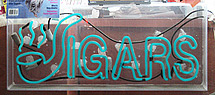
PictureLogo

We know it’s supposed to say “CIGARS” even though the picture neither looks like the letter “C” nor depicts a cigar! Perhaps the association with some tobacco product is enough.

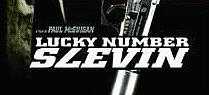
And then there are the movie logos that replace letters with numbers:

PictureLogo PictureLogo
PictureLogo

And of course movie logos that replace numbers with pictures:

PictureLogo PictureLogo

But Google takes the cake. They frequently swap out their traditional logo with one paying to tribute to a holiday or celebrity birthday. Their substitute logos often replace letters with picture, relying on our familiarity with the Google name and logo. They use color to remind us of the original logo, too.

PictureLogo

And the granddaddy of all is this Google logo celebrating the Persian New Year. Only one letter remains as a reminder of the original logo:

PictureLogo

June 6, 2006

Georgia O’Kleenex

Georgia O'Kleenex

This is what I saw when I reached for the last tissue in the box.

May 31, 2006

Idea: Lexidiem, the word of the day.

Why isn’t there a word that means “Word of the day?” Well now there is.

Lexidiem. n. sing. lek-si’-dee-im. (preferred) lek-si-dee’-im (altern. accepted) 1. Word of the day. [Modern American English, from Greek lexis (word) and Latin diem (day), reflecting the hodgepodge of international roots that make up Modern American English words].

Example 1: “Lexidiem will probably be this blog’s only lexidiem.”
Example 2: “Dictionary.com features a lexidiem section.”
Example 3: “Webster’s Dictionary on-line has a lexidiem section, too.”

May 24, 2006

Idea: The Correlation Project

I want to see a website that lets me keep track of something simple for a set period of time, and then compares it to a database to search for correlations. For example, over the course of a week or month or year, or even on an ongoing basis, it could ask, “What did you have for breakfast today?” or “What color shirt did you wear today?” or “How many calls did you get on your cell phone today?” Maybe a daily e-mail would remind you to log in with the answers.

Then it would compare the answers to other things that are already tracked such as the stock market, phases of the moon, sports scores, etc., and spit out some correlations.

It could tell you “On 93% of the days on which you ate eggs for breakfast, the stock market went up.” Or, “When the moon is waxing, you are 88% more likely to wear a green shirt than when it is waning.” Or, “On days when you get more than 7 phone calls, the Yankees win their games.”

Or, if you opt in to share your information with others, it could tell you, “For the past year, you’ve been on the same Green Shirt Schedule as Joe Shmoe of Hackensack, NJ, who has worn a green shirt every day that you did.”

There would need to be a notice reminding people that there is no causation implied by these findings, just correlations. People have a tendency to apply too much meaning to these sorts of things, and think they are evidence of paranormal phenomenon or conspiracy. But I think it’s interesting just to look at these things for the sake of seeing how easy it is to find coincidental correlations retrospectively. If such a project existed, maybe it could show people just how common coincidence really is with an experiment they can participate in themselves.

May 1, 2006

Idea: A remake of “Fred Ott’s Sneeze”

OttIt seems these days that Hollywood scrapes the bottom of the barrel for movie material. Of the movies opening this summer, 7 are sequels and 17 are remakes or adaptations.

Well I’ve decided to do Hollywood one better. I’ve gone back further than anybody ever has before to remake a movie. I’ve remade one of the earliest known movies, an 1894 film called Edison Kinetoscopic Record of a Sneeze, also known as Fred Ott’s Sneeze, starring Thomas Edison’s assistant Fred Ott. You can view the original film here, courtesy of the Library of Congress.

My remake is more of a re-imagining, really, than a remake. I’ve decided not to make a period piece, but instead to modernize the story of one man’s struggle to remove an irritant from his nostril, setting it in the present day in a small apartment in New York City.

Here is my film, simply called Ott. Enjoy.

Bonus: Watch the extended Director’s Cut of Ott.

April 18, 2006

The Google Maps Guide to Ghostbusters

NOTE: After two years working just fine, the map is having problems. I’m trying to fix it. Sorry for the inconvenience. Should be fixed now. Let me know if you have any problems!


Click to launch map in new window
Hey! There’s a Ghostbusters symbol in my Google logo! What’s going on? One’s a movie, and one’s a search engine. Next thing you know, fish will be flying, trees will be swimming, cats and dogs living together — mass hysteria!

Welcome to the Interactive Google Maps Guide to Ghostbusters. You can click the Google logo above or the map image below at any time to launch the map in a new window, or read on for more info.


Click to launch map in new window
I’ve created a mashup of Google Maps and every New York City location used in filming the movie Ghostbusters and its sequel Ghostbusters 2 that a person might be likely to visit on a trip to Manhattan. It’s my first time using the Google Maps API, but I think I’ve come up with a slick way to use it. But still, let me know if anything doesn’t work right.

Also, if you’d like to link to the map, please link to this entry’s permalink instead of the map itself. Thanks.

Ready? Check it out! The map will open in a new window.

April 11, 2006

Boris Vallejo’s palette

Vallejo paintingIf you’ve ever walked through the science fiction and fantasy section of a bookstore, you’ve seen the artwork of Boris Vallejo. This weekend, I got to watch him create one of his paintings, a rather detailed picture of a dragon that he completed in only four hours.

I attended an event called Art Out Loud at the Society of Illustrators where Vallejo, Julie Bell, Jon Foster, Dan Dos Santos, Gregory Manchess, and Adam Rex demonstrated their techniques to aspiring illustrators, and answered lots of questions. I think proceeds from the event go to the Society’s student scholarship fund, so it’s great that the artists were all so gracious.

When Vallejo finished his painting, and everyone gathered around to admire the finished product, I noticed his palette sitting there. I realized that while millions are familiar with his work, few have probably seen his palette. So I took a picture of it. Perhaps it will provide insight or inspiration for those who were unable to attend the event this weekend.

Boris Vallejo palette

I’m told that his use of disposable palettes is significant, as the romantic notion of an artist would have him using a permanent wooden palette. Take note, students.

Artist links: Boris Vallejo, Julie Bell, Jon Foster, Dan Dos Santos, Gregory Manchess, and Adam Rex.

Bonus: Here are the palettes of Dan Dos Santos and Julie Bell:

April 4, 2006

60 Seconds in the Life of Landing Gear

Part 7 in an ongoing series of (approximately) 60 second films.

If you only see one 60-second movie this year, see this one. Seriously. I think it’s my favorite. It actually gets my heart racing every time I watch it.


April 3, 2006

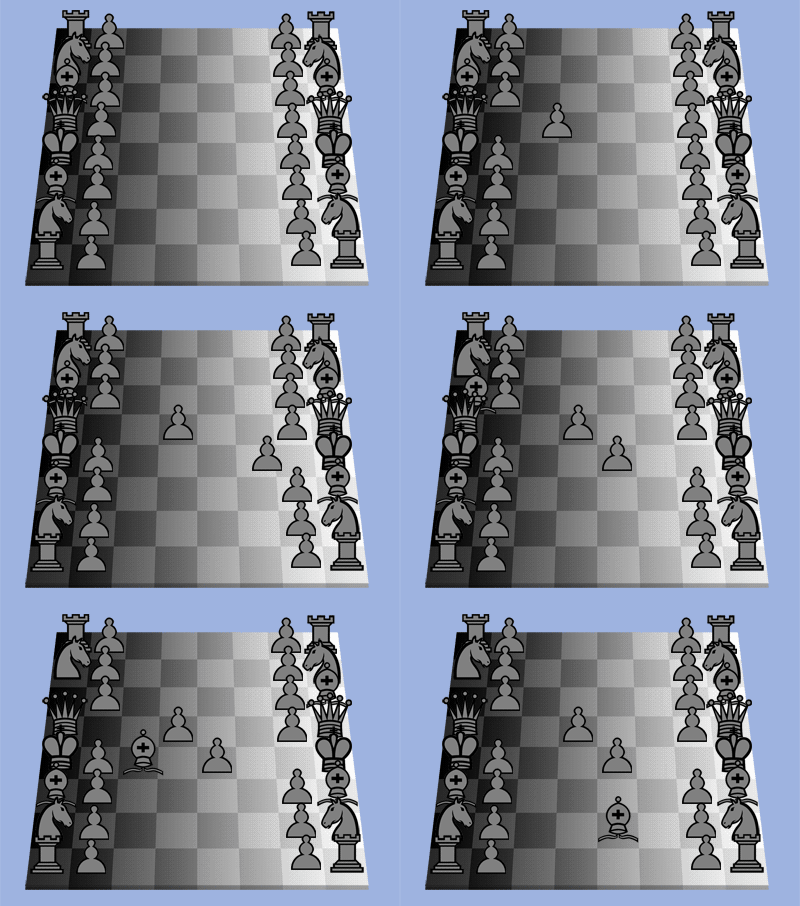
Idea: The Pacifist Chess Set

Pacifist Chess

Chess is a game of war. So for those who disapprove of war, I’ve come up with the Pacifist Chess Set. The concept is illustrated above.

At first glance, it looks like you could play a legitimate game of chess with this set. But once you start playing you realize that you can’t play for very long — at least not very easily. As you play, and your pieces get closer to your opponent’s pieces, it becomes apparent that one side’s pieces are indistinguishable from the other side’s pieces. They are all the same color.

It’s not really a functional chess set. It’s more of an art or conversation piece. It makes the statement that, no matter what side of the battle we’re on, we have in common that we are all human.

[I got this idea while wandering through the Imagery of Chess Revisited exhibit at the Noguchi Museum in Queens. The exhibit is only around for two more weeks, but if you get a chance I highly recommend a visit. It features works by Man Ray, Marcel Duchamp, Max Ernst, Alexander Calder, and others. A book is also available, in case you miss the show.]

March 29, 2006

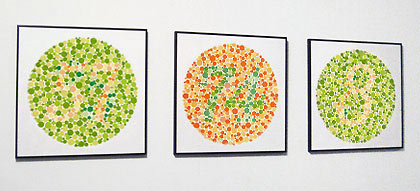
Idea: The Ishihara Triptych

The Ishihara Triptych

Remember when you were in third grade and the school nurse gave you that test to see if you’re color blind? The one where she shows you a circle made up of smaller colored circles and asks you what number you see? That test is the Ishihara Test of Color Vision.

I’m fascinated by perception, especially by the uncommon traits that make some people’s perception different than the rest of us — color blindness, tetrachromatism, synesthesia, monocular vision, etc. I also enjoy original art. I decided to combine the two interests by making a triptych out of three Ishihara color vision test plates.

At greater expense than I anticipated, I obtained a set of Ishihara color vision test plates. I picked out three plates that I felt looked good together, and blew them up to a size suitable for framing. The entire finished triptych, seen above, hangs above my bed. I think it makes a compelling piece of art.

It’s titled “57-74-8, or 35-21-3”

Want to make your own? Click each thumbnail below to download a high-res image you can download, print out, and frame.

LeftMiddleLeft

March 27, 2006

Idea: Design for a WTC Monument

I know, designing your own WTC memorial is so 2002. But it’s been years since the World Trade Center Site Memorial Competition, and there’s been next to no progress on actually building anything. Last week, some dirt was moved around and people got angry about it. So I’ve been thinking again about my own monument design that I came up with a few years back, but never actually rendered. It’s nice to finally get it out of my head and on paper. Er, pixel.

WTCWhen viewed from one direction, my memorial resembles the original towers. It stands tall and proud. It’s big and bold. Its height depends aesthetically on where it will be placed — in a memorial park, I assume — but I imagine it being really tall, the tallest thing in the park, peaking out above the tallest trees, or (since the tallest trees will eventually grow) in the middle of a clearing. The names of the September 11 victims who lost their lives are engraved in lines on the faces of the towers, like the lines of windows on the buildings.

WTCSo viewed from one direction, it looks like the towers themselves. But when viewed from another direction, the monument becomes an empty shell. It’s a reminder of how fragile the towers were, and of the empty space they used to occupy. It’s very, very simple. Hopefully it’s also poignant.

In my original vision, these were as big as the original towers, becoming part of the city’s skyline in the same way the original towers were. Viewing Manhattan from one side, you’d see the towers’ silhouette and the skyline looks just like it used to. Viewing from another direction you’d just see the outline of where they were. It’s a grandiose vision. But probably not realistic, so I shrunk it down to a size suitable for placement in a park.

To get the best view of the monument, and really convey how it looks, I’ve put together an animated fly-around that shows it from all sides.

And for those who might be interested, a note about how I created these images and the animation is after the jump.

A note about how I created these images.

I used a program called SketchUp. I loved it enough to heap the following unsolicited praise.

I’d never heard of SketchUp before I read last week that Google acquired them. And neither, apparently, had the Google Toolbar spellchecker, which thinks I’m writing about ketchup.

Anyway, when I came up with this monument idea several years ago, I drew sketches of it, but none of them really did the idea justice the way a 3D rendering could. But I knew nothing about CAD and the learning curve seemed steep. I considered building an actual 3D model, but what would I do with it once I’d made it? I have no room for such a thing in my apartment. But after viewing SketchUp’s demo on their website, I realized I’d found a tool even I could use. SketchUp makes 3D rendering easier than sketching. Seriously. I downloaded the free trial version (fully functional for 8 hours), watched the tutorials for about 15 minutes, and put all this together in about an hour. None of my sketches of this concept ever looked this good. It’s a cool product. I congratulate them on their recent successes.

March 23, 2006

Idea: Advertisements on the overhead bins

The overhead bins

Look, I didn’t say it’s a good idea. I admit that it’s ugly as sin. Every bit of empty space in our lives is slowly being taken over by ads, so why would I want even more? Well, have you noticed how expensive your airplane tickets are getting? Airlines are filing for bankruptcy protection, seats are getting less comfortable, and you’re asked to pay $6 for a box of stale crackers on a flight.

I was on a plane yesterday, and I noticed that with all the ads they were showing us on the overhead TVs, and all the ads crammed into the in-flight magazine, there was all this prime advertising real estate overhead that wasn’t being used. You already see overhead ads on the subways, on buses, in taxis, and on trains. Sometimes you’re even glad it’s there so you have something to look at to avoid eye contact with the person sitting across from you. So what’s a little more advertising on another mode of transportation?

I’m not even sure I should file this under “Ideas.” Maybe I need a category called “Predictions.” This seems sort of inevitable to me.

March 20, 2006

Idea: Pre-pixelated clothes for Reality TV shows

Pixelated ClothingI don’t watch much Reality TV, but I’ve seen enough of it to notice an on-going phenomenon: Someone wears a garment with a trademarked logo or artwork on it, and the producers have to pixelate it beyond recognition in post-production. Of course no Reality TV star wants their shirt, which displays their well-chosen article of self-expression, senselessly pixelated so nobody can see it. But no Reality TV producer wants to deal with the headache of removing said article of self-expression to avoid trademark violations. The pixelation process seems like an awful lot of trouble to go through for something that could have been avoided with a little pre-planning.

Pixelated HatSo I’d like to introduce my new line of pre-pixelated clothing for Reality TV shows. If you’re going to be on a Reality TV show, you can buy one of these fine products and save someone a lot of headaches later. In fact, if you live in an area where a reality TV show is taping, you should think about getting one of these shirts in case you get caught in the background of a shot. And if you’re heading to audition for a Reality TV show, maybe you should wear one of these shirts to the audition so they know that you’re really serious about Reality TV.

Available here in these and other fine styles:

Update: Hey, this little post has become popular! So now I get to say, “As seen on: TVGasm, MSNBC, USA Today, Wired, Entertainment Weekly, Defamer, Fark, Digg, Kottke, Consumerist, the Morning News, Boston.com, C|Net, and about a hundred other blogs.” Thanks!

Update: And now I’ve made the New York Magazine Approval Matrix!

March 15, 2006

Balabananza, the Convention for Bob Balaban Fans.

BalabananzaThere should be a convention for Bob Balaban fans called Balabananza. Imagine:
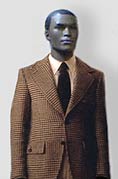
People show up dressed as their favorite Bob Balaban character. “Look, I’m dressed like Enid’s Dad from Ghost World!” “Hey, check out that guy who’s dressed like Bob’s character Ted Marcus from that episode of The West Wing that he guest starred in during the 2000 season.” “Woah, that guy has every detail perfect from Bob’s costume in Gosford Park!”

There could be panel discussions with topics like:

  • Warren Littlefield vs. Russell Dalrymple - An examination of how one actor plays two NBC executives

  • The Wallace Shawn Controversy - Was it right for Bob to play William Shawn in Capote, when his own son Wallace Shawn is such an accomplished character actor?

  • My Boyfriend’s Back - What went wrong?

costume
Bob’s costume from Close Encounters on display at Balabananza 2005
Celebrity guests on the panels could include people Bob’s worked with, like Brian Sawyer, director of Tex the Passive-Aggressive Gunslinger and that guy who played Guffman in Waiting for Guffman who I can’t picture for some reason right now (not Paul Benedict).

And there could be a whole area for vendors. You know, companies that sell Bob Balaban merchandise. Vendors like Balabanana Republic — the finest purveyor of octagonal-framed glasses — and Elmerson Entertainment, the video game company whose long-awaited terrorist-hunting game “Balaban vs. Taliban” is scheduled to finally hit stores.

It would be great. I can’t wait to go.

Update: Merchandise from Balabananza ‘96 is now available as part of the “Merchandise from Events that Never Happened” series.

March 14, 2006

Idea: A commercial for batteries

A commercial I’d love to see, using borrowed footage from the movie “Say Anything…” with new footage integrated. Picture this:

battery adIone Skye is upstairs sleeping in her bedroom. Outside, John Cusack stands below her window with a boombox held up high over his head. He’s blasting “In Your Eyes” by Peter Gabriel. Ione wakes up. “…the light, the heat (your eyes), I am complete (your eyes)…” Where’s that music coming from?

Down below, the batteries die in John’s boombox. He can’t believe it. Now, of all times! The camera pans over to a shorter, geekier guy standing a few feet away, holding a boombox over his head, too. It blasts, “Nothing’s Gonna Change My Love For You” by Glenn Madeiros. We see that it’s powered with [whatever brand] batteries. Ione goes to her window and sees geeky kid down below. His boombox blares. “One thing you can be sure of, I’ll never ask for more than your love…” She swoons.

[Whatever brand] batteries. Nothing lasts longer.

March 12, 2006

60 Seconds in the Life of Steam

Part 2 in an ongoing series of (approximately) 60 second films.

This one is called “60 Seconds in the Life of Steam” and was filmed at 42nd Street and Second Avenue in Manhattan.