Filed under “You Made It”

February 11, 2011

I wrote it, you made it: The Make-out Hoodie

Back in August, I envisioned the Make-out Hoodie, a pair of his-and-hers (or whatever combination you’re into) hoodies that form a complete picture when the couple kisses with the hoods up.

This was my concept sketch:

I recently heard from a reader named Nate who said, “Thanks for the idea! My gf and I sewed some simple patches onto some hoodies and they turned out great.”

Here’s their photo:

Thanks, Nate!

April 8, 2009

I wrote it, you made it: The Bulbdial Clock

Just about a year ago, I came up with a concept for a clock whose hands are shadows projected by bulbs shining on a center post. I called it the Bulbdial Clock, and my concept design looked like this:

Well, I’m thrilled to see that the evil mad scientists over at Evil Mad Scientist Laboratories have actually built a working model! They posted lots of pictures, and it’s pretty awesome:

Head over to their site and see how they made it. They’re considering making a kit available so people can build their own Bulbdial Clocks. If you’d like to see that happen, let them know in the comments on their blog.

Update: Kits are now available! Visit EMSL for more info.

February 2, 2009

I wrote it, you made it: Histoface

The previous “I wrote it, you made it” posts have been examples of people who executed an idea I proposed. But this time I’m writing about people who took one of my ideas to another level altogether.

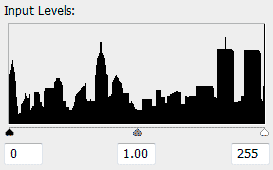
In September, 2007, I demonstrated how an image can be hidden in the histogram of another image. The example I used was the New York City skyline…

…hidden in the histogram of a simple gradient:

I followed that up by writing about Josh Millard, a reader who figured out how to embed the histogram in a more recognizable picture than just a gradient. He was able to embed the NYC skyline histogram in the original source image of the NYC skyline!

But I never wrote about what Stewart Smith did with this concept. He took the idea in a different direction, wondering if it would be possible to embed an actual word or phrase in the histogram of an image. So he developed Histoface, a web app that allows you to generate a gradient which contains a secret message in the histogram.

So this image…

…has this histogram:

It should be obvious that it says “STARWARS” but unfortunately not all the letters in the typeface are as easy to recognize as these. It’s difficult to create recognizable letters that work in a histogram. But I give Stew major credit for making it this good!

I’d love to see a combination of Stew’s project and Josh’s project, allowing you to type a message and hide it in the histogram of any grayscale image. Who wants to work on that?

January 26, 2009

I wrote it, you made it: A commercial

Back in November, 2006, I posted an idea for a commercial I’d like to see. Some time later, I was contacted by Ethan Cushing who wrote, “I am a director trying to expand my reel and would love with your permission to hire a crew, rent some great HD cameras, and film [this].”

So without further ado, I now present… the commercial:

Nice work, Ethan! Going back and reading my original post, I was surprised to realize that he more or less used what I wrote verbatim. If I’d known that would happen, I would have spent more time crafting the dialogue.

Incidentally, I’d still love to see this battery commercial concept turned into reality. It would require a bit of F/X trickery, I think. If anyone wants to take it on, go for it.

Previously: I wrote it, you made it: Montris

January 19, 2009

I wrote it, you made it: Montris

Sometimes I post ideas that would blow me away if they could actually be made real (I’m still waiting for someone to build an Ant Desk). But occasionally I do hear from people who have taken one of my more practical ideas and actually turned it into reality. I keep meaning to write about them, so I’m starting with this one: Montris.

About a year ago, I came up with an idea for a game I described as Tetris, one brick at a time. I called it “Montris.”

I was eventually contacted by a reader named Chris Kastorff who decided to make a working Montris game. We discussed various factors that would affect game playability: The number of colors, the width of the playing field, etc. He wrote a proof-of-concept game that allows users to adjust all of those factors. (Note: In his conceptual implementation, bricks do not fall on their own. You must press the down arrow to progress the game).

More recently, I heard from a reader who has actually taken the concept and fleshed it out completely into a functional game! He calls it Sirtet. You can find it along with other games on his website.

I like that he penalizes players for making pieces of more than 4 squares. It adds another level of complexity to the game. Nice work!