I'm a professional photographer, but sometimes I get ideas for projects, designs, gadgets, and other topics. I write about it all on this blog. You can find the meaning behind the name “Ironic Sans” back in the very first post.
David Friedman Photography
When I'm not writing the blog, I make a living as a photographer. This is my photography website.
You are reading all the entries posted to Ironic Sans in the “Lists” category. If you are looking for something specific, you may try searching in the Ironic Sans archive.
It’s been five years since Twitter introduced Lists and frankly I never found a use for them. It’s not that I don’t see the value in curated lists, but I never remembered to look at them, preferring to watch my complete stream of tweeters, signal, noise, and all.
But I finally came up with a use for them. So without further ado, here are a bunch of Pop Culture Twitter Lists you can follow, in apparently random order, with notes about what you’ll find there.
(You can also see them with nicer formatting but without the notes, and easily to subscribe to them, here on Twitter).
Roseanne: 6 cast members, but mainly Roseanne being weird
The Breakfast Club: 4 cast members, but mainly Molly Ringwald, who has a brand new advice column and I can’t believe more people aren’t talking about that.
Doctor Who: 19 cast members, mainly Doctors and companions
Rowan & Martin’s Laugh-In: sadly just 3 cast members, but what cast members they are: Lily Tomlin, Ruth Buzzi, and Goldie Hawn. I’d watch a movie starring all of them.
Family Ties: 5 cast members, and you should be following Justine Bateman’s blog about going back to college and being a Computer Science undergrad as an adult
Growing Pains: 7 cast members, but mainly Kirk Cameron. You’ve been warned.
The Brady Bunch: just 2 cast members, and really just Florence Henderson. I’m surprised there aren’t more.
The Facts Of Life: 8 cast members. After much internal debate, I decided to omit the characters who didn’t make it past Season 1 (although once again I can’t believe nobody’s talking about Molly Ringwald’s advice column).
Am I missing your favorite cast that’s on Twitter? Let me know at @ironicsans and maybe I’ll add it when I get a chance.
(Wow, a bulleted list of links sure highlights how dated my site’s design feels)
Over the years, I’ve drawn a bunch of little cartoons for Ironic Sans. Some became part of an Esoteric Comics series. Others were standalone posts. But I still have a big list of comics I never got around to drawing. Some were for lack of time, and some were for lack of knowing exactly how I would do it.
For example, I’ve always wanted to do a one-panel cartoon of an alligator driving a car with a bumper sticker that says “My son is a black belt.” But I couldn’t quite figure out how to draw it from an angle so you can see the driver is an alligator and also read the bumper sticker.
So here’s a bunch of cartoons that didn’t get done. Some are fully formed in my head, and others are just caption ideas. If anyone wants to draw them, I’ll post them in a follow-up:
• An alligator driving a car with a bumper sticker that says “My son is a black belt.”
• Neil Young with two heads and three arms, playing guitar on stage and singing “…searching for the Heart of Gold”
• Shields and Brooke Shields. (It turns out I’m no good at drawing either of them)
• Dilbert Gottfried.
• Members of the Jetson family washed up on a beach with other debris. Caption: “Flotsam and Jetsons.”
• Flat Stanley gets fed up with the nickname and goes to get breast implants.
• The Terence Trent Derby. You know, a race of Terent Trent D’Arbys.
• Mario and Weegee. (the plumber and the street photographer)
• WALL-E and the Beav. (Or perhaps WALL-E and the EVE drawn Leave-it-to-Beaver style, whatever that would be)
• Mecca Godzilla. (Um, this one I might not post.)
Wow. Listing them all like this makes me realize my humor seems mostly derived from bad puns.
Someone should start a tumblr that’s nothing but quotes from people saying that someone should start a tumblr. It should look something like this: someoneshouldstarta.tumblr.com
That reminds me. I started a tumblr of pictures of Showrunners On Couches. Please send me submissions.
I recently discovered that a lot of people use Twitter to write brief open letters to unnamed inventors. They usually are expressing extreme love or extreme hatred for something. Occasionally they are even addressed to the imaginary inventor of something completely intangible like power naps or emotions.
The more I looked into it, the more amusing I found it. So I thought I’d share. Here is a round-up of tweets from the past week addressed to inventors, grouped roughly into categories.
Clothes
[This space unintentionally left blank. There’s a bug somewhere I need to squash. Just scroll down to the content for now. Thanks.]
Dear the inventor of the stiletto/platform heel, WHAT DID WOMEN EVER DO 2 U?!?!?!?!?!?
What you’ve missed if you don’t read SundayMagazine.org
My analytics tell me that the majority of Ironic Sans readers don’t follow my side project SundayMagazine.org so I thought I’d do a little roundup here of some of the articles you’re missing out on if you’re not a SundayMagazine.org reader:
[Reminder: SundayMagazine.org is where I reprint the most interesting articles from the New York Times Sunday Magazine from 100 years ago each weekend with some notes for historic context or commentary]
• The night Abraham Lincoln was assassinated at Ford’s Theatre, there was another couple in the private box with Abe and his wife. They were young and in love, invited guests of the Lincolns. Imagine how that night affected them, and guess how their story ends. It is perhaps even more tragic and gruesome than the Lincolns’ story. Read it here.
• There was an international conference in 1910 to consider revising the calendar so that it doesn’t change from year to year. One of the proposals actually makes pretty good sense to me. Read it here.
• A look at 1910s state-of-the-art motion picture special effects and how they were done. Read it here.
• A fascinating description, complete with illustrations, of how to fly an airplane. Read it here.
• The details of a murder that was overshadowed by a more prominent murder. To this day, the case remains unsolved. Read it here.
• An anecdote about a case of mistaken identity at the theater that tells us something about class differences in 1910. Read it here.
• Leonid Andreyev was considered Russia’s answer to Edgar Allen Poe. The Sunday Magazine serialized one of his stories, The Man Who Found The Truth over four weeks. I posted the entire story complete with illustrations as a PDF, and also linked to the free ebook edition. Read it here.
• As an aside during an otherwise slow week, I published an 1890 article about telegraph operators. They got to know each other so well that they could identify each other based on Morse code tapping style, and could even determine the gender of an operator by how he or she taps. Plus, they used abbreviations that share a lot in common with today’s text-messaging. Read it here.
• As air travel became popular, people came up with all sorts of related patents. This article is about some of the more absurd patents, including illustrations. I’m a fan of the airship powered by eagles. Read it here.
• A study sought to determine whether or not you can predict a person’s musicality based on the shape of the ear. Read it here.
• One man had a license to hunt in Central Park. In fact, it was his job. And he tried to get his work done without bothering tourists. Read it here.
• I had no idea that the first ascent of Mt. McKinley was filled with such drama. The first person to claim victory turned out to be a liar. And the first party to really reach the top had no climbing experience. So how could they have done it? Were they lying, too? Read it here.
• Circus clowns are serious people out of the ring, but nobody treats them with any humanity. This article tells a clown’s sad tale, and I follow up by describing the tragic turn his life took after the article was written. Read it here.
• A 14-year-old kid was the president of the first amateur radio club in America. When Congress was considering regulating the airwaves, he went and testified before Congress. He had a lot of smart things to say, and I saw a lot of parallels between his 1910 radio club and the computer clubs of the 1970s. Read it here.
Those are just a handful of examples. I usually put up 5 articles each week, give or take. If you like what you see, check out the SundayMagazine.org archives, and subscribe to the RSS.
I’m pretty good when it comes to grammar, but my wife is better, as I’m reminded every time I misuse the word lay and she corrects me. Some bad grammar sticks out like a sore thumb for me, but lay/lie misuse goes past me every time. My wife never fails to catch it, and she seemed to be pointing out lay/lie misuse every time we watched Mad Men. We wondered whether it’s the fault of the actors, or if they’re saying the lines faithfully as they’re written.
I decided to turn it into a learning opportunity. If I could catch every use and misuse of lay and lie in every episode of Mad Men so far, surely that would pound the lesson so firmly in my brain that I will never confuse the words ever again.
And so I made the video embedded above. Here is a list of every quote, from each episode in the first three seasons, in the order they appear in the video:
2.10 Joan: “Go ahead. Lay down. I’ll keep the drunks away.” (incorrect)
3.06 Joan: “Go lay down.” (incorrect)
1.10 Peggy: “Maybe you need me to lay on your couch to clear that up for you again.” (incorrect)
2.05 Peggy: “Do you mind if I lay down?” (incorrect)
2.05 Peggy: “I have to lie down” (correct)
1.03 Betty: “I’m going to go and lay the kids’ food out.” (correct)
3.01 Pete: “I should just lay down and we should run together holding hands.” (incorrect)
3.08 Pete: “I’d lie in bed at night, hear horses going by.” (correct)
1.13 Pete: “I think I should lie down.” (correct)
2.02 Don: “I’m going to lie down for a minute.” (correct)
2.12 Don: “Can I take a shower and lie down?” (correct)
2.10 Don: “Do you want me to lay everything out for you?” (correct)
3.09 Don: “I’m going to go lie down.” (correct) [Note: The subtitles for episode 3.09 say that Don says “I’m gonna go lay down” which is incorrect. But it sounds a lot to me like he says “I’m going to go lie down,” so I gave him a pass.]
3.11 Don: “I’m going to lie down.” (correct)
3.12 Don: “Take a pill and lie down.” (correct)
2.08 Ken: “You need someone to lay down on the barbed wire so you can run over them.” (incorrect)
3.07 Henry: “Victorian ladies would get overwhelmed. Corsets and things. They’d need a place to lie down.” (correct)
1.04 Client: “I hate to be a pain in the ass, but if they didn’t just lay there so flat.” (incorrect)
3.03 Carla: “Maybe you should lie down. Sally!” (correct)
2.04 Sally: “Do you lay on top of her?” (incorrect)
2.11 Jane: “I lay on my pillow at the Sherry-Netherland Hotel.” (incorrect)
2.03 Jennifer: “I need to lay down.” (incorrect)
2.04 Katherine: “And I don’t care if you have to lay there. Put your shoes on!” (incorrect)
2.04 Gerry: “I’m sorry, I’ve gotta lay down.” (incorrect)
3.12 TV: “Then Governor Connally, after slumping to the left for a moment, lay on the floor of the rear seats.” (incorrect) (correct) — My mistake. The reporter is speaking in past tense.
I originally included three clips that I later decided to remove:
In episode 3.01, Sal says, “Our worst fears lie in anticipation,” which is correct. But he’s quoting Balzac so I wasn’t sure if he should get credit for it. In fact, he even follows up the line by pointing out, “That’s not me. That’s Balzac.” (The actual Balzac quote is “Our worst misfortunes never happen, and most miseries lie in anticipation.”).
In episode 3.05, Don uses the same Balzac quote after hearing Sal say it. Again, I was unsure whether or not to include it for the same reason. But I did like that the character he’s talking to replies, “Are you sure about that?”
In episode 3.09, Sal says, “I think if I get away from Lucky Strike and lay low from Roger for a day or two, everything will be fine.” I wasn’t sure if the common expression lay low is grammatically correct or not. So I looked it up. Dictionary.com says that lay low means to overpower or defeat (as in “to lay low one’s attackers”). The phrase Sal should have used is lie low which means to conceal oneself (as in “Until the dispute is settled, you would do best to lie low.”). So Sal’s usage is technically incorrect. But “lie low” falls strangely on my ears, and lay low is a common enough expression that I couldn’t decide whether to give it a pass or not, so I chose to simply not include the clip at all.
Next year, Tim Burton’s version of Alice in Wonderland hits theaters. It’s his seventh time working with Johnny Depp, who might be the first actor you associate with Tim Burton. He has also worked frequently with Helena Bonham-Carter, Jeffrey Jones, Michael Keaton, and a few others. But with this movie he adds a few new big names to his list. It’s his first time working with Crispin Glover, Anne Hathaway, Stephen Fry, and relative newcomer Mia Wasikowska.
Whenever a new Tim Burton movie comes out, I marvel at the caliber and range of actors he’s worked with. So inspired in part by the upcoming Tim Burton retrospective that opens at MOMA in a couple weeks, I decided to compile a list. Here are 94 notable people that you might have forgotten were in movies directed by Tim Burton*:
Christina Applegate
Alan Arkin
Patricia Arquette
Alec Baldwin
Kim Basinger
Annette Bening
Milton Berle
Valerie Bertinelli
Jack Black
James Brolin
Pierce Brosnan
Jim Brown
Steve Buscemi
Robert Carradine
Helena Bonham Carter
Max Casella
Dick Cavett
Glenn Close
Sacha Baron Cohen
Sofia Coppola
Marion Cotillard
Billy Crudup
Miley Cyrus
Elizabeth Daily
Geena Davis
Johnny Depp
Danny DeVito
Vincent D’Onofrio
Michael Clarke Duncan
Shelley Duvall
Morgan Fairchild
Albert Finney
Michael J. Fox
Stephen Fry
Paul Giamatti
Crispin Glover
Robert Goulet
Pam Grier
Robert Guillaume
Lukas Haas
Anthony Michael Hall
Jerry Hall
Phil Hartman
Anne Hathaway
Freddy Highmore
Jan Hooks
James Earl Jones
Jeffrey Jones
Tom Jones
Michael Keaton
David Kelly
Kris Kristofferson
Maurice LaMarche
Martin Landau
Jessica Lange
Christopher Lee
Lisa Marie
Ian McDiarmid
Ewan McGregor
Bill Murray
Jack Nicholson
Leonard Nimoy
Catherine O’Hara
Barret Oliver
Jack Palance
Sarah Jessica Parker
Cassandra Peterson
Michelle Pfeiffer
Natalie Portman
Vincent Price
Missy Pyle
Paul Reubens
Miranda Richardson
Alan Rickman
Christina Ricci
Tim Roth
Deep Roy
Winona Ryder
Glenn Shadix
Martin Short
Sylvia Sidney
Dee Snider
George ‘The Animal’ Steele
Rod Steiger
Daniel Stern
Tracey Ullman
Mark Wahlberg
Loudon Wainwright III
Christopher Walken
Mia Wasikowska
Emily Watson
Dianne Wiest
Billy Dee Williams
Robert Wuhl
*For the purpose of this blog entry, I also include the actors from Tim Burton’s short film Frankenweenie, plus the “Aladdin” episode of Faerie Tale Theater that he directed.
As George Bush prepares to move out of the White House at 1600 Pennsylvania Avenue in Washington, DC, and Barack Obama prepares to move in, I thought I’d take a virtual trip around the country and see what’s going on at other locations with the same address.
As summer ends, so does the blockbuster season. It’s time to stop watching movies all day and start attending classes. But wait! What if there were a way to do both? I thought it would be interesting to see what lessons are taught in the movies, so I’ve rounded up 10 classroom lectures from a variety of films. See if you can remember what movie each lesson is from. Answers are at the end.
(Hint: One of them is actually a lesson from a field trip, not a classroom).
SUBJECT: MATH
1) “Parenthesis means multiply. Every time you see this, you multiply. A negative times a negative equals a positive. A negative times a negative equals a positive. Say it. A negative times a negative equals a positive. Say it!”
SUBJECT: SCIENCE
2) “The parts of a flower are so constructed that very, very often the wind will cause pollination. If not, then a bee or any other nectar-gathering creature can create the same situation. Yes, anything that gets the pollen to the pistil’s right on the list. I’ll try to make it crystal clear. A flower’s insatiable passion turns its life into a circus of debauchery! Now you see just how the stamen gets its lusty dust on to the stigma and why this frenzied chlorophyllous orgy starts each spring is no enigma. We call this quest for satisfaction a what, class?”
3) “Archeology is the search for fact. Not truth. If it’s truth you’re interested in, Doctor Tyree’s Philosophy class is right down the hall. So forget any ideas you’ve got about lost cities, exotic travel, and digging up the world. We do not follow maps to buried treasure and X never, ever, marks the spot. Seventy percent of all archaeology is done in the library. Research. Reading.”
4) “For many days before the end of our Earth, people will look into the night sky and notice a star, increasingly bright and increasingly near. As this star approaches us, the weather will change. The great polar fields of the north and south will rot and divide, and the seas will turn warmer.”
SUBJECT: HISTORY
5) “You remember that thing we had about 30 years ago called the Korean conflict? And how we failed to achieve victory? How come we didn’t cross the 38th parallel and push those rice-eaters back to the Great Wall of China then take the fucking wall apart brick by brick and nuke them back into the fucking stone age forever? Tell me why! How come? Say it! Say it!”
6) “Three weeks we’ve been talking about the Platt Amendment. What are you people? On dope? A piece of legislation was introduced into Congress by Senator John Platt. It was passed in 1906. This amendment to our Constitution has a profound impact upon all of our daily lives.”
7) “In 1930, the Republican-controlled House of Representatives, in an effort to alleviate the effects of the… Anyone? Anyone?… the Great Depression, passed the… Anyone? Anyone? The tariff bill? The Hawley-Smoot Tariff Act? Which, anyone? Raised or lowered?… raised tariffs, in an effort to collect more revenue for the federal government. Did it work? Anyone? Anyone know the effects? It did not work, and the United States sank deeper into the Great Depression.”
SUBJECT: MUSIC
8) “In this life, you can’t win. Yeah, you can try, but in the end you’re just gonna lose, big time, because the world is run by the Man. The Man, oh, you don’t know the Man. He’s everywhere. In the White House… down the hall… Ms. Mullins, she’s the Man. And the Man ruined the ozone, he’s burning down the Amazon, and he kidnapped Shamu and put her in a chlorine tank! And there used to be a way to stick it to the Man. It was called rock ‘n roll, but guess what, oh no, the Man ruined that, too, with a little thing called MTV! So don’t waste your time trying to make anything cool or pure or awesome ‘cause the Man is just gonna call you a fat washed up loser and crush your soul. So do yourselves a favor and just GIVE UP!”
9) “You’re quite correct, you can’t dance to Mr. Beethoven. Can you tell me why, Mr. Manfield? Because the Beethoven piece doesn’t use a constant rhythm or tempo. Madonna is 4/4 time all the way through. The melody changes but the rhythm is constant. So you can dance to it. The quartet changes both melodically and rhythmically. I’m going to play them again. Listen for this.”
SUBJECT: LITERATURE
10) “Excrement. That’s what I think of Mr. J. Evans Pritchard. We’re not laying pipe, we’re talking about poetry. I mean, how can you describe poetry like American Bandstand? I like Byron, I give him a 42, but I can’t dance to it. Now I want you rip out that page. Go on, rip out the entire page. You heard me, rip it out. Rip it out!”
EXTRA CREDIT: PLAYTIME
11) “Now we’re going to do something extremely fun. We’re going to play a game called ‘Who is my daddy and what does he do?’”
Okay, pencils down. Trade answer sheets with your neighbor. Here are the answers:
1) Stand and Deliver; 2) Grease 2; 3) Indiana Jones and the Last Crusade 4) Rebel Without A Cause; 5) Back to School; 6) Fast Times at Ridgemont High; 7) Ferris Bueller’s Day Off; 8) School of Rock; 9) Running on Empty; 10) Dead Poets Society; 11) Kindergarten Cop
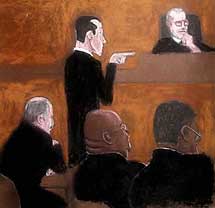
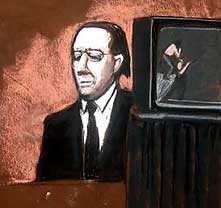
In 1996, Supreme Court Justice David Souter told a congressional panel that “the day you see a camera come into our courtroom, it’s going to roll over my dead body.” While the controversy over whether or not cameras should be allowed in courtrooms rages on, sketch artists remain fairly non-controversial, covering even the most important trials. The general public sees their artwork on the news, online, and in print. These artists see the trials for us, and often their artwork is our only glimpse into the proceedings.
I found myself wondering who these artists are. Is courtroom sketching a full time job? Are these people fine artists or commercial artists? And what kind of artwork do they do outside the courtroom? I decided to contact a range of courtroom sketch artists and see what I could find out. There are many more talented artists in courtrooms than just the seven I contacted, and I present them in no particular order. (All artwork shown with permission of the artists).
MONA SHAFER EDWARDS
In the courtroom: Mona has been covering celebrity trials in Los Angeles for more than 25 years. Her courtroom sketches have appeared on ABC, CNN, Entertainment Weekly, the Los Angeles Times, and elsewhere. She recently released a book called Captured! featuring sketches and commentaries from a quarter century of celebrity trials.
Outside the courtroom: Before she began sketching trials, Mona was a fashion illustrator. She has illustrated several fashion books and has taught fashion sketching at UCLA. Some of her fine art is available in posters from Winn Devon. I think she conveys a lot of elegance in seemingly simple lines.
In the courtroom:In 1975, Steve was passing through Philadelphia on his way to Hollywood, when a photojournalist friend offered him a press pass to watch the moving of the Liberty Bell with him. As luck would have it, the bad weather that day prevented the photographers from getting the shots they needed, but the fact that an illustrator was present meant that the media could at least get an artist’s rendition of the event. The Philadelphia Daily News was impressed by his work and asked if he’d ever done courtroom sketching before. He hadn’t, but he was willing to give it a try. For nearly 30 years since then, Steve covered court cases for every major media outlet, drawing his courtroom pictures with color markers. A drawing Steve made of Judge Lance Ito, his staff, and all the major players from the OJ Simpson trial hangs framed above the juror box in Judge Ito’s courtroom.
Outside the courtroom: Steve finally made it to Hollywood, where he has a prolific career drawing storyboards for major motion pictures including The Day After Tomorrow, Along Came Polly, and Dirty Dancing: Havana Nights. Steve also does fantasy and sci-fi illustration and is working on a book of stories from his illustration adventures. Here’s an example of his storyboard work for The Day After Tomorrow:
In the courtroom: From 1973 to 1998, Marilyn worked for WABC in New York, covering some of the city’s most famous trials. She was there for the courtroom appearances of Woody Allen, Martha Stewart, Don King, Sid Vicious, Mick Jagger, and more. In a 2006 interview, she recalled drawing notorious mob boss Jon Gotti: “He was always turned out in his Armani suits with his hair blown out and back, he exuded charisma. I saw him as terrifying. I used to watch him through binoculars. And one day he wagged his finger at me and pointed to his neck. I had been drawing his fat neck, and he didn’t like it.” Marilyn recently released a book called Art of Justice recounting 30 infamous trials from the artist’s perspective.
Outside the courtroom: Besides her illustrious career as a courtroom sketch artist, Marilyn is an accomplished painter whose post-impressionistic work has earned several solo exhibitions. Here are some examples:
In the courtroom: Patrick recently moved to a state that allows cameras in the courtroom, which pretty much put the kibash on his courtroom sketch art. But for 10 years prior to the move, Patrick’s courtroom art appeared in numerous regional and national press. I quite like his style, which he executes in chalk pastels and colored pencils (“very messy” he notes) because it’s not exactly what I imagine when I picture typical courtroom sketch art. These sketches are from the Kirby Puckett trial and the Marilyn Manson trial:
Outside the courtroom: Patrick describes himself as “a reality-based artist” adding, “I do still lifes, landscapes, and illustrations that make wry comments and witty observations on modern life.” His website features oil paintings depicting Bob’s Big Boy, a series of Pez Dispensers, and a cow-shaped creamer. Others depict seemingly mundane corners of suburban landscape. And his portfolio is rounded out with commercial work showing both creative and technical illustration skills.
In the courtroom: Dana says that the most memorable court case she’s sat in on was NBC Sportscaster Marv Albert’s sexual assault trial, which she describes as “one big surprise after the next.” In that case, Albert was accused of biting a woman, and it was revealed that he sometimes wore women’s underwear. Sometimes, Dana says, time restraints don’t allow her to finish her sketches in the courtroom, so she adds the finishing touches afterwards, even if that means setting up shop in the courthouse bathroom, using the sink for her watercolors. Dana’s courtroom art has appeared on CNN, ABC, FOX, and elsewhere.
Outside the courtroom: Dana’s illustrations have been featured in national publications like Newsweek, which used her work extensively for its article “The Day That Changed America” about the attacks of 9/11. On a more local scale, Dana does commissioned portraits for clients, and is even available as a caricaturist for events.
In the courtroom: Paulette says about courtroom art: “Being a courtroom artist is like capturing lightning in a jar. The artist must grasp the image of the moment, hold it, and express it onto an 11x14 drawing pad in their lap without spilling ink, paint or supplies onto the lap of the person sitting beside them. The composition must tell the story at a glance. In all my art I go for essence. The essence of my subject in the mood of the moment is my goal. I have written a biography with artwork of the great radical criminal defense lawyer J. Tony Serra, and I’m working on a book about the world’s greatest mime, Marcel Marceau. I learned about essence from Marceau and about drama in the courtroom from Serra.”
Outside the courtroom: In addition to being a courtroom artist and author, Paulette is also a photographer, a magician, a mime, and a fine artist who work was first exhibited in a joint show with her father, designer Paul T. Frankl. Here are two of her portraits:
In the courtroom: The United States Supreme Court is Art’s regular beat, drawing for NBC News. But he has covered cases across the country, and even as far south as Guantanamo Bay where his sketches are the only visual records of various military proceedings. He began doing courtroom sketches in 1976, and works mostly with colored pencils and watercolor markers. I asked Art what he thinks of cameras in the courtroom. He said, “My fear is that trials could become reality shows. The viewing public, not realizing that the trial they are witnessing, with commentary from pundits and sandwiched between commercials, is very different from the case the jury gets.” Here is Art’s sketch of last week’s Supreme Court arguments in the Exxon Valdez case:
Outside the courtroom: Art’s courtroom work make up most of his visual artistry these days, but he does practice two other kinds of art that I think are worth mentioning. First of all, he writes an interesting blog where you can see Art’s latest drawings, along with commentary about the cases he covers. And until recently, Art was playing Mandolin in the Baltimore Mandolin Orchestra. You can see Art in this photo, partially obscured, third from the left:
With the first major Presidential primaries already behind us, the election year is officially under way. This November, the President, Vice President, one third of the Senate, and the entire House are up for election. Between now and then, we’ll see dozens of debates, thousands of ads, and hear mixed messages from various groups, pundits, candidates, their former co-workers, their third grade teachers, former lovers, and anyone else who can be pulled out of the woodwork to support or tear down a politician. So I figure this is a good time to review the 7 Common Propaganda Devices that were identified by the Institute for Propaganda Analysis (IPA) way back in 1937 and see if we can find them in use today.
1. GLITTERING GENERALITIES
The IPA used this term to describe virtuous words that mean different things to different people, but are used in such a general way that you can project your own meaning into the speaker’s words. So when people talk about freedom, strength, Democracy, or patriotism, you are likely to assume they think of those words the same way you do.
In 2008: It’s almost like this Mitt Romney ad was made just to demonstrate use of glittering generalities:
Remedy: When you hear someone speaking in glittering generalities, the IPA recommended that you stop to ask whether or not the idea being pitched is really a good one, or if it’s just being sold to you through association with words you like. If you take those words out of the equation, is the substance of what’s left still any good?
2. NAME CALLING
“Name calling” is a technique where someone uses words to link a person or proposal to a negative or emotionally charged symbol. The idea is to get you to reject the person due to the association with the symbol rather than actual evidence, which may or may not be there. Words like flip-flopper, radical, terrorist, and even liberal are contemporary labels that might qualify as name calling.
In 2008: The Annenberg Political Fact Check recently reported that e-mails have been circulating calling Barack Obama a racist and a radical Muslim. Neither claim seems to be supported by evidence, but aims to associate the Senator with negative views of racists and Muslim extremists.
Remedy: The IPA recommended that when you hear name-calling, you should stop to consider what the name means, whether or not it is being legitimately applied, and what the person or idea’s merits are without the name.
3. TRANSFER
There are institutions and objects that you have positive associations with, so politicians try to appear with symbols of those institutions in the hopes that you will transfer your positive associations onto them. For example, by standing in front of American flags or next to a cross, a candidate hopes that your positive associations with those symbols will be transferred to them. Transfer can be used for positive associations or negative associations, depending on the symbol and intent.
In 2008: Mike Huckabee’s Christmas campaign ad featured a bookcase in the background which resembled a cross. There was some debate in the media over whether or not the cross was a subtle but deliberate attempt at using transfer. Of course, Governor Huckabee’s statement in the ad that “what really matters is the celebration of the birth of Christ” is a much less subtle attempt to further align himself with the church.
Remedy: The IPA suggests that when you notice transfer in use, you ask what the merits of a person or idea are without the transferred associations, and whether or not there is a legitimate connection between the person or idea and the thing from which the person is attempting to transfer some association.
4. TESTIMONIAL
The IPA pointed out that sometimes citing a qualified source is a good way to emphasize a legitimate idea. But you should consider whether or not the source being cited is really qualified to make judgments about a particular issue.
In 2008: Barack Obama has received endorsements from Oprah Winfrey, Jennifer Aniston, Will I Am, and Jessica Beil. Hillary Clinton has Magic Johnson, Jenna Jameson, and Rob Reiner in her camp. Kevin Bacon endorses John Edwards. Bo Derek, Adam Sandler, and Kelsey Grammar have all come out for Giuliani. Chuck Norris has got Mike Huckabee’s back. Mitt Romney has the support of both Osmonds. And John McCain is endorsed by, um, Wilford Brimley. (source)
Remedy: The IPA recommended that, when considering endorsements like these, you ask what makes the individual qualified to be an expert on the subject in question. Does Oprah know what’s best for the country? Does Kelsey Grammar have more insight than you do? The IPA suggested that you should consider the merits of the person or idea without the testimonial.
5. PLAIN FOLKS
The “Plain Folks” technique is at work whenever a speaker promotes the idea that he or she is “of the people,” just an Average Joe despite the fact that he or she may go home to a mansion at the end of the day.
In 2008: John Edwards is fond of pointing out that he is the son of a mill worker. Several candidates have eschewed a suit and tie on the campaign trail in favor of a sweater and blue jeans. And Mitt Romney perfectly illustrates the technique in this campaign ad showing him as just a regular family guy. He does dishes, just like you!
Remedy: When you see examples of the Plain Folks technique at work, try temporarily ignoring the candidate’s personality, and just think about his or her ideas. Do they still sound good?
6. CARD STACKING
“Stacking the deck” is a gimmick used by magicians where a deck of cards appears to be randomly shuffled but is in fact arranged in a specific way. The IPA borrowed the term to describe a technique where only one side of a topic is favored, or another side is ignored or played down.
In 2008: Fox News is accused of having a right-wing bias, selectively reporting on issues that support a right-wing agenda. Similarly, PBS is accused by some of having a left-wing bias . And Ron Paul supporters have been shouting that the entire mainstream media has an anti-Ron Paul bias, downplaying his successes in the campaign.
Remedy: It can be difficult to recognize card stacking, because the viewer does not always know what other arguments are being ignored. If you don’t know about Ron Paul, for example, you wouldn’t know that he isn’t being represented in some discussions of the candidates. But by seeking out different media outlets with various viewpoints, you can get a more well rounded view of the issues.
7. BANDWAGON
The idea behind the Bandwagon technique is that, since everyone else is doing it, so too should you. There is a bit of showmanship involved in hyping the bandwagon, filling halls with supporters, playing music to get everyone excited, and waving colorful banners. Often the appeal is directed towards groups that already share a common tie based on religion, race, gender, etc. Studies have shown that the bandwagon effect really does work in elections. In the current race, the media reports poll results consistently, telling us who women are voting for, who blacks are voting for, who Christians are voting for, etc.
In 2008: The New York Times reports today that Barack Obama is increasingly being viewed as being electable among Democrats. In fact, the Times reports that “The percentage of Democrats who say he would be the strongest candidate against the Republicans has more than doubled in a month.” If enough Democrats hear that their fellow Dems feel this way, we may expect his electability rating to increase even more, based on the bandwagon effect. In a similar vein, there is sometimes an underdog effect at work, also. Many people want to vote for the winning team, but others like to throw support to the underdog. And the recent New Hampshire primary showed that the declared front-runner doesn’t always win anyway.
Remedy: The IPA recommended that, when you notice the bandwagon effect, you stop to consider whether or not you should support an idea or candidate regardless of the fact that others do. Does the person or idea really serve your individual and collective best interests?
These 7 techniques were identified by the IPA 70 years ago, but other techniques could be mentioned in this context including the use of fear, a technique employed to great effect in recent years. More information on propaganda techniques can be found at propagandacritic.com.
Sure, I’ve seen book covers that identify the book as “A Novel.” But I never realized just how ubiquitous it is until a recent visit to my local brick and mortar bookstore. It’s on practically every novel! All of the below images are details from the covers of books currently on the New York Times Bestseller Lists for hardcover or trade paperback fiction. You can click on each image to see what book it’s from:
I guess just being a work of fiction isn’t enough anymore. You have to emblazen your book with a category on the cover so the book superstore employees know where it belongs. I can’t count how many times I’ve seen Hermann Hesse’s Siddhartha wind up in the religion section.
How am I supposed to know what terrorist group put out this video?Terrorist groups, like any organization, need brand identities. With so many groups claiming credit for terrorist acts, and so many videotapes being put out featuring men in ski masks, it’s hard to keep track of which group committed what violent act. So terrorist organizations have logos. It recently occurred to me that someone had to actually design those logos. But how did they decide who gets to do it? Did the job go to whichever terrorist had a copy of Adobe Illustrator?
I did some research and rounded up as many logos as I could find from terrorist groups past and present. While I hate to give terrorists any more attention, I still think it’s interesting to see the various approaches they took in their logos, and wonder what considerations went into designing them. Does the logo successfully convey the organization’s message? Is it confusingly similar to another group’s logo? Does it exhibit excessive drop shadows, gradients, or use of whatever font is the Arabic equivalent of Papyrus?
Quick Disclaimer: I picked these terrorist groups from a list of designated terrorist organizations on Wikipedia. Since Wikipedia is a user-edited website, I can’t verify who decided these groups are terrorist organizations. So if it turns out one of these groups is an actual army or a legitimate non-violent organization, don’t blame me.
I decided to group the logos roughly by their dominant design elements:
1) Stars
It occurs to me that “stars inside circles” is a subgroup of this category.
2) One Gun
Notice that there’s a little bit of overlap between this group and the last group. The last two “Stars” logos featured a gun, but I decided that the star motif was strong enough to keep them in the “Star” group. The first logo in this group has a star, too, but it’s small.
The bottom three logos are presented in the order they were designed, each inspired by the one before it.
3) Two guns crossed
Why settle for one gun, when you can have two?
4) Other weapons crossed
Guns are so barbaric. Here are some logos which feature blades instead.
5) Crossbones
White supremacists seem to prefer skulls over swords. Hey, haven’t I seen that Combat 18 logo somewhere before?
6) Animals with multiple heads
The SLA’s seven-headed cobra, below, was apparently taken from an ancient Sri Lankan symbol.
[Note: There is interesting discussion in the comments below over what constitutes a terrorist group, with the Kosovo Liberation Army particularly being called into question, and comments an both sides of the issue. The BBC has an interesting history of the KLA here, explaining why the US urged Kosovo Albanians to regard the KLA as a terrorist group, and why the Kosovo Albanians stopped short of that designation. I intend no offense by this logo’s inclusion.]
7) Other
What to make of the rest? I’m not sure what the Oromo Liberation Front logo is supposed to suggest. And that “EPB” logo doesn’t inspire terror at all. It looks like an Olympic team logo. I’ve never heard of the Creativity Movement before, and now I still have no idea what they stand for. What’s with the “W”?
Note:This weekend, an Al Qaeda suicide bomber killed 150 people in a market north of Baghdad. Another 250 were wounded. When this news broke, I had already begun working on this blog entry, and thinking of those victims made it hard to finish. So I just want to be clear that, although this entry focuses on a relatively trivial aspect of terror organizations, it is in no way intended to make light of terrorism. The guns, the blades, the maps of Israel, and other elements in these logos do effectively communicate with painful clarity what some of these groups intend. While my overview of terrorist logos is meant half-seriously as an examination of graphic design in a place we might not think to look, I don’t want to minimize the devastation these groups have wrought.
The Economist is a weekly magazine that focuses on world news, business, and politics. The magazine, based in London, is dense with information and can be tough to wade through. The publishers target an upper-class demographic, and it shows in their ads for the magazine. A recent ad had a tag line which read, “It’s lonely at the top, but at least there’s something to read.” The Economist is the sort of magazine pretentious people like to be seen reading.
Naturally, I have a subscription.
As I was wading through this week’s issue, I realized that whoever writes the headlines (the copy editor, I think) has an interesting sense of humor and a penchant for puns and cultural references. Some of the headlines are better than others. I went through the stack of unread issues that’s been piling up in the living room and picked out some of the best and the worst headline puns and references from recent weeks. Whether you think they are the best or the worst probably depends on whether you like puns. Here are some examples:
Article topic: What conservatives get, and do not get, about foreign aid. Headline: Right to bear alms
Article topic: Former CIA Director George Tenet’s new book has some factual errors but is still worth reading. Headline: George’s tenets
Article topic:Two big meat producers agree to merge. Headline:A steak in the market
Photograph: A polar bear stands on a piece of ice surrounded by water. The article is about global warming. Caption: It’s getting unbearable
Article topic: Scrubbing carbon from coal-fired power stations is possible but pricey. Headline: Dirty king coal
(I’m not sure if that’s supposed to be a play on Nat King Cole or Old King Cole)
Article topic: Businesses are engaging in war game style simulations to gain new perspective on complex problems. Headline: Shall we play a game?
Article topic: The cost of making cell phone calls overseas. Headline: When in roam
Article topic: Californians are leaving the state, filling its neighbor states with former Californians. Headline: Dreams of Californication
Article topic: Ecuador has a new President, Rafael Correa Headline: Magical mystery tour
(Seriously, I have no idea what this headline is supposed to mean. I read the whole article and still can’t figure it out. Correa isn’t touring anywhere. He’s not listening to the Beatles. Why the reference? I don’t get it.)
Article topic: Rio de Janeiro’s economy isn’t doing so well. Headline: Blame it on Rio
Article topic: The popularity of the Russian royal family Headline: Tsarstruck
Article topic: The president’s policies on global warming Headline: Emissionary positions
Article topic: Scientist Craig Venter takes on yet another big project Photo caption: Craig’s list gets longer and longer
Nearly every episode of the 1970s sitcom Welcome Back, Kotter began or ended (sometimes both) with the main character Gabe Kotter telling a really corny joke about a family member. It usually started with him and his wife sitting around, and he asks, “Did I ever tell you about my Uncle So-and-so?” When I was a kid, I loved this show. I found it hilarious. Now, not so much. But I’d still like to see a definitive list of Kotter family members and the situations they found themselves in. I think there’s a Wikipedia article somewhere waiting to be written. I’ve done a little bit of research, and here’s what I’ve come up with so far:
Uncle Carl was a hunter out hunting game. One day, he shot a beautiful girl in the woods because she told him that she’s game. (Season 2, Episode 11)
Uncle Max was a barber. He once hired a private investigator to follow a man who kept coming in the barber shop, asking how long the wait was until the next haircut, and leaving. The investigator followed the man and reported back to Max that the man was going to Max’s house every day. (Season 2, Episode 11)
Aunt Brenda believed in reincarnation. After Uncle Sidney died Brenda went to a seance where Sidney’s ghost revealed that in the afterlife he has a lot of sex before and after every meal. He explained that he is not in heaven — he has been reincarnated as a bull in Montana. (Season 3, Episode 5)
Uncle Eddie was a thief. He used bricks to break windows of stores so he could steal precious items for his girlfriend. When she got too annoying about all the things she wanted, Eddie asked her if she thinks he’s made of bricks. (Season 3, Episode 5)
Uncle Julian was raised by wild dogs. Eventually he was brought to civilization and became a mailman. He was fired for biting himself on the leg. (Season 3, Episode 24)
Uncle William was a pharmacist. He was fired for trying to fit bottles into a typewriter in order to type information on the labels. (Season 3, Episode 24)
Uncle Milton was a famous spiritualist who held seances every Friday night. One night Milton felt the presence of a spirit named Max who in life made a living as a waiter. Milton asked Max’s spirit to come closer to the table. Max refused, as Milton was not at one of Max’s tables. (Season 3, Episode 25)
An un-named uncle went to an Italian restaurant where he noticed a Chinese waiter who speaks perfect Italian. He asked the restaurant owner why. The owner explained that the waiter has only been in the country for two months and is under the impression that the owner is teaching him English. (Season 3, Episode 25)
Uncle Melzer was a navigator. He once removed a thorn from an elephant’s foot in Africa. The elephant was so grateful that he picked Melzer up in his trunk and placed him in his second floor hotel room. A year later, at the circus in Pittsburgh, the elephant picked up Melzer in its trunk and flung him into the balcony, breaking his legs. It was a different elephant. (Season 4, Episode 3)
Uncle Nezbit had no friends, but he brought his dog everywhere, including to the movie theater. The dog enjoyed a particular movie, which surprised Nezbit, because it hated the book. (Season 4, Episode 4)
When Gabe was young, his father told him that the local bully Tommy O’Shaughnessy was a coward. So Gabe told Tommy that, prompting Tommy to beat up Gabe’s father. (Season 1, Episode 2)
Young Gabe’s mother told him to ignore kids who made fun of his big head. But when she sent him on an errand to the supermarket, she suggested he could carry all the groceries home in his hat. (Season 1, Episode 2)
Occasionally during downtime on a particularly slow photo shoot, I’ve played this game with my assistants. Everyone takes out a piece of paper, and numbers it from 1 to 50. Then you get 10 minutes to write down every state you can remember. Finally, you compare it to the master list and see who got the most answers. 10 minutes seems like more than enough time to remember a list of 50 items, right? And yet somehow I’ve never managed to get more than 48 of them.
Well, you don’t need to get out a piece of paper or a timer. I’ve put together an on-line version of this game. It’s a bit low-tech [see update below for high-tech version], but it works.
Have a go at it and then post your score in the comments.
Update: Thanks to reader Erik Wannebo, we now have a nifty interactive version which keeps track of your progress as you go and tallies your score for you. Check it out!
I don’t usually write about things going on elsewhere on other blogs. I pretty much just write original stuff and let other people link to me. Well, this week has been extremely busy and I haven’t had much time to write anything, so I figured I’d take a moment this morning to acknowledge and thank some of the websites out there that have linked to entries I’ve written on more than one occasion. Thanks goes to the following blogs, which you should check out if you don’t already. In no particular order:
Hmm. Now that I look at the list, those are all pretty popular websites anyway. They probably won’t benefit that much by my listing them here. Well, since I’m taking this rare moment to link to other blogs, here are three lesser-known blogs I enjoy and recommend:
• News From Me - Mark Evenier’s blog could be described accurately as being a great site for finding entertaining video from yesteryear. It could also be described as a site that keeps you updated on animation industry greats as they pass away, including illustrators, voice actors, and others. It could also be described as a place to find occasional insightful political commentary. It’s all these things and more.
• Dave Greten’s Blog - His reviews of movies he hasn’t seen are highly entertaining, and his description of his hike up Mount Kilimanjaro had me ready to tie on my hiking boots and book a flight to Tanzania.
[Update: All the photos are now available in larger sizes on flickr.]
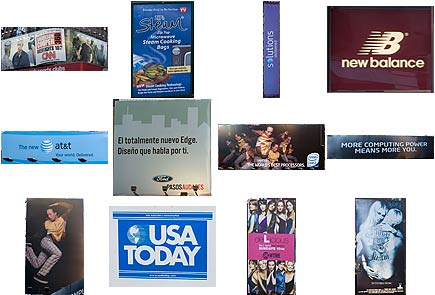
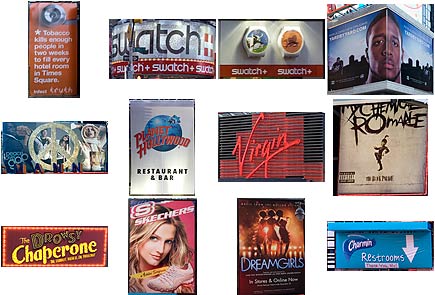
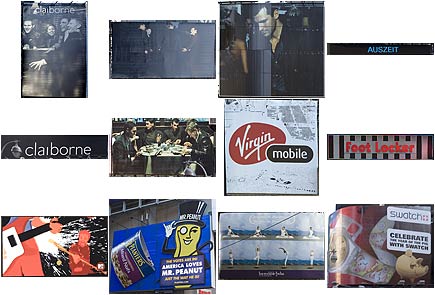
Sometimes I get dangerous thoughts in my head, like “I wonder what it would look like to see every ad in Times Square all on one page.” So when I knew I’d be passing through Times Square this weekend, I made sure I had my camera. For the purposes of this nearly purposeless project, I considered storefront signs the same as ads if they were flashy and glitzy like Times Square ads tend to be.
I’m sure I missed a few, and there may be some I got more than once. I do know that some appear to be duplicates, but are actually similar billboards in different spots. Also, if an ad took up more than one billboard, I usually shot each billboard separately, unless it was a wraparound billboard on a corner, in which case I tried to get it in one shot.
So without further ado, here is every ad in Times Square. More or less.
Right now, you’re probably thinking one of two things. Either you’re thinking, “Does that ad really say that there’s a musical version of Legally Blonde coming to Broadway?” or you’re thinking, “Someone has too much time on his hands.” Well, I can tell you, it took about 20 minutes to take the photos, and about 2 or 3 hours to crop the images while I was listening to the pundits on Sunday morning TV. It wasn’t as bad as I feared.
And yes, there is a Legally Blonde musical coming to Broadway. I don’t know what they’re thinking, either.
I feel kinda cheap pointing out that the 2007 Weblog Awards are open for nominations until January 10, and humbly noting that Ironic Sans would make an excellent nominee for the Best New Weblog or Best-Kept Secret Weblog categories. But it does give me a good excuse to review some of the highlights of the past year, as Ironic Sans approaches its first anniversary. It all started with one little idea and has grown so much from there.
A particularly nice accolade came recently when Gawker Media’s founder Nick Denton e-mailed me. He wrote, “Can’t believe I’d never seen your site before… spent half an hour browsing around. Thanks for wasting my morning!” A comment like that from Nick Denton made my day almost as much as the post I saw on one reader’s livejournal page. She wrote, “I went to the site to dip my toes in, and came out an hour later soaking wet.”
Ironic Sans was put on the map when I posted my idea for pre-pixelated clothes for reality TV. I thought it was a funny idea, but I didn’t expect all the attention it received. I was taken completely by surprise when it got mentions by MSNBC, USA Today, Wired, Entertainment Weekly, Defamer, Fark, Digg, Kottke, Consumerist, the Morning News, Boston.com, C|Net, New York Magazine, and even Stuff Magazine, which recently asked for photos of the shirts for an upcoming issue. And next month, the shirts will be seen in a new book called The Big Book of Irony by Jon Winokur.
Here are some of this year’s other entries of note:
In all, it’s been a good first year. I try to periodically feature some of my favorite entries in a Favorites page, so if you’re new to Ironic Sans you can check there for more highlights. And you can browse the complete archive for the rest of this year’s 150-or-so entries.
When I started this site, I had to figure out what exactly I want it to be. I thought about all the blogs that already exist. There is no shortage of excellent sites that just point to all sorts of interesting things on the web. The world doesn’t need any more of those. Instead, I aim to be one of those interesting things on the web that all of those sites can point to. So far, I hope I’m off to a good start.
Last month, Google introduced its new Patent Search feature (in beta), allowing users to dig through 7 million US patents from 1790 to mid-1996. On-line patent searching has already been possible through the US Patent and Trademark Office website, but Google makes it fast and easy using their already familiar interface.
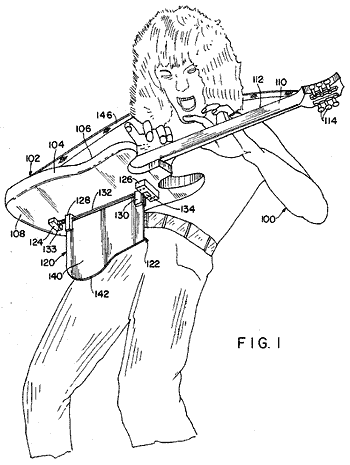
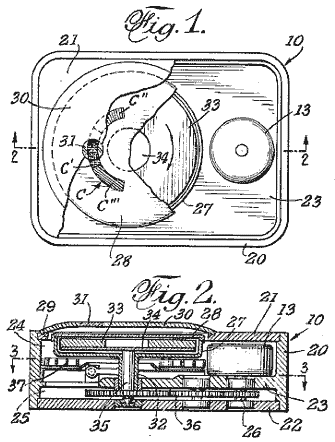
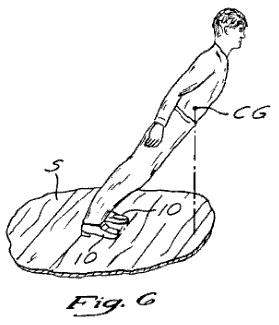
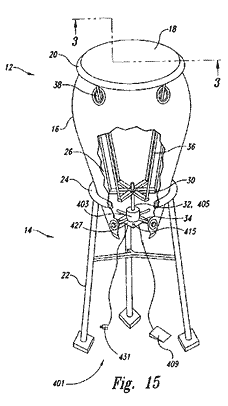
So, inspired by Google’s new easy-to-use patent search, I decided to dig up some of the celebrity patents that have been issued over the years. The following 18 20 patents are all by celebrities not usually known for being inventors. You can follow the links to the actual patents to learn more about each one.
I recently noticed how many body parts have made the leap from noun to verb. Here are a few things you can do with your body parts as verbs:
Shoulder the burden.
Face the music.
Arm yourselves!
Foot the bill.
Stomach an awful movie.
Finger the suspect.
Elbow a pushy jerk on the subway.
Neck with your girlfriend.
Tongue her if she’ll let you.
Bone her once your parents go to sleep.
Mouth along with the music.
Head out of here.
Skin a cat.
Scalp the cat’s owner.
Back out on your commitment.
Eyeball the hot girl at the club.
Hand over your cash.
Knee a mugger in the nuts.
Thumb your nose at the President.
Heart New York.
Butt out.
I’m spending this week in New Hampshire, getting some much needed R&R. The house I’m staying in is fairly remote but it’s quite nice. And it was once owned by Norbert Wiener, the brilliant mathematician who coined the term “cybernetics.”
Not much remains from when Wiener lived here, but the bookshelves are filled with his old books. So I’ve gone through some of the shelves and picked out a few of the more interesting titles. Here’s a selection of what Mr. Wiener read:
Lots of dictionaries: Appleton’s New Spanish Dictionary; Cassell’s German Dictionary; Cassell’s French Dictionary; Dutch (A “Teach Yourself Book”); Nuevo Diccionario Enciclopedico Ilustrado de la Lengua Catellana; Graglia’s Italian-English and English-Italian Dictionary;
Various songbooks including: A booklet called “Patriotic Songs of America” with lyrics and music to The Star Spangled Banner, Hail! Columbia, Yankee Doodle, Battle Hymn of the Republic, Dixie Land, America the Beautiful, Tenting on the Old Camp Ground, etc.; “A Book of Songs - Words and Melodies Only - For Unison & Part Singing For Grades IV, V and VI (Student’s Edition)”; “The Golden Treasury of Songs and Lyrics”; and “An Elizabethan Songbook - Lute Songs: Madrigals & Rounds; Sing!”
A German Historical Atlas; The Bartholomew World Pocket Atlas
Lots of math books, obviously. They mainly have titles that suggest they would be far over my head, including: “Mathematical Tables from Handbook of Chemistry & Physics”; “Four Place Tables - Unabridged Edition”; “Plane and Spherical Trigonometry” by Ashton and Marsh; “Wentworth’s Plane and Solid Geometry”; “A Survey of Modern Algebra”; “Geometry in Three Dimensions”
“An Essay on Man” by Ernst Cassirer
“The Science of Health”
“Basic Course in Botany”
“An Outline of General Zoology”
“Comparative Anatomy of Vertebrates”
“Beyond Hypnosis” by Hugh Lacy in 1952, including a chapter called “Dianetics” which criticizes L. Ron Hubbard but only with regards to his thoughts on hypnosis.
“Emily Post’s Etiquette - The Blue Book of Social Usage”
“The Standard Book of British and American Verse”
“Hotel Berlin ‘43” by Vicki Baum
“The Mutineers” by Charles Boardman Hawes with a lovely illustrated cover
“Scaramouche” by Rafael Sabatini
“The City of Open Air and Other Verse” by Charles Poole Cleaves
“This I Believe: The personal philosophies of one hundred thoughtful men and women in all walks of life — twenty of whom are immortals in the history of ideas, eighty of whom are our contemporaries of today — written for Edward R. Murrow.” This is the second volume, and is inscribed “To Professor Norbert Wiener” and I can’t read the signature. It looks like “Ward Wheeler” or something like that. I figured out what the inscription says. It reads, “With great thanks for your outstanding contribution” and is signed “Ward Wheelock.” Mr. Wheelock was a friend of Edward R. Murrow’s and was the one to come up with the idea for a “This I Believe” series. Norbert Weiner is one of the people who contributed an essay for this book.
“Posthistoric Man - An Inquiry” by Roderick Seidenberg
“Les Miserables” by Victor Hugo. In five volumes.
“Departmental Ditties” by Rudyard Kipling.
“Praha Guidebook”
“The Black Arrow” by Robert Louis Stevenson
“The Hunting of the Snark and Other Poems”
“New Arabian Nights” by R.L. Stevenson
The College Entrance Examination Board’s “Comprehensive Examination Questions” for June and September 1918, including sections on Chemistry, English, French, German, Greek, History, Latin, Mathematics, Physics, and Spanish.
A beautiful 1921 leather-bound copy of “The Astronomer-Poet of Persia” that’s sadly falling apart.
“History of European Morals” Third Edition, Revised, in two volumes.
“The France of Today” from 1916
“The Pleasures of an Absentee Landlord and Other Essays”
“The Mechanics of Writing” which has the very long subtitle “A compendium of rules regarding manuscript-arrangement, spelling, the compounding of words, abbreviations, the representation of numbers, syllabication, the use of capitals, the use of italics, punctuation, and paragraphing.”
If you live in a major city anywhere in the world, there’s a good chance that there’s an “-ist” website covering your town. Beginning with Gothamist, covering New York City, the “istaverse” as they call it extends to Los Angeles, London, Shanghai, and beyond.
Each “-ist” website has its own cute logo following the same theme: a few sillhouettes of buildings, other architecture or landmarks, followed by “citynameist.” Each one also features a different colorful background. The original Gothamist logo, above, was designed by Sam Park, of Tiny Factory.
So I got to thinking. What if the “istaverse” people existed in fictional cities? I’m sure they would write about the new Starbucks being built in that up-and-coming neighborhood in Townsville, or some event being put on by that funky art collective in downtown Delta City. And I’m sure Bedrockist.com is where the Flintstones would point their, um, rockputer to see what the mayor said in his latest news conference about all those layoffs at the quarry.
But what would the website logos look like? I imagine they’d look something like this:
Bonus: There are two more that I didn’t think worked quite as well as those above, so I didn’t include them in the list. But you can click to see them anyway: Bonus 1 and Bonus 2
Update: Other -ists that I considered but rejected, partly because I couldn’t really think of any architectural icons to go with them at 2:00 this morning when I wrote this piece included Pleasantvilleist, Mayberryist, Funkytownist, Bumfuckist (oh, crap, I totally forgot — I was going to do a broken-down shack and some tumbleweeds for this one; oh well), CrystalLakeist, Dogpatchist, Grover’sCornersist, TwilightZoneist, and a few others. Was there a name for the town where the Smurfs lived?
The radio station 1010 WINS is for New York City what CNN Headline News is for cable television. It’s just nonstop headlines, weather, and traffic, repeating every 22 minutes. Their slogan is, “You give us 22 minutes, and we’ll give you the world.” Their website, 1010WINS.com, features local headlines and news stories mixed in with syndicated newswire stories.
But for me, the real treat is the unintentional art gallery at 1010WINS.com. Sometimes, 1010 WINS uses photos from the newswire. But often, some Photoshop Whiz Kid Artist at 1010 WINS smashes together some stock photos with a Photoshop filter and makes some of the greatest image mashups on the internet.
So I now present a small gallery of artwork from 1010 WINS that I call, “You give us 22 news stories, and we’ll give you bad art.”
The Featured Exhibit
1. Peace Grannies on Trial for Times Square Protest
The crown jewel of the 1010 WINS Art Collection is Peace Grannies on Trial for Times Square Protest. For a story about a group of senior citizen war protesters, the artist placed a black shadow behind one of the so-called “Peace Grannies,” representing the plight of the protester during a deadly war, even while she herself is heading to her grave. The cane represents the narrow band of freedom on which we all lean, while her hat signifies oppression from above. Her coat, of course, is the cloak of dignity. A powerful image indeed.
2. Man Charged with Having Crack in Sundae
It’s a classic struggle for every artist. How do you illustrate a news story about a man caught smuggling two rocks of crack cocaine in an ice cream dessert? Well, the artist at 1010 WINS found a creative way to solve that problem, using photos of crack cocaine and an ice cream sundae. By superimposing them both on a pile of powdered substance — representing both the popular drug and the sweet sugar used in making delicious desserts — he unifies the images thematically, while the black background represents the health problems implicit in too much of either substance.
3. Forecast Predicts Another Rough Hurricane Season
The influence of conceptual artist Barbara Kruger is obvious in this piece, which uses imagery and words in montage. When the AccuWeather Hurricane Center predicted a strong hurricane season, the 1010 WINS artist chose to ironically juxtapose two simple sandbags hurricane warning flags with the power of one giant hurricane, representing the futility of man against nature. The disproportionate scale of the flags represent mankind’s desire to hold back the winds, even as they overtake us. The label “2006 Hurricane Season” acts as a forecast, but may in the future be seen as an accurate description of what the image depicts.
4. Final Moments on Tape. Family Hears WTC Call
Nearly five years after the tragic events of September 11, 2001, audio tapes were released featuring conversations between 911 operators and people trapped in the World Trade Center. For the event, the 1010 WINS artist created this commemorative work. On the day the tapes were released, a cell phone was so clearly important — a modern technological luxury but also an icon of this day in history — that it seemed like an object as large as the towers themselves. Or perhaps slightly larger, in black and white, looking a bit like it was photocopied and then faxed a few times before being scanned in for a montage.
5. Rockland County Joins Gas Sales Tax Capping
The ashy, veiny hand reaches out, gas pump nozzle in hand, a stream of “S”es pouring forth from its spout like precious drops of gasoline. Together, the hand and pump give off an eerie glow as Honest Abe looks onward, his gaze obstructed by an exaggerated dot screen. George Washington is barely visible, shrouded by an orange shadow of depression. The message is clear: Rockland County joins gas sales tax capping.
The Extended Gallery
6. Fatal Shooting in Brooklyn
7. Murders on the Rise in NYC
8. Untitled
9. Westchester Law Locks Down Wireless Networks
10. Jury — Merk Liable for Vioxx Users Heart Attack
11. Subway Stabbing in Brooklyn
12. NJ University Drops SAT Scores, Gains Applicants
13. Conn. Officials - Lyme Disease up 26 Percent
14 & 15. The “Police Line” Diptych.
Individually titled, “1 Killed, 4 Injured, in Parkway Crash (Blue)” and “5 People Struck in Hit and Run (Red).”
16. FBI Commish Orders Review of 911 Tapes
17. Strong Earthquake Strikes Central Indonesia
18. Quick Thinking Student Saves Teacher with CPR
19. Rockland County Woman Arrested for ID Theft
20. Fatal Car Crash in Brooklyn
21. NYC HDC Earmarks $179m for Apt’s
22. Study - Less Time, Passengers Reduce Teen Crashes
I’ve been noticing logos lately that have replaced letters with pictures. I think it’s fascinating how the brain just fills in the blanks, whether or not the pictures actually resemble the letters they replace. Various studies have shown that we don’t look at the letters which make up words as much as we look at the shapes of the words as a whole. In fact, it deosn’t mttaer in waht oredr the ltteers in a wrod are, the olny iprmoetnt tihng is taht frist and lsat ltteer is at the rghit pclae. The brain just takes care of the rest.
Here are examples where the letter isn’t completely gone, but a picture is formed by stylizing and embellishing a letter:
And here are examples where the letter is totally gone, completely replaced by a picture that resembles the missing letter:
It probably helps that the picture in the word is often a representation of the word itself. Something like the Stroop Effect may be going on here (or maybe the opposite of the Stroop Effect, whatever that would be called. The Poorts Effect?). Take this example, for instance:
The strawberry doesn’t look anything like the letter “a” but we know what letter is supposed to go there because we recognize the rest of the word, and after all, it is a picture of a strawberry.
This is one of my favorites:
We know it’s supposed to say “CIGARS” even though the picture neither looks like the letter “C” nor depicts a cigar! Perhaps the association with some tobacco product is enough.
And then there are the movie logos that replace letters with numbers:
And of course movie logos that replace numbers with pictures:
But Google takes the cake. They frequently swap out their traditional logo with one paying to tribute to a holiday or celebrity birthday. Their substitute logos often replace letters with picture, relying on our familiarity with the Google name and logo. They use color to remind us of the original logo, too.
And the granddaddy of all is this Google logo celebrating the Persian New Year. Only one letter remains as a reminder of the original logo:
The poster for Adam Sandler’s new movie Click asks the question, “What if you had a universal remote… that controlled your universe?”
Well, that’s an intriguing question. For the answer, maybe he should have just asked one of these people:
The main character from the 1985 episode of Steven Spielberg’s TV show Amazing Stories called “Remote Control Man.” The plot: “An unhappy and frustrated husband with a nagging wife and an incorrigible son, finally finds solace in his new TV set that comes alive with the use of a magic remote control.”
Pete from the British Australian kids’ show Round the Twist. Here’s the plot of a 1990 episode called “Spaghetti Pig Out”: “Chaos reigns after a bolt of lightning hits the video remote control - it works on people! Pause, rewind and fast-forward have amusing consequences.”
Benny Hill. His Golden Classics DVD contains a skit called “Henry’s Remote Control” in which “Benny discovers he can control the real world with his remote control and sets off on his journey, leaving his nagging wife in ‘freeze-frame’ mode.”
George Jetson. In a 1985 episode of The Jetsons, “George Jetson happens to sit next to a brilliant, but unrecognized genius. This genius has invented the one-of-a kind Re-Play-Ola. The genius decides to give it to George because the genius can always make another one. The Re-Play-Ola has the ability to rewind time, allowing the person who possesses it, the ability to rewind, modify, erase, and the unusable stop button.”
The main character from Rewind, a 1999 Spanish movie about a man who has a party that “doesn’t go terribly well — food gets burned, things get broken, Pablo makes a scene — and later in the evening, Andres nearly finds himself regretting that he videotaped the entire evening. However, when he rewinds the tape, much to his surprise he finds he can rewind real life as well, giving him a chance to salvage the party after all.”
Bart Simpson, from the Simpsons episode “Treehouse of Horror IX”, where a plutonium-charged remote control has the power to send him and Lisa into episodes of their favorite — and least favorite — TV shows.
The kids from the movie Pleasantville where a fight over a magic remote control sends them into the world of their favorite old black and white TV show.
Ned from the 90s Fox Kids cartoon Ned’s Newt. In a third season episode called “Remote Possibility,” Ned recieves help from “a magical remote that doesn’t work on televisions but does seem to work on everything else.”
The kids from Eerie, Indiana. In an episode called “Scariest Home Videos,” a magical remote control sends them into an old black and white mummy movie.
R.L. Stine. He wrote a short story called “Click” for his Goosebumps books that was eventually adapted into an episode of the Goosebumps TV series. From tv.com: “Seth Gold is sick of being ordered around by his sister, his mother, and his father. His hobby is channel-surfing, so he orders a remote from a company in a magazine… Seth notices it can also be used to change the radio station… As a joke, Seth presses the Pause button while aiming the remote at his sister. His sister actually pauses! Seth now realizes this new remote can control more than just the TV.”
I guess there just aren’t any original movie ideas anymore. Maybe something good is on TV. Now what did I do with my remote…?
Get out your #2 pencils, everyone. It’s time for a quiz.
Each of the following is either a Blog name or Band name. Which is which?
1. River Tyde
2. An Emotional Fish
3. Small Ball Paul
4. Greedy Kristian
5. Trout Fishing in America
6. The Factory Floor
7. Albany Injury Lawyers
8. Early Edison
9. Sidearm Delivery
10. Coffin Break
11. Glamordisiac
12. Whoopity Doo
13. The House of Rapp
14. Grim Skunk
15. Dr. Know
16. Dr. Sanity
17. Generation K
18. Metafizzics
19. Joust the Facts
20. Stolen Ogre
21. Subway to Sally
22. 702
23. The Third Decade
24. Clea
25. Mother Pus Bucket
Okay, time’s up. Pencils down. Pass your answer sheets to the front of the class. Here are the answers:











 Next year, Tim Burton’s version of
  As George Bush prepares to move out of the White House at 1600 Pennsylvania Avenue in Washington, DC, and Barack Obama prepares to move in, I thought I’d take a virtual trip around the country and see what’s going on at other locations with the same address.


 As summer ends, so does the blockbuster season. It’s time to stop watching movies all day and start attending classes. But wait! What if there were a way to do both? I thought it would be interesting to see what lessons are taught in the movies, so I’ve rounded up 10 classroom lectures from a variety of films. See if you can remember what movie each lesson is from. Answers are at the end.
 featuring sketches and commentaries from a quarter century of celebrity trials.


 In the courtroom:In 1975, Steve was passing through Philadelphia on his way to Hollywood, when a photojournalist friend offered him a press pass to watch the moving of the Liberty Bell with him. As luck would have it, the bad weather that day prevented the photographers from getting the shots they needed, but the fact that an illustrator was present meant that the media could at least get an artist’s rendition of the event. The Philadelphia Daily News was impressed by his work and asked if he’d ever done courtroom sketching before. He hadn’t, but he was willing to give it a try. For nearly 30 years since then, Steve covered court cases for every major media outlet, drawing his courtroom pictures with color markers. A drawing Steve made of Judge Lance Ito, his staff, and all the major players from the OJ Simpson trial hangs framed above the juror box in Judge Ito’s courtroom.
 Outside the courtroom: Steve finally made it to Hollywood, where he has a prolific career drawing storyboards for major motion pictures including The Day After Tomorrow, Along Came Polly, and Dirty Dancing: Havana Nights. Steve also does fantasy and sci-fi illustration and is working on a book of stories from his illustration adventures. Here’s an example of his storyboard work for The Day After Tomorrow:









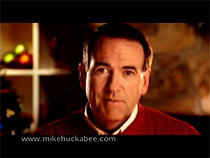 In 2008: Mike Huckabee’s Christmas campaign ad featured a bookcase in the background which resembled a cross. There was some debate in the media over whether or not the cross was a subtle but deliberate attempt at using transfer. Of course, Governor Huckabee’s statement in the ad that “what really matters is the celebration of the birth of Christ” is a much less subtle attempt to further align himself with the church.









 As I was wading through this week’s issue, I realized that whoever writes the headlines (the copy editor, I think) has an interesting sense of humor and a penchant for puns and cultural references. Some of the headlines are better than others. I went through the stack of unread issues that’s been piling up in the living room and picked out some of the best and the worst headline puns and references from recent weeks. Whether you think they are the best or the worst probably depends on whether you like puns. Here are some examples:
 Nearly every episode of the 1970s sitcom
  Occasionally during downtime on a particularly slow photo shoot, I’ve played this game with my assistants. Everyone takes out a piece of paper, and numbers it from 1 to 50. Then you get 10 minutes to write down every state you can remember. Finally, you compare it to the master list and see who got the most answers. 10 minutes seems like more than enough time to remember a list of 50 items, right? And yet somehow I’ve never managed to get more than 48 of them.
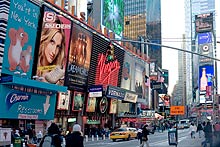 Sometimes I get dangerous thoughts in my head, like “I wonder what it would look like to see every ad in Times Square all on one page.” So when I knew I’d be passing through Times Square this weekend, I made sure I had my camera. For the purposes of this nearly purposeless project, I considered storefront signs the same as ads if they were flashy and glitzy like Times Square ads tend to be.

















 Shoulder the burden.
 Each “-ist” website has its own cute logo following the same theme: a few sillhouettes of buildings, other architecture or landmarks, followed by “citynameist.” Each one also features a different colorful background. The original Gothamist logo, above, was designed by Sam Park, of










 The radio station 1010 WINS is for New York City what CNN Headline News is for cable television. It’s just nonstop headlines, weather, and traffic, repeating every 22 minutes. Their slogan is, “You give us 22 minutes, and we’ll give you the world.” Their website,
  The crown jewel of the 1010 WINS Art Collection is Peace Grannies on Trial for Times Square Protest. For
  It’s a classic struggle for every artist. How do you illustrate a
  The influence of conceptual artist
  Nearly five years after the tragic events of September 11, 2001, audio tapes were released featuring conversations between 911 operators and people trapped in the World Trade Center. For the event, the 1010 WINS artist created this commemorative work. On the day the tapes were released, a cell phone was so clearly important — a modern technological luxury but also an icon of this day in history — that it seemed like an object as large as the towers themselves. Or perhaps slightly larger, in black and white, looking a bit like it was photocopied and then faxed a few times before being scanned in for a montage.
 The ashy, veiny hand reaches out, gas pump nozzle in hand, a stream of “S”es pouring forth from its spout like precious drops of gasoline. Together, the hand and pump give off an eerie glow as Honest Abe looks onward, his gaze obstructed by an exaggerated dot screen. George Washington is barely visible, shrouded by an orange shadow of depression. The
























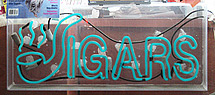

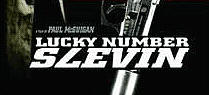



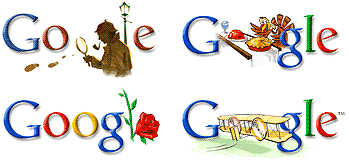

 The poster for Adam Sandler’s new movie Click asks the question, “What if you had a universal remote… that controlled your universe?”