I'm a professional photographer, but sometimes I get ideas for projects, designs, gadgets, and other topics. I write about it all on this blog. You can find the meaning behind the name “Ironic Sans” back in the very first post.
David Friedman Photography
When I'm not writing the blog, I make a living as a photographer. This is my photography website.
You are reading all the entries posted to Ironic Sans in the “Advertising” category. If you are looking for something specific, you may try searching in the Ironic Sans archive.
Idea: A Plug-in That Throws Out the High and Low Score Reviews
This summer the New York Times reported that, by one estimate, a third of all consumer reviews online are fake. And 1-star reviews are often misguided or misplaced anger, which can make them pretty much useless. So some suggest that the best thing to do when looking at consumer reviews is ignore all the 5-star and 1-star reviews, and just concentrate on the middle reviews, since that’s where you’ll find the substance. I’ve seen it compared to how some Olympic events throw out the highest and lowest scores to find the true score of a gymnast or diver.
So here’s an idea: how about a browser plug-in that does that automatically? I’d like one that hides the 5-star and 1-star reviews on Amazon, TripAdvisor, and the like (are Apple App Store reviews were available on the web?). But maybe too little data is front-facing, making it impossible without deep access to databases that aren’t publicly available. So I’ll settle for toggles added by the retailers themselves that allow me to turn on and off the high and low reviews.
This is the Best Idea Ever! ★★★★★. I would definitely read this post again!
I saw this ad on the subway yesterday. I haven’t visited the site, but I assume it’s part of a viral marketing campaign to keep Community on the air.
Okay, now I’ve visited the site. They’ve built a pitch-perfect imitation of a mattress-cover company’s website. I’m not sure what it has to do with Abed, but I’ll bet if I dig deep enough I’ll figure it out. It must be some sort of meta-ironic-pop-culture-referencing thing. That’s so Abed.
Now here’s a timely parody. It combines elements of a popular t-shirt from 2001 that’s already been parodied to death and a movie from 1969 about swingers that you probably haven’t seen.
But it’s been rattling in my head begging to be done, so here it is:
Now, it’s possible this has already been done. I mean, what else in popular culture is already set up as four names with ampersands between them? It’s almost as though the movie title was meant for this parody. But if so, I couldn’t find it. However I’m pretty sure that my other idea for a Bob & Carol & Ted & Alice poster parody hasn’t been done. I couldn’t even bring myself to do it. It was going to be Bobby & Carol & Greg & Alice. Yeah, I know. (Bonus: just as timely!)
Interestingly, the original movie poster for the film was entirely typographical, having no photos or illustrations. Just the title repeated in Cooper Black with the tagline “consider the possibilities.”
You’ve probably noticed QR codes in ads, real estate listings, and band fliers around your town. They look like broken checkerboards or crossword puzzles, with black squares and white squares placed seemingly at random. The idea is that you’ll use your phone’s camera to scan the QR code, and reveal a URL, phone number, or message about the advertiser.
At SXSW this year, I noticed that they were everywhere. Surfaces were covered with fliers and stickers that all featured QR codes. People wore t-shirts promoting their company on the front, with a big QR code on the back. Did people actually bother to scan the QR codes with their phones? I have no idea. But I wished I had the forethought to bring my own fliers or stickers with totally useless QR codes to post hidden among the noise.
So I’ve come up with some useless QR codes just right for stickers and fliers. Maybe you’ll have an opportunity to use them before I do.
You can scan these with your phone (try an app like RedLaser for iPhone or Android) to reveal the messages the way other people will see them. Or, hover your mouse over the code for a second to reveal the encoded message.
Product Placement in Amazon Reviews for Related Products
This is either a real thing, or it’s all in my head. If it’s a real thing, consider this post an exposé that’s blowing the lid off of this new form of subversive advertising. If it’s all in my head, consider this post an innovative idea that creates a new form of effective advertising that has the unfortunate side effect of ruining the product review system.
Companies have already been caught placing fake reviews on Amazon. Sometimes the fake review is just one degree from the product — that is to say, the reviewer works for the company being reviewed. Sometimes a fake review is two degrees away, which makes it harder to spot; for example, Belkin was caught hiring people on Mechanical Turk to write the fake reviews, so the reviews don’t come from people who work for the company. Other companies have offered gifts in exchange for positive reviews.
But what if they could remove themselves by one more degree? What if there were a way to make it almost impossible to even notice that it’s a fake review? What if even a negative review would work as well as a positive one? Nobody would suspect a fake negative review! It would be almost untraceable! It’s the perfect crime.
I have a home theater system that needs speaker mounts. So, naturally, I turned to Amazon and looked at several options. As far as I could tell, no particular speaker mount is that much better than any other. But I did notice something strange, as I read the reviews: an astonishing number of people who review speaker mounts happened to mention that they bought the mounts for their Onkyo HT-6100 speakers.
This is a versatile sturdy product. It works well and I recommend it for a lower cost mount. I mounted the Onkyo HT-6100 speakers on this and it worked great. The extentions that come with the mount really came in handy for my speakers. -David B
I used these with an Onkyo HT6100 HTIB system, and everything worked out fine. I was a little worried at first because the mounts are plastic, but they were plenty strong enough to handle the Onkyo speakers which are about 12 inches tall. Good mounts at a good price! -Nick
Excellent product. I brought this product from Amazon after reading several positive review comments. Product arrived on time. I have brought Onkyo HT-S7300 home theater from Amazon and excellent product to mount the satellite speakers on the celling. My wife loved it. I hired a contractor to install the satellite speakers even he was surprised the excellent flexible positioning of the speakers with this product. This product comes with all types of screws you need to mount the satellite speakers. -Uday
It doesn’t even matter if the speaker-mount review is positive or negative, because that’s not a reflection on the Onkyo speakers. The important thing is just to mention Onkyo speakers. Here’s an example of a negative review that still shows Onkyo in a positive light:
Not good for medium-large size speakers, not fully compatible with Onkyo speakers. I would suggest investing more and get better mounts. -M. Al Rawi
Maybe it’s just a coincidence that so many people mention their Onkyo speakers make and model in their review. Maybe it’s helpful information to give. And maybe Onkyo is more popular than I realized. It certainly isn’t the only brand I saw mentioned in the reviews. It’s just the one I noticed the most. So maybe there’s nothing subversive going on at all. That’s probably the case.
But I can tell you this: Onkyo was never on my radar before. Now I have the impression that a lot of people seem happy with their Onkyo HT-6100. So either this new form of subversive advertising is incredibly effective, or this non-form of non-subversive non-advertising (I think they call it “word of mouth”) happens to actually work.
Now that this idea is out there, how long before we see fake book reviews that happen to mention the eReader the reviewer read it on? Or fake large-screen TV reviews that happen to mention how good that new movie that just came out on DVD was? Or fake bicycle reviews that mention how easily it fits in the roomy trunk of a particular new car?
I’m pretty good when it comes to grammar, but my wife is better, as I’m reminded every time I misuse the word lay and she corrects me. Some bad grammar sticks out like a sore thumb for me, but lay/lie misuse goes past me every time. My wife never fails to catch it, and she seemed to be pointing out lay/lie misuse every time we watched Mad Men. We wondered whether it’s the fault of the actors, or if they’re saying the lines faithfully as they’re written.
I decided to turn it into a learning opportunity. If I could catch every use and misuse of lay and lie in every episode of Mad Men so far, surely that would pound the lesson so firmly in my brain that I will never confuse the words ever again.
And so I made the video embedded above. Here is a list of every quote, from each episode in the first three seasons, in the order they appear in the video:
2.10 Joan: “Go ahead. Lay down. I’ll keep the drunks away.” (incorrect)
3.06 Joan: “Go lay down.” (incorrect)
1.10 Peggy: “Maybe you need me to lay on your couch to clear that up for you again.” (incorrect)
2.05 Peggy: “Do you mind if I lay down?” (incorrect)
2.05 Peggy: “I have to lie down” (correct)
1.03 Betty: “I’m going to go and lay the kids’ food out.” (correct)
3.01 Pete: “I should just lay down and we should run together holding hands.” (incorrect)
3.08 Pete: “I’d lie in bed at night, hear horses going by.” (correct)
1.13 Pete: “I think I should lie down.” (correct)
2.02 Don: “I’m going to lie down for a minute.” (correct)
2.12 Don: “Can I take a shower and lie down?” (correct)
2.10 Don: “Do you want me to lay everything out for you?” (correct)
3.09 Don: “I’m going to go lie down.” (correct) [Note: The subtitles for episode 3.09 say that Don says “I’m gonna go lay down” which is incorrect. But it sounds a lot to me like he says “I’m going to go lie down,” so I gave him a pass.]
3.11 Don: “I’m going to lie down.” (correct)
3.12 Don: “Take a pill and lie down.” (correct)
2.08 Ken: “You need someone to lay down on the barbed wire so you can run over them.” (incorrect)
3.07 Henry: “Victorian ladies would get overwhelmed. Corsets and things. They’d need a place to lie down.” (correct)
1.04 Client: “I hate to be a pain in the ass, but if they didn’t just lay there so flat.” (incorrect)
3.03 Carla: “Maybe you should lie down. Sally!” (correct)
2.04 Sally: “Do you lay on top of her?” (incorrect)
2.11 Jane: “I lay on my pillow at the Sherry-Netherland Hotel.” (incorrect)
2.03 Jennifer: “I need to lay down.” (incorrect)
2.04 Katherine: “And I don’t care if you have to lay there. Put your shoes on!” (incorrect)
2.04 Gerry: “I’m sorry, I’ve gotta lay down.” (incorrect)
3.12 TV: “Then Governor Connally, after slumping to the left for a moment, lay on the floor of the rear seats.” (incorrect) (correct) — My mistake. The reporter is speaking in past tense.
I originally included three clips that I later decided to remove:
In episode 3.01, Sal says, “Our worst fears lie in anticipation,” which is correct. But he’s quoting Balzac so I wasn’t sure if he should get credit for it. In fact, he even follows up the line by pointing out, “That’s not me. That’s Balzac.” (The actual Balzac quote is “Our worst misfortunes never happen, and most miseries lie in anticipation.”).
In episode 3.05, Don uses the same Balzac quote after hearing Sal say it. Again, I was unsure whether or not to include it for the same reason. But I did like that the character he’s talking to replies, “Are you sure about that?”
In episode 3.09, Sal says, “I think if I get away from Lucky Strike and lay low from Roger for a day or two, everything will be fine.” I wasn’t sure if the common expression lay low is grammatically correct or not. So I looked it up. Dictionary.com says that lay low means to overpower or defeat (as in “to lay low one’s attackers”). The phrase Sal should have used is lie low which means to conceal oneself (as in “Until the dispute is settled, you would do best to lie low.”). So Sal’s usage is technically incorrect. But “lie low” falls strangely on my ears, and lay low is a common enough expression that I couldn’t decide whether to give it a pass or not, so I chose to simply not include the clip at all.
I don’t want to encourage marketing people to send me stuff hoping I’ll write about it, but this is a particularly nice bit of marketing so I think it deserves a mention. It’s creative, and has a personal touch.
The team behind the upcoming movie Coraline has sent 50 handmade boxes featuring props from the movie to 50 different bloggers. I’m the recipient of Box #40, made from an old cigar box:
I admit, it was pretty cool to get the box and wonder what it contained. I won’t keep you in suspense:
It contains 3 headless dog bodies. Somebody else got the dog heads. It also contains one glittery halo, and still images from the movie scenes in which these objects appear. There is also this quote printed on a piece of paper: “She heard a shuffling noise, and a light came toward her, swinging from side to side. When it was closer she saw the light was coming from a flashlight being carried in the mouth of a large black Scottie dog, its muzzle gray with age.” -Chapt. IV
Not all 50 boxes have turned up yet, but NOTCOT has a pretty good roundup of those that have.
Back in November, 2006, I posted an idea for a commercial I’d like to see. Some time later, I was contacted by Ethan Cushing who wrote, “I am a director trying to expand my reel and would love with your permission to hire a crew, rent some great HD cameras, and film [this].”
So without further ado, I now present… the commercial:
Nice work, Ethan! Going back and reading my original post, I was surprised to realize that he more or less used what I wrote verbatim. If I’d known that would happen, I would have spent more time crafting the dialogue.
Incidentally, I’d still love to see this battery commercial concept turned into reality. It would require a bit of F/X trickery, I think. If anyone wants to take it on, go for it.
“You see us as you want to see us, in the simplest terms, in the most convenient definitions. But what we found out is that each one of us is a leprechaun, a monster, a cap’n, a tiger, and a rabbit. Sincerely yours, the Breakfast Cereal Club.”
With the first major Presidential primaries already behind us, the election year is officially under way. This November, the President, Vice President, one third of the Senate, and the entire House are up for election. Between now and then, we’ll see dozens of debates, thousands of ads, and hear mixed messages from various groups, pundits, candidates, their former co-workers, their third grade teachers, former lovers, and anyone else who can be pulled out of the woodwork to support or tear down a politician. So I figure this is a good time to review the 7 Common Propaganda Devices that were identified by the Institute for Propaganda Analysis (IPA) way back in 1937 and see if we can find them in use today.
1. GLITTERING GENERALITIES
The IPA used this term to describe virtuous words that mean different things to different people, but are used in such a general way that you can project your own meaning into the speaker’s words. So when people talk about freedom, strength, Democracy, or patriotism, you are likely to assume they think of those words the same way you do.
In 2008: It’s almost like this Mitt Romney ad was made just to demonstrate use of glittering generalities:
Remedy: When you hear someone speaking in glittering generalities, the IPA recommended that you stop to ask whether or not the idea being pitched is really a good one, or if it’s just being sold to you through association with words you like. If you take those words out of the equation, is the substance of what’s left still any good?
2. NAME CALLING
“Name calling” is a technique where someone uses words to link a person or proposal to a negative or emotionally charged symbol. The idea is to get you to reject the person due to the association with the symbol rather than actual evidence, which may or may not be there. Words like flip-flopper, radical, terrorist, and even liberal are contemporary labels that might qualify as name calling.
In 2008: The Annenberg Political Fact Check recently reported that e-mails have been circulating calling Barack Obama a racist and a radical Muslim. Neither claim seems to be supported by evidence, but aims to associate the Senator with negative views of racists and Muslim extremists.
Remedy: The IPA recommended that when you hear name-calling, you should stop to consider what the name means, whether or not it is being legitimately applied, and what the person or idea’s merits are without the name.
3. TRANSFER
There are institutions and objects that you have positive associations with, so politicians try to appear with symbols of those institutions in the hopes that you will transfer your positive associations onto them. For example, by standing in front of American flags or next to a cross, a candidate hopes that your positive associations with those symbols will be transferred to them. Transfer can be used for positive associations or negative associations, depending on the symbol and intent.
In 2008: Mike Huckabee’s Christmas campaign ad featured a bookcase in the background which resembled a cross. There was some debate in the media over whether or not the cross was a subtle but deliberate attempt at using transfer. Of course, Governor Huckabee’s statement in the ad that “what really matters is the celebration of the birth of Christ” is a much less subtle attempt to further align himself with the church.
Remedy: The IPA suggests that when you notice transfer in use, you ask what the merits of a person or idea are without the transferred associations, and whether or not there is a legitimate connection between the person or idea and the thing from which the person is attempting to transfer some association.
4. TESTIMONIAL
The IPA pointed out that sometimes citing a qualified source is a good way to emphasize a legitimate idea. But you should consider whether or not the source being cited is really qualified to make judgments about a particular issue.
In 2008: Barack Obama has received endorsements from Oprah Winfrey, Jennifer Aniston, Will I Am, and Jessica Beil. Hillary Clinton has Magic Johnson, Jenna Jameson, and Rob Reiner in her camp. Kevin Bacon endorses John Edwards. Bo Derek, Adam Sandler, and Kelsey Grammar have all come out for Giuliani. Chuck Norris has got Mike Huckabee’s back. Mitt Romney has the support of both Osmonds. And John McCain is endorsed by, um, Wilford Brimley. (source)
Remedy: The IPA recommended that, when considering endorsements like these, you ask what makes the individual qualified to be an expert on the subject in question. Does Oprah know what’s best for the country? Does Kelsey Grammar have more insight than you do? The IPA suggested that you should consider the merits of the person or idea without the testimonial.
5. PLAIN FOLKS
The “Plain Folks” technique is at work whenever a speaker promotes the idea that he or she is “of the people,” just an Average Joe despite the fact that he or she may go home to a mansion at the end of the day.
In 2008: John Edwards is fond of pointing out that he is the son of a mill worker. Several candidates have eschewed a suit and tie on the campaign trail in favor of a sweater and blue jeans. And Mitt Romney perfectly illustrates the technique in this campaign ad showing him as just a regular family guy. He does dishes, just like you!
Remedy: When you see examples of the Plain Folks technique at work, try temporarily ignoring the candidate’s personality, and just think about his or her ideas. Do they still sound good?
6. CARD STACKING
“Stacking the deck” is a gimmick used by magicians where a deck of cards appears to be randomly shuffled but is in fact arranged in a specific way. The IPA borrowed the term to describe a technique where only one side of a topic is favored, or another side is ignored or played down.
In 2008: Fox News is accused of having a right-wing bias, selectively reporting on issues that support a right-wing agenda. Similarly, PBS is accused by some of having a left-wing bias . And Ron Paul supporters have been shouting that the entire mainstream media has an anti-Ron Paul bias, downplaying his successes in the campaign.
Remedy: It can be difficult to recognize card stacking, because the viewer does not always know what other arguments are being ignored. If you don’t know about Ron Paul, for example, you wouldn’t know that he isn’t being represented in some discussions of the candidates. But by seeking out different media outlets with various viewpoints, you can get a more well rounded view of the issues.
7. BANDWAGON
The idea behind the Bandwagon technique is that, since everyone else is doing it, so too should you. There is a bit of showmanship involved in hyping the bandwagon, filling halls with supporters, playing music to get everyone excited, and waving colorful banners. Often the appeal is directed towards groups that already share a common tie based on religion, race, gender, etc. Studies have shown that the bandwagon effect really does work in elections. In the current race, the media reports poll results consistently, telling us who women are voting for, who blacks are voting for, who Christians are voting for, etc.
In 2008: The New York Times reports today that Barack Obama is increasingly being viewed as being electable among Democrats. In fact, the Times reports that “The percentage of Democrats who say he would be the strongest candidate against the Republicans has more than doubled in a month.” If enough Democrats hear that their fellow Dems feel this way, we may expect his electability rating to increase even more, based on the bandwagon effect. In a similar vein, there is sometimes an underdog effect at work, also. Many people want to vote for the winning team, but others like to throw support to the underdog. And the recent New Hampshire primary showed that the declared front-runner doesn’t always win anyway.
Remedy: The IPA recommended that, when you notice the bandwagon effect, you stop to consider whether or not you should support an idea or candidate regardless of the fact that others do. Does the person or idea really serve your individual and collective best interests?
These 7 techniques were identified by the IPA 70 years ago, but other techniques could be mentioned in this context including the use of fear, a technique employed to great effect in recent years. More information on propaganda techniques can be found at propagandacritic.com.
I enjoy satellite radio as part of my mix of audio news and entertainment, which includes satellite, broadcast, and podcasts. But I was a bit surprised when Sirius sent me an advertisement this week which asked:
…and answered the question with this chart (I’ve put a red box around the portion that intrigued me):
Really? NPR isn’t available on FM or AM or MP3? Then what are those podcasts I’ve I been listening to when I miss my local broadcast?
Back in March 2006 I wrote a post suggesting that airlines could use the blank panels on the overhead bins as advertising space. I made a mock-up of what this ugliness might look like:
An alert leader pointed me to news that came out this summer: Ryanair — Europe’s largest low fare airline — has just put this into practice. Here’s a quote from their press release:
We are delighted to be the first Brand to market with this new advertising medium… The Aeropanel® offers a unique and exciting advertising format in an uncluttered, relaxed and comfortable environment
Sure, I’ve seen book covers that identify the book as “A Novel.” But I never realized just how ubiquitous it is until a recent visit to my local brick and mortar bookstore. It’s on practically every novel! All of the below images are details from the covers of books currently on the New York Times Bestseller Lists for hardcover or trade paperback fiction. You can click on each image to see what book it’s from:
I guess just being a work of fiction isn’t enough anymore. You have to emblazen your book with a category on the cover so the book superstore employees know where it belongs. I can’t count how many times I’ve seen Hermann Hesse’s Siddhartha wind up in the religion section.
Back in January, I decided to take photos of every advertisement in Times Square. So when I was walking through Times Square the other day and I saw these billboards, the likes of which I’ve never seen in that part of town, I figured it would make a good follow-up post:
The way I see it, companies have about a week or so left in the life of the lolcat meme to come up with some clever ads that use the lolcat format. I think for the most bang for their advertising dollar, the campaign should probably appear in college newspapers or someplace else where the fewest people possible will be scratching their heads in confusion.
Take a pizza and burger joint, for example. They could start with a picture of a pizza delivery guy, with the caption “I’M IN YOUR NEIGHBORHOOD, DELIVERING YOUR PIZZA” or it could have a picture of a burger and fries with the caption “YES YOU CAN HAS CHEEZBURGER.” Okay, they could probably come up with something more clever than that. But it would give me a chuckle to see a company incorporate an on-line meme into their ads without referencing where it came from. It would be sort of an inside joke among the internet savvy.
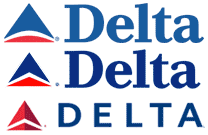
Changes in Delta*Earlier this month, Delta launched a new ad campaign called “Change,” along with a new logo. Even before the launch, I’d found myself recently appreciating the logo for features I’d never noticed before. Somehow it had never dawned on me that, in addition to being an abstraction of an airplane’s wings, the actual shape of the logo is a triangle — the Greek letter Delta. Maybe it’s not as brilliant as the FedEx arrow but I like it.
The new red version of the logo has been promoted with a new ad campaign by SS & K. The campaign highlights all the changes recently made at Delta. The ads say things like “CHANGE IS: TXTING U UR FLT STATUS” or “CHANGE IS: NEVER BEING BORED ON BOARD.” I saw one ad that summed up the campaign’s theme as simply “CHANGE IS: DELTA.”
And that’s when I realized: Delta really is change. In physics, the Greek letter Delta is used to indicate change. For example, a simple formula for calculating a change in velocity might look like this (taken from this article about deltas in physics):
This would be read as, “The change in velocity is equal to the second velocity measurement minus the first velocity measurement.”
So is this an intentional double entendre meant to be appreciated by science and math nerds only? Or is it just serendipitous that Delta really does mean change, and that happens to be the word they based their campaign around? I’m not sure. But I appreciate it either way.
* I almost captioned this image “Can I help ya help ya help ya?” but thought it might be too obscure.
A mattress company should do a commercial playing off the “Princess and the Pea” story by Hans Christian Andersen. In the original story, a prince seeking a princess to marry is visited by a young woman claiming to be a princess. Not sure whether or not she is telling the truth, the prince’s mother tests her by giving her a bed to sleep on with 40 mattresses, and puts a tiny pea under the bottom mattress. In the morning, the Queen asks the girl how she slept, and the girl complains that there was something hard under her mattress so she got a very poor night’s sleep. The queen knows that only a princess would have skin so delicate as to feel a pea through the mattresses, and marriage ensues.
The commercial should tell a 30-second version of the story, except in this one we see the girl lay down on a Sealy (or whatever brand) mattress, and when the girl wakes up she says she got a great night’s sleep — perhaps even the most comfortable night’s sleep in her life. To her dismay, the queen kicks her out, accusing her of being a commoner posing as royalty. We see the girl go sadly back to her own castle, so we know she was really a princess. It was just that darn Sealy mattress, so comfortable that even a princess couldn’t feel a pea.
A new mall called The Domain opened this weekend in Austin. The bizarre photo at right has been chosen to represent the mall in advertisements, brochures, and directories. Seriously, this might be one of the strangest photos I’ve seen used for something commercial. Or at all.
What has happened to the poor woman in this photo? What story does it tell? Has she had her legs cut off by an obsessed madman who’s keeping her captive on that table, like Sherilyn Fenn in the movie Boxing Helena?
Or maybe she’s one of those exotic mythical table-centaurs, with the body of a woman and the legs of a table. Wasn’t there one of those in The Lion, the Witch, the Wardrobe, the Desk, and Other Furniture?
Very bizarre. But she does make a lovely centaur-piece.
[Update: All the photos are now available in larger sizes on flickr.]
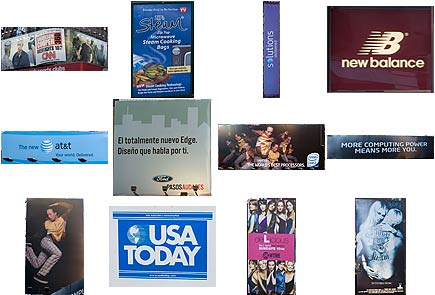
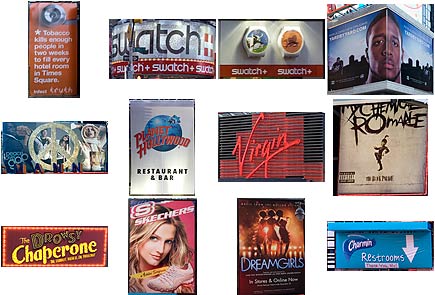
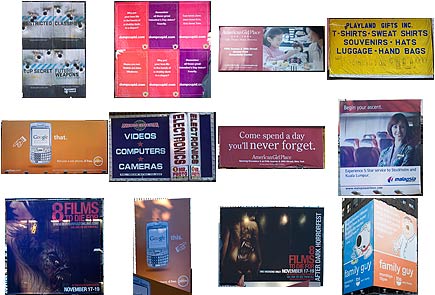
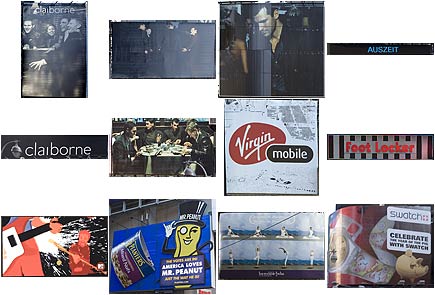
Sometimes I get dangerous thoughts in my head, like “I wonder what it would look like to see every ad in Times Square all on one page.” So when I knew I’d be passing through Times Square this weekend, I made sure I had my camera. For the purposes of this nearly purposeless project, I considered storefront signs the same as ads if they were flashy and glitzy like Times Square ads tend to be.
I’m sure I missed a few, and there may be some I got more than once. I do know that some appear to be duplicates, but are actually similar billboards in different spots. Also, if an ad took up more than one billboard, I usually shot each billboard separately, unless it was a wraparound billboard on a corner, in which case I tried to get it in one shot.
So without further ado, here is every ad in Times Square. More or less.
Right now, you’re probably thinking one of two things. Either you’re thinking, “Does that ad really say that there’s a musical version of Legally Blonde coming to Broadway?” or you’re thinking, “Someone has too much time on his hands.” Well, I can tell you, it took about 20 minutes to take the photos, and about 2 or 3 hours to crop the images while I was listening to the pundits on Sunday morning TV. It wasn’t as bad as I feared.
And yes, there is a Legally Blonde musical coming to Broadway. I don’t know what they’re thinking, either.
I saw these two advertisements side-by-side on the subway this weekend. They’re both part of the same “Take Care of Your Baby” public service campaign by the New York City Administration for Children’s Services, and the New York City Department of Health and Mental Hygiene. I couldn’t take a good photo that showed both ads side-by-side, so I took this short video instead:
The one on the left says, “Don’t leave him alone anywhere.” Then, right next to it, there is another ad that says, “It’s safest for him to sleep alone.” Hmm.
Part 18 in an ongoing series of (approximately) 60 second films.
I’m always fascinated every time they change this ad space. Instead of putting up a giant printed ad, like I see on other walls, this wall actually gets repainted by hand, sometimes in great detail.
A guy is showing his girlfriend his brand new flat screen TV. He’s beaming with pride showing it off. “Honey, this is the best flat screen TV money can buy. It’s a 1080p HDTV with dual HDMI inputs, and digital audio output. It’s got a 1200 to 1 contrast ratio. It has four different memory card expansion slots for viewing digital photos or playing MP3s, and it auto-uprezzes from 480 and 720 sources with bicubic interpolation. The blacks are ink black. The whites are paper white. And the color is as vivid as real life. Baby, I’m telling you. This is the Cadillac of televisions.”
Then we see the Cadillac logo, and their latest fancy car rotating slowly against a black background. “Cadillac. We set the standard.”
This could be a whole series of commercials like this featuring different luxury products. Clocks. Fine wines. Pianos. Each one would have a person — maybe the product’s owner, or a salesperson, etc — extolling the virtues of the product, and finally calling it “the Cadillac of” whatever it is. Everyone knows that “The Cadillac of…” is frequently used to express that an item is at the top of its class. So why shouldn’t Cadillac capitalize on that? I’m surprised they haven’t already.
Since Congress passed the Bipartisan Campaign Reform Act in 2002, candidates for federal office must state their approval of campaign ads. Most frequently, we hear the phrase, “I’m [candidate’s name] and I approve this message.” Sometimes, to make it less awkward, the statement is lengthened along the lines of, “I’m [candidate’s name] and I approve this message because it’s time to stop playing around in Congress, and time to start getting things done.”
Well I think an effective ad could be made that goes a step further and really embraces the “I approve this message” line as part of its campaign. It could go something like this:
“I’m John Candidate and I disapprove of the message this administration is sending the world by staying in Iraq. I disapprove of a the way the President is dealing with terrorism. And I certainly disapprove of the way Republicans are spending money with no regard as to who will pay the bills. It’s time to change the direction this country is headed. It’s time to remind the world through our actions that America is a noble country, a leader in ethics, economy, and education.
I approve of a plan to bring American kids back to school where they will recieve a top level education. I approve of getting health care where it’s needed most. I approve of helping Iraq get back on its feet and bringing our troops home. I approve of actions that send a message to the world that America is prouder, stronger, and safer than it ever has been.
I am John Candidate. And I approve this message.”
Of course, all those glittering generalities would be replaced by meaningful specifics and substance, but you get the idea.
I was recently shopping for paper at Staples when I had this thought: NBC should really license the “Dunder Mifflin” name to some paper company, and put it on real reams of paper. I don’t have brand loyalty when it comes to 8.5” x 11” paper, so it’s not like I can’t be persuaded to buy one ream over another. If I were buying paper at Staples and I saw the Dunder Mifflin brand name on a ream of paper, I’d totally get it. Just because it’s funny. Even if it cost a few cents more than the other brands.
They could even co-brand, for those people who haven’t heard of Dunder Mifflin or are afraid to try new things. The reams could say, “Staples [or some reputable paper company] presents Dunder Mifflin Paper” or something like that. And they could put a one-sheet ad for “The Office” in the packaging.
(Dunder Mifflin, for those who don’t know, is the fictional paper company whose day-to-day goings on are documented in the TV show The Office)
These days, everyone wants your ear. You’ve got Sirius, XM, terrestrial radio, podcasts, CDs, MP3s, and your cell phone all competing for your attention while you’re in your car. For advertisers, “drive time” is the most important time of day. That’s when most people are listening to their radios, and it’s when advertisers spend the most money hoping you’ll hear their ads. But if you’re listening to anything other than terrestrial radio, the major advertisers are losing out.
But who’s listening to terrestrial radio anymore? According to Bridge Ratings, the company that measures radio audiences, people are listening to terrestrial radio less and less in favor of their MP3 players and podcasts. So how can terrestrial radio get those listeners back? They’ve tried new music formats and talk formats, flipping stations from one to the other and back, but they’re still losing listeners.
So I suggest a new format. Well, an old one, really. Why not revisit the golden age of radio, when the airwaves were filled with comedy and drama, and people were captivated by their radios?
CBS owns lots of radio stations. They also own one of the most popular TV franchises running, CSI. So how about producing a radio-only version of the show? Call it “CSI: Drive Time.” If it’s compelling, people will sit through commercial breaks to hear the resolution. Detective shows were big on radio back in the day. They could be again today.
Sure, you run the risk of people trading episodes on-line with the commercials cut out, like they do today with TV shows. But old time radio had entire shows sponsored by particular products, and so can modern radio. “Johnson’s Wax Presents CSI: Drive Time” isn’t too long a name, is it? And commercial breaks can be done by the radio program stars, just like they used to, integrating the commercial into the program.
“CSI: Drive Time” could be followed by last night’s Late Show with David Letterman. It’s already been recorded. Why not replay it for people who missed it? The production cost there is pretty much zero.
ABC Radio could have special radio-only episodes of LOST, which is owned by ABC. These episodes could feature characters on the island that we don’t see on the TV program, but whose stories would intertwine with that week’s episode. LOST has so many fans, they would surely stay tuned in through the commercial to hear what happens next.
And then there’s the old standby, the Sitcom. Radio-only sitcoms would be great. They could even be performed live in front of an audience, just like in the old days. If it’s a big hit, you could probably even make the leap from radio to television, having a built-in audience of fans who listened to the radio show.
As someone who grew up listening to recordings of old time radio, wishing I had been around at a time when I could have listened to them as they were broadcast, I would absolutely tune in to a station like this.
Recently announced in partnership with CafePress.com, New Line Cinema is encouraging anyone and everyone to become an official licensee of merchandise for the upcoming movie Snakes on a Plane (which, if you haven’t heard by now, promises to be exactly the sort of movie you think it will be based on that title). Most of the movie’s buzz has already come from movie fans on the internet resulting in a flurry of free publicity for the film, and there are tons of unofficial products already out there. So it makes sense that New Line continues to take advantage of the hype with this promotion that lets you say you’re an “official” licensee.
Well, this weekend I had some blank paper and some art supplies and a little free time, so news of the CafePress deal inspired me to join the bandwagon and come up with my own Snakes on a Plane inspired design. I call the resulting picture “Plane in a Snake.”
I wasn’t sure I would actually do anything with it — I’m not generally a “join the hype” type — but as it turns out I like how it looks on the shirts. I think my favorite product might be the baby bib featuring the Plane in a Snake. But even if you don’t have a baby in need of a bib, check out the store anway, where you can find the drawing on a variety of stylish shirts and other fine products like these:
Have you heard about all the problems New Jersey has been having coming up with a motto to attract tourists?
First, the state paid $260,000 to a consulting firm to come up with a slogan. They came up with, “New Jersey. We’ll win you over.” It was quickly rejected. Then the state held a contest to come up with a new slogan. The big winner was “New Jersey. Come see for yourself” submitted by Jeffrey Antman of Passaic, New Jersey. Well, a couple months ago they scrapped that one too after realizing that other states have used it in the past.
The consulting firm was on the right track in recognizing that many potential tourists have a negative view of New Jersey, and a good slogan could help people get over that hump. But “We’ll win you over” doesn’t convey that there’s anything good about the state. It almost reinforces the idea that it’s overrun by mobsters who will get you to like the state one way or another.
So I’ve come up with a slogan for New Jersey that I think captures the spirit of the state, and may entice people to visit who wouldn’t consider it otherwise. Imagine a whole campaign showing the lush vegetation, beaches, concerts, quaint little towns, and, well, whatever else they have there across the Hudson. And the slogan reads:
“New Jersey. It’s not what you expect from New Jersey.”
You like that one, New Jersey? Okay, so maybe off the bat you think it’s not positive enough. Now imagine it said in a really upbeat tone by someone like George Clooney. You like it now, huh? Well, you can have it for the low price of only $25,000. And I guarantee that no other state has used it.
Am I the only person who looks at this IBM ad and sees a depiction of the World Trade Center after the first tower was hit on the morning of September 11, 2001? This explosive image that I guess is supposed to express creativity or something looks to me more like smoke and flames rising from the tower, just moments before the second tower was struck.
Is it as blatantly obvious as I think it is? Or is it just that I made the association because I saw this ad displayed poster-size and back-lit at my departing gate at the airport?
Update: Wow. Judging by the almost 50 comments so far today, I guess this isn’t going to go down in history as my most successful post ever. Fark.com sent lots of people my way, and some Farkers can sure be vicious in the comments (welcome to my site, Fark readers — I hope you explore the rest of it while you’re here). Just to be clear, I’m not someone who sees 9/11 imagery everywhere I look (or faces on Mars, etc). And I certainly wasn’t offended by the ad. I too am bothered by people who confuse simply being reminded of a tragedy with actually being offended by whatever triggered that memory. I just thought this particular ad looked so obviously like the twin towers to me that its placement at the airport of all places could have been thought out a bit better. But people see all sorts of things in different ways, and I guess I’m not in the majority with this one. At any rate, you can read on in the comments to see lots and lots of people who disagree with me, and a few who agree. But be warned: Some of the less mature Farkers’ responses may not be suitable for (but perhaps were written by) young children.
This bus drove by me on Friday. I think it must have gotten here accidentally from some Parallel Bizarro Earth 2 on the exact opposite side of the sun from us, where everything is just slightly different from our own planet. In this parallel world, uptown means downtown, Rockefeller Plaza has a roller skating rink, the Chrysler Building is taller than the Empire State Building, taxis are purple, and — as shown on the side of this bus — the Statue of Liberty holds her torch in her left hand instead of her right. How it reached our world I’ll never know.
But it got here just in time for Independence Day. Happy Fourth of July, everyone.
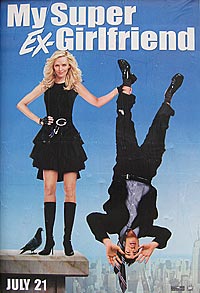
When I saw the poster on the left for Uma Thurman’s upcoming movie My Super Ex-Girlfriend, I immediately thought, “Oh my God. Poor Uma. Someone did an awful job grafting her head on a totally different body.” Then I saw the poster on the right, and I did a double take. Someone grafted the exact same head onto this poster, too. If they weren’t going to do a good job, couldn’t they at least make it less obvious that it’s the exact same head? And I think her (body double’s?) breasts are bigger in one shot than in the other.
If you want to see just how exactly matched the heads are, click here to watch a little animation.
Hmm. “Uma Thurman’s Severed Head” would make a great band name.
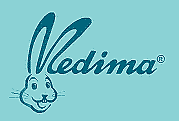
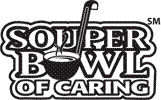
I’ve been noticing logos lately that have replaced letters with pictures. I think it’s fascinating how the brain just fills in the blanks, whether or not the pictures actually resemble the letters they replace. Various studies have shown that we don’t look at the letters which make up words as much as we look at the shapes of the words as a whole. In fact, it deosn’t mttaer in waht oredr the ltteers in a wrod are, the olny iprmoetnt tihng is taht frist and lsat ltteer is at the rghit pclae. The brain just takes care of the rest.
Here are examples where the letter isn’t completely gone, but a picture is formed by stylizing and embellishing a letter:
And here are examples where the letter is totally gone, completely replaced by a picture that resembles the missing letter:
It probably helps that the picture in the word is often a representation of the word itself. Something like the Stroop Effect may be going on here (or maybe the opposite of the Stroop Effect, whatever that would be called. The Poorts Effect?). Take this example, for instance:
The strawberry doesn’t look anything like the letter “a” but we know what letter is supposed to go there because we recognize the rest of the word, and after all, it is a picture of a strawberry.
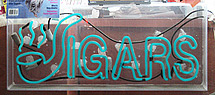
This is one of my favorites:
We know it’s supposed to say “CIGARS” even though the picture neither looks like the letter “C” nor depicts a cigar! Perhaps the association with some tobacco product is enough.
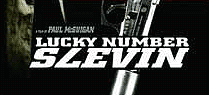
And then there are the movie logos that replace letters with numbers:
And of course movie logos that replace numbers with pictures:
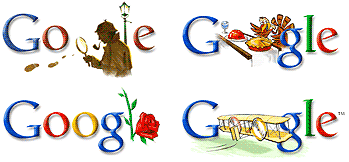
But Google takes the cake. They frequently swap out their traditional logo with one paying to tribute to a holiday or celebrity birthday. Their substitute logos often replace letters with picture, relying on our familiarity with the Google name and logo. They use color to remind us of the original logo, too.
And the granddaddy of all is this Google logo celebrating the Persian New Year. Only one letter remains as a reminder of the original logo:
This weekend I saw a poster advertising the new Coca-Cola Blak, some sort of Coke-and-Coffee hybrid.
I went through what must be the usual response to seeing this new product, an assortment of comments involving the word “gross” and mentions of Pepsi AM and Pepsi Cappuccino.
But then I looked more closely and was shocked at what I saw. Is that a Pepsi logo on the bottle of Coca-Cola Blak?
Am I seeing things? It is a slightly distorted Pepsi logo, right? I mean, I’m sure it’s supposed to be some sort of riff on the Coca-Cola swooshy ribbon thing, but it sure looks like a stylized Pepsi logo to me. Will this go down in history as another great Cola Packaging Snafu?
The poster for Adam Sandler’s new movie Click asks the question, “What if you had a universal remote… that controlled your universe?”
Well, that’s an intriguing question. For the answer, maybe he should have just asked one of these people:
The main character from the 1985 episode of Steven Spielberg’s TV show Amazing Stories called “Remote Control Man.” The plot: “An unhappy and frustrated husband with a nagging wife and an incorrigible son, finally finds solace in his new TV set that comes alive with the use of a magic remote control.”
Pete from the British Australian kids’ show Round the Twist. Here’s the plot of a 1990 episode called “Spaghetti Pig Out”: “Chaos reigns after a bolt of lightning hits the video remote control - it works on people! Pause, rewind and fast-forward have amusing consequences.”
Benny Hill. His Golden Classics DVD contains a skit called “Henry’s Remote Control” in which “Benny discovers he can control the real world with his remote control and sets off on his journey, leaving his nagging wife in ‘freeze-frame’ mode.”
George Jetson. In a 1985 episode of The Jetsons, “George Jetson happens to sit next to a brilliant, but unrecognized genius. This genius has invented the one-of-a kind Re-Play-Ola. The genius decides to give it to George because the genius can always make another one. The Re-Play-Ola has the ability to rewind time, allowing the person who possesses it, the ability to rewind, modify, erase, and the unusable stop button.”
The main character from Rewind, a 1999 Spanish movie about a man who has a party that “doesn’t go terribly well — food gets burned, things get broken, Pablo makes a scene — and later in the evening, Andres nearly finds himself regretting that he videotaped the entire evening. However, when he rewinds the tape, much to his surprise he finds he can rewind real life as well, giving him a chance to salvage the party after all.”
Bart Simpson, from the Simpsons episode “Treehouse of Horror IX”, where a plutonium-charged remote control has the power to send him and Lisa into episodes of their favorite — and least favorite — TV shows.
The kids from the movie Pleasantville where a fight over a magic remote control sends them into the world of their favorite old black and white TV show.
Ned from the 90s Fox Kids cartoon Ned’s Newt. In a third season episode called “Remote Possibility,” Ned recieves help from “a magical remote that doesn’t work on televisions but does seem to work on everything else.”
The kids from Eerie, Indiana. In an episode called “Scariest Home Videos,” a magical remote control sends them into an old black and white mummy movie.
R.L. Stine. He wrote a short story called “Click” for his Goosebumps books that was eventually adapted into an episode of the Goosebumps TV series. From tv.com: “Seth Gold is sick of being ordered around by his sister, his mother, and his father. His hobby is channel-surfing, so he orders a remote from a company in a magazine… Seth notices it can also be used to change the radio station… As a joke, Seth presses the Pause button while aiming the remote at his sister. His sister actually pauses! Seth now realizes this new remote can control more than just the TV.”
I guess there just aren’t any original movie ideas anymore. Maybe something good is on TV. Now what did I do with my remote…?
Am I the only person who can’t look at this Marriott advertisement without thinking of Johnny Eck?
Johnny Eck, of course, was the talented performer billed in circus sideshows as “The Only Living Half Boy.” An actor, magician, painter, and photographer, Eck is famously featured in the Tod Browning movie Freaks.
More information about Johnny Eck can be found at the excellent Johnny Eck Museum, an on-line tribute complete with biography, photos, answers to the usual questions, and more.
Remember the last commercial idea I had? Well I like this one even better. Okay, picture this:
The commercial begins with a shot of a bedside alarm clock. There’s a cell phone next to it. The alarm clock turns from 6:59 to 7:00 and the alarm goes off. A woman’s hand turns off the alarm, and the cell phone immediately rings. The hand grabs the phone. We hear her sleepy voice. “Yes.” Pause. “Yes.” Pause. “Yes.” Pause. Cut to…
The woman brushing her teeth, still holding the phone to her face while she brushes. As she brushes, she’s talking into the phone. “Yes.” Pause. “Yes.” Pause. Cut to…
The woman goes about her day. She’s making breakfast while she talks. “Yes.” Pause. “Yes.” Pause.
She’s shopping for groceries. Still talking. “Yes.” Pause. “Yes.” Pause.
She drops some letters in a mailbox. “Yes.” Pause. “Yes.” Pause.
She does various other daily routine activities, all while talking on the phone. “Yes.” Pause. “Yes.” Pause.
Her day comes to an end. She’s back at home. It’s evening. She sits down on her living room couch to watch TV. She still has the phone to her ear. “Yes.” Pause. “Yes.” Pause.
We can see a big window behind her over her shoulder. It looks out onto her front yard. “Yes.” Pause. “Yes.” Pause.
Outside her window, the Verizon Wireless Guy steps into view. We hear him ask into his phone, “Can you hear me now?”
The woman answers into her phone, “Yes.”
Verizon Wireless Guy takes a step. “Good. Can you hear me now?”
She turns and waves at him through her window. “Yes.”
Verizon Wireless Guy waves back, takes a step. “Good. Can you hear me now?”
“Yes.”
Tagline: “Verizon Wireless. Keeping calls clear for both sides of the conversation.”
Or something like that. You can thank me at the Clio Awards, Verizon!
I saw this banner outside a museum last week, and I had to take a picture. I haven’t seen such a confusing use of type is a long time.
First I thought it said “museum store shop for is open inspiration!” but of course that makes no sense.
I tried again, separating the small 2D letters from the big 3D letters. This time I ended up with two sentences, “store is open” and “museum shop for inspiration!” I’m pretty sure the first sentence makes sense, but I don’t know about the second one.
Trying again, I attached “museum” to “store is open” to get “museum store is open” which makes sense. But that left me with “shop for inspiration!” which I guess makes sense grammatically but seems overly exuberant for a gift shop.
In the end, I guess I may have figured out what the designers meant, or I may not have figured it out. I’m sure there are other equally-likely ways to parse the sentences that I haven’t even tried. I have no idea. But if it takes more than a couple seconds to figure it out, that can’t really be a sign of a well-designed banner, can it?
The other is the logo from a bottle of Zephyrhills water that I bought recently. That’s right. It’s a brand of bottled water. But I can’t look at it without thinking it looks like a medicine logo. This label needs a redesign.
Was “Zephyr Hills” too difficult to keep as two words? It looks like someone ran the formula Zyrtec + Syphillis and came up with Zephyrhills. I’ve come to call it Zephyrillin.
It’s like an Amazing Window that let’s you See Through a Wall!
I saw this in a toy store the other day. I was just there to buy something for, um… Okay, sometimes I just like to go to the toy store. Anyway, I saw this toy. Spy Vision Goggles. Pretty cool, right? It says right there on the box: “See in the Dark 25 Feet!” How awesome is that? Man, we never had anything that cool when I was a kid. I can’t believe the technology for this stuff has gotten so cheap that they can — Hey, wait a minute.
“Night vision goggles with lights?” What does that mean? Here’s the fine print: “The Spy Vision Goggles can see in the dark up to 25 feet away with two powerful beams of light!” So basically they just have little flashlights on the sides. If you’re in the dark, you can turn on the light. Wow. That’s a far cry from seeing in the dark. In fact, that’s pretty much the opposite of seeing in the dark.
When I was a kid, I had a pretty good imagination. But not that good.
Chevrolet has decided to let people design their own commercials for the Chevy Tahoe. The site features a simple interface that lets you pick some sexy film clips featuring the SUV, select an audio track, overlay some text, and share it with your friends. As you can imagine, not everyone is taking it seriously.
This commercial is an example of what lots of people are doing — using the technology to make a statement about gas guzzling vehicles and the environment. But it seems Chevy doesn’t like these sorts of shenanigans and keeps taking them down. So if that link doesn’t work, here’s a whole list of other Chevy ads with environmental anti-SUV statements. Some are better than others.
Well, I’ve been inspired to join the Home-Brew Chevy Commercial Bandwagon. But I’ve decided to use the technology to make my own statement. It’s a bit different than all the others. You can check it out here while the link lasts.
Did you know that AOL’s recently launched slogan for AOL Instant Messenger is “I AM”? Aside from being offensive to oversensitive religious people, it’s really, really lame.
I suggest a new slogan: “What’s your AIM Name?”
It’s so easy. It’s simple. It rolls off the tongue. It rhymes. It’s fun to say. It’s a sentence people will find themselves actually using in real life. Imagine a whole ad campaign revolved around “What’s your AIM Name?” Ads can show people meeting each other in bars, at school, in business meetings, etc., asking each other, “What’s your AIM Name?” It works in a million different scenarios. Then the announcer or ad copy can ask the viewer, “What’s your AIM Name?”
People will think of the ad when they’re meeting new people. They’ll swap information. They’ll ask for your phone number and your AIM Name.
It can even be reinforced by the product itself. Logging on to AIM right now, it just asks for your “ScreenName.” But the product itself can ask “What’s your AIM Name?” when you log in.
Now if only I can find a use for all those free AOL CDs…
Look, I didn’t say it’s a good idea. I admit that it’s ugly as sin. Every bit of empty space in our lives is slowly being taken over by ads, so why would I want even more? Well, have you noticed how expensive your airplane tickets are getting? Airlines are filing for bankruptcy protection, seats are getting less comfortable, and you’re asked to pay $6 for a box of stale crackers on a flight.
I was on a plane yesterday, and I noticed that with all the ads they were showing us on the overhead TVs, and all the ads crammed into the in-flight magazine, there was all this prime advertising real estate overhead that wasn’t being used. You already see overhead ads on the subways, on buses, in taxis, and on trains. Sometimes you’re even glad it’s there so you have something to look at to avoid eye contact with the person sitting across from you. So what’s a little more advertising on another mode of transportation?
I’m not even sure I should file this under “Ideas.” Maybe I need a category called “Predictions.” This seems sort of inevitable to me.
A commercial I’d love to see, using borrowed footage from the movie “Say Anything…” with new footage integrated. Picture this:
Ione Skye is upstairs sleeping in her bedroom. Outside, John Cusack stands below her window with a boombox held up high over his head. He’s blasting “In Your Eyes” by Peter Gabriel. Ione wakes up. “…the light, the heat (your eyes), I am complete (your eyes)…” Where’s that music coming from?
Down below, the batteries die in John’s boombox. He can’t believe it. Now, of all times! The camera pans over to a shorter, geekier guy standing a few feet away, holding a boombox over his head, too. It blasts, “Nothing’s Gonna Change My Love For You” by Glenn Madeiros. We see that it’s powered with [whatever brand] batteries. Ione goes to her window and sees geeky kid down below. His boombox blares. “One thing you can be sure of, I’ll never ask for more than your love…” She swoons.
Seen in Newark International Airport, this advertisement for the Army National Guard:
As soon as I saw it, I had to wonder whether or not it was sending the message it is meant to convey.
I mean, I can’t help but think that they seemed so much happier as citizens than soldiers. Look at those happy smiling faces. They’re relaxed. Enjoying life. And now look at them when they’re soldiers.
One girl even seems to have a look on her face as though to say, “Please help me. I didn’t know what I was getting myself into. I want to come home.”
Update: I just noticed the following in my visitor log (IP address redacted by me):















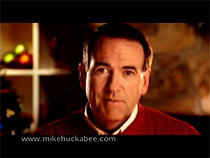 In 2008: Mike Huckabee’s Christmas campaign ad featured a bookcase in the background which resembled a cross. There was some debate in the media over whether or not the cross was a subtle but deliberate attempt at using transfer. Of course, Governor Huckabee’s statement in the ad that “what really matters is the celebration of the birth of Christ” is a much less subtle attempt to further align himself with the church.



 A mattress company should do a commercial playing off the “Princess and the Pea” story by Hans Christian Andersen. In the original story, a prince seeking a princess to marry is visited by a young woman claiming to be a princess. Not sure whether or not she is telling the truth, the prince’s mother tests her by giving her a bed to sleep on with 40 mattresses, and puts a tiny pea under the bottom mattress. In the morning, the Queen asks the girl how she slept, and the girl complains that there was something hard under her mattress so she got a very poor night’s sleep. The queen knows that only a princess would have skin so delicate as to feel a pea through the mattresses, and marriage ensues.

 A new mall called The Domain opened this weekend in Austin. The bizarre photo at right has been chosen to represent the mall in advertisements, brochures, and directories. Seriously, this might be one of the strangest photos I’ve seen used for something commercial. Or at all.
 Sometimes I get dangerous thoughts in my head, like “I wonder what it would look like to see every ad in Times Square all on one page.” So when I knew I’d be passing through Times Square this weekend, I made sure I had my camera. For the purposes of this nearly purposeless project, I considered storefront signs the same as ads if they were flashy and glitzy like Times Square ads tend to be.







 Since Congress passed the Bipartisan Campaign Reform Act in 2002, candidates for federal office must state their approval of campaign ads. Most frequently, we hear the phrase, “I’m [candidate’s name] and I approve this message.” Sometimes, to make it less awkward, the statement is lengthened along the lines of, “I’m [candidate’s name] and I approve this message because it’s time to stop playing around in Congress, and time to start getting things done.”

 I was recently shopping for paper at Staples when I had this thought: NBC should really license the “Dunder Mifflin” name to some paper company, and put it on real reams of paper. I don’t have brand loyalty when it comes to 8.5” x 11” paper, so it’s not like I can’t be persuaded to buy one ream over another. If I were buying paper at Staples and I saw the Dunder Mifflin brand name on a ream of paper, I’d totally get it. Just because it’s funny. Even if it cost a few cents more than the other brands.
 Recently announced in partnership with CafePress.com, New Line Cinema is encouraging anyone and everyone to become an official licensee of merchandise for the upcoming movie Snakes on a Plane (which, if you haven’t heard by now, promises to be exactly the sort of movie you think it will be based on that title). Most of the movie’s buzz has already come from
 First, the state paid $260,000 to a consulting firm to come up with a slogan. They came up with, “New Jersey. We’ll win you over.” It was quickly rejected. Then the state held a contest to come up with a new slogan. The big winner was “New Jersey. Come see for yourself” submitted by Jeffrey Antman of Passaic, New Jersey. Well, a couple months ago they scrapped that one too after realizing that
  Am I the only person who looks at this IBM ad and sees a depiction of the World Trade Center after the first tower was hit on the morning of September 11, 2001? This explosive image that I guess is supposed to express creativity or something looks to me more like smoke and flames rising from the tower, just moments before the second tower was struck.



















 This weekend I saw a poster advertising the new Coca-Cola Blak, some sort of Coke-and-Coffee hybrid.
 The poster for Adam Sandler’s new movie Click asks the question, “What if you had a universal remote… that controlled your universe?”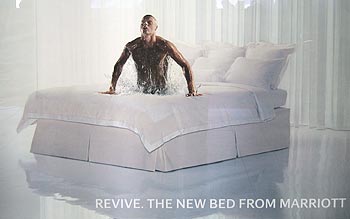
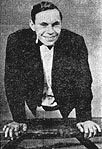 Johnny Eck, of course, was the talented performer billed in circus sideshows as “The Only Living Half Boy.” An actor, magician, painter, and photographer, Eck is famously featured in the Tod Browning movie Freaks.
 The woman goes about her day. She’s making breakfast while she talks. “Yes.” Pause. “Yes.” Pause.
 I saw this banner outside a museum last week, and I had to take a picture. I haven’t seen such a confusing use of type is a long time.

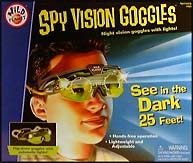 I saw this in a toy store the other day. I was just there to buy something for, um… Okay, sometimes I just like to go to the toy store. Anyway, I saw this toy. Spy Vision Goggles. Pretty cool, right? It says right there on the box: “See in the Dark 25 Feet!” How awesome is that? Man, we never had anything that cool when I was a kid. I can’t believe the technology for this stuff has gotten so cheap that they can — Hey, wait a minute.
 “Night vision goggles with lights?” What does that mean? Here’s the fine print: “The Spy Vision Goggles can see in the dark up to 25 feet away with two powerful beams of light!” So basically they just have little flashlights on the sides. If you’re in the dark, you can turn on the light. Wow. That’s a far cry from seeing in the dark. In fact, that’s pretty much the opposite of seeing in the dark.
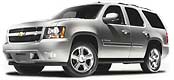 Chevrolet has decided to let people
  People will think of the ad when they’re meeting new people. They’ll swap information. They’ll ask for your phone number and your AIM Name.
  Ione Skye is upstairs sleeping in her bedroom. Outside, John Cusack stands below her window with a boombox held up high over his head. He’s blasting “In Your Eyes” by Peter Gabriel. Ione wakes up. “…the light, the heat (your eyes), I am complete (your eyes)…” Where’s that music coming from?
 As soon as I saw it, I had to wonder whether or not it was sending the message it is meant to convey.

