(The fourth in a series of occasional interviews with people I find interesting or who work on interesting projects.)
Fifteen years ago, I spent a Friday night camped out on the mezzanine level of 30 Rockefeller Center, hoping to get one of the standby tickets to Saturday Night Live that are handed out on Saturday mornings. The line forms at around 8:00 Friday night. That’s when I met Louis Klein, the SNL fan who had seen almost every episode of Saturday Night Live in person, going back to the very first episode.
Last Friday, I decided to go back to the SNL Standby Line and see if Louis was still waiting in line to get his ticket. In the years since I camped out there, the line had moved from the warmth of the indoor mezzanine to the chill of 49th street, but Louis was still there, right behind a group of teenagers who beat him to the first spot (one of the teens asked about my website, “Ironic Sans? Does it have anything to do with Horatio Sanz?”). When Louis stands in line these days, he is accompanied by his wife Jamie, whom he met on-line around six years ago. And by “on-line” I mean on the internet, not the standby line.
I spoke with Louis about his SNL Standby hobby.
When Saturday Night Live started, nobody knew it was going to be a big hit. Why did you go to the first episode of a new show that nobody really knew?
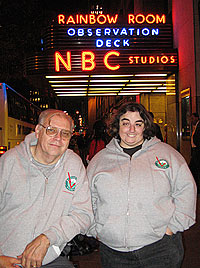
Louis Klein with his wife JamiePrior to SNL, I was going to a lot of game shows. Like, I watched the game show called Jackpot, which was done in Studio 8H prior to SNL. It ended its run in the summer of ‘75, hosted by Geoff Edwards. I was also going to the Pyramid — any one of them, whether it was 10, 20, 25, 100 thousand, 2 cents, you know, whatever it was. I went to all of them over at TV-15 which doesn’t exist anymore. Any game shows that were done here, if any, I went to them also. So I was notorious as far as NBC was concerned. They knew who I was because I went to all the shows.
Then in April of ‘75 I found out that the show SNL was coming up, so I went to the Guest Relations department and said I hear you’re doing this show. They said, Well, they want 500 people in 8H. They want to do a show that’s going to be a run through for sound purposes. We’re going to have an audience for that, and you can float around the building and find somebody who’s going to give out standby tickets. So I come over here right after work, and I found the standby ticket and I got it and I went inside and I stood in line.
I got upstairs. I saw a full fledged comedy routine by George Carlin. I saw a full fledged comedy routine by Billy Crystal. I saw performances by Janis Ian and Billy Preston. I saw comedy by the Not Ready for Prime Time Players including Jon Belushi and Gilda Radner among others. Now that’s three and a quarter hours of pure entertainment for free. And I could come back tomorrow night. And I did. And I got in a second time. I came back the following week and I didn’t get into the second show but I wasn’t going to give up at this point. This is a great thing to do on a Saturday night. I went to the third show, I got in, and in the first 5 years I’ve seen 59 out of 106 [episodes].
At what point did you realize it was turning into something you were making a regular routine?
I never really thought of it that way at that particular time. It was just something to do on a Saturday night. I just came over. If I got in, I got in. If I didn’t, I went home.
My memory from meeting you 15 years ago was that you had seen every episode live except for a few. But I guess you’ve missed more than that.
In the first 5 years I’d seen 59 out of 106. So I missed 47 shows then. To date I’ve missed I think 83. That means in the last 27 years I’ve missed 36 shows.
How many have you seen?
This is my 528th show.
The original producer, Lorne Michaels, is still with SNL. But he left the show for a few years in the middle. So is there anyone who outnumbers you in the number of shows attended?
Don Pardo. He only missed one year. It was the ‘81 season.
How come after all this time you still have to wait in the Standby Line? Why don’t they just give you season tickets?
They do. I’ve had season tickets since 1990.
But you just enjoy the Standby?
When they gave that to me, they asked me to do Standby anyway, just in case the tickets didn’t come through. So I have the standby tickets to back it up. However I never needed them, and now I just walk in. But I still do standby because I’m helping NBC out watching this, make sure people don’t jump and things like that. It helps them out. If something goes wrong they know that I’ll take care of it. And then I give the details to them later in the evening. If they have to do something about it they’ll do something.
What’s the worst thing you’ve seen go wrong while on standby?
Jumping the line, and having people join the line. That’s a no-no, because basically the people who are joining are jumping the line. Once somebody tried to get me off the line. This was for the Soundgarden and Jim Carrey episode. We were all standing inside because there was nobody out here, and then all of a sudden somebody let me know that somebody was out here and so I came out, and he was standing over by the pole over here, two guys, and I said all the standbys are inside. He said, Oh, I’m sorry. This is where the line is and I’m going to be number one and two. Well I said, No, I’m number one. He says no, we’re going to be number one. And he argued with me all night at this pole. And I was a little perturbed about it because they weren’t really nice about the whole thing. Well when they didn’t take any standbys for the dress rehearsal, these two guys nearly blew their top to NBC. They said, A standby got upstairs! So NBC checked to see if any standby tickets were upstairs, but I went up on my regular ticket. Little did they realize, I went to the party that night!
Do you get to go the after-party often?
Only the season finale, if they ask. Sometimes they do, sometimes they don’t.
When I was here 15 years ago, the line was inside. When did they move it outside?
‘93. Letterman was still here at the time, and according to what I’ve heard, somebody did damage to the building inside in the mezzanine. So Rockefeller Center said no you can’t be up here anymore, because they have to protect their tenants. And as a result all the lines were put outside. The line started at that time on this side of the building. And then NBC put it on the 50th street side because the Rainbow Room was complaining that we look like homeless people. Now we’re back on this side. We’d love to be inside the building again. They’ve got plenty of room on hand. But that’s not going to happen.
I seem to remember that 15 years ago you told me Tim Kazurinsky mentioned your name during a Weekend Update segment.
No, no. Not Weekend Update. It was in a sketch that he did. The Guru sketch. His name was Havnagootiim Vishnuuerheer [pronounced “havin’-a-good-time wish-you-were-here”]. What he was doing was he was answering Unanswered Questions of the universe. So he invited everybody in the country to write in unanswered questions that they had, and he picked one of mine, and all of a sudden I’m at dress rehearsal and he says, “Louis Klein from Ridgewood New York wants to know, does God wear Pajamas when he sleeps?”
And what was the answer?
The Guru says, “No he doesn’t. All he wears is a t-shirt. and on the t-shirt it says I created the universe and all I got out of it was this lousy t-shirt.” That was a Flip Wilson show in December ‘83.
Did they mention your name on any other episodes?
Yes, they did. And Jamie too. This was in April of 2004. Will Ferrel was the host. And he was doing the Pepper Sketch, where Will was putting pepper on Will Forte’s salad. And the character’s name was Dr. Louis something, and his wife Jamie. In honor of my 500th show.
Who was the writer that wrote you into the script?
Will Forte.
Have you seen “Studio 60” and Tina Fey’s new show “30 Rock”?
I have.
What do you think?
They’re both great.
Which do you like better?
Oh I don’t know. I love Tina. I love Tracy [Morgan], too. And I relate more to 30 Rock than I do Studio 60 because of that. But I definitely like both shows.
Do you get to know the SNL cast members?
They all know me. They all come and say Hi. I’ve met most everybody. I was invited to the 25th anniversary show, and I went to that. I had to ask for a ticket, and they said that they already have a ticket for me. I was fairly shocked.
Do you have a favorite season of SNL? Or a least favorite season?
That’s a hard question. A favorite season? You know, I don’t remember what all the hosts and musical guests are, and it’s hard. I love them all. I mean, yes, you’re going to have somebody that doesn’t do too well, especially sports figures. I mean, if you want a show that I thought the host was terrible, okay, um… uh… there was… uh… I can’t even say that. I mean, I don’t want to hurt anybody’s feelings.
Thanks, Louis! As I packed up my notes and my recorder, Louis pointed out that he would be there for several more hours if I had any further questions. And if you have any questions, I’m sure you can find Louis exactly where I did, near the front of the Standby Line outside Rockefeller Center on Friday nights.
[The preceding transcript has been edited for space and clarity].











 To me, the best thing about Art’s “Star Trix” project is that he actually documented the creation of all the films as he went, taking behind-the-scenes photos and footage. In an attempt to get the films shown on TV at the time, Art even made a “Making of” documentary so the total running time would better fit a TV schedule. The result is that today we have a detailed look at a particularly enthusiastic fan and his friends embracing the Do-It-Yourself spirit to create something wonderfully geeky in an era we now look back on with nostalgia.
 Looking back at yourself when you were making those films, how do you see yourself? Were you more of an Ed Wood or a young Spielberg?
 There was so little material to learn from in the early 1970’s, especially in the vicinity of Vandenberg [Air Force Base], that I had to figure out a lot as I went along. I did have the advantage of the Mopic Documentary Photo section being near the barracks. I would wander over and haunt the place, asking questions and they were would show me what they were taught in the motion picture camera technical school… As for the clay animations, when I talked about a Star Trek animation, the guys got excited about this like it was something they could really sink their creative teeth in. Unfortunately, by the time we were almost ready to film, all my mentors (grand old men of 21 and 22 years of age) were either finished their enlistments or transferred. So I simplified things and carried on.
 Since I was in the Air Force at the time and getting paid twice a month, I guess they did indirectly fund them… When I arrived at Vandenberg AFB in California, I lived in my own room in a WWII-era barracks building. This arrangement had a sort of college dorm/apartment house vibe where you could at least close your door to the occasional rowdiness. It was here that the Star Trix shorts began their slow path to the screen.
 I had a Polaroid camera and my roommate Dennis Cargill had gotten hold of some out-of-date film that was going to be trashed. He gave it to me and I started using it for progress photos on the set construction. I’m glad I did that because as my memory gets a bit dodgy I can refer back to them. I’ve also noticed that after I scan them into the computer and bring them up onscreen, I can see details in them that I didn’t notice before.
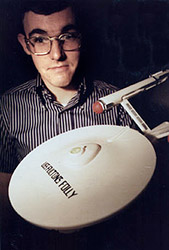 My steady employment during this time has been as an offset press operator. I’ve been with the Office of the Santa Barbara County Superintendent of Schools, A-1 Lithographers in Lompoc and presently in the print shop of the Lompoc Unified School District again (I worked on STAR TRIX-THE FLICK during my first stay there in the early 1980’s). I found that each time I tried to leave printing behind for the film business, I eventually ended up broke and bitter. After a few times of that, you eventually see where your bread is buttered. So I keep the lights on with printing to allow me to pursue my interests, many of which have very limited commercial value but are fun nevertheless.
  Morgan Taylor is a singer-songwriter who just released a DVD and CD set full of sing-along songs about a mellow yellow character named
  Take a look at this image. On the left, we see Gustafer engaged in one of his favorite hobbies, jumping on cake. On the right, we see a tile mosaic from a New York City subway station. Every time I see the mosaic, it reminds me of Gustafer. Coincidence?
 That’s where the podcast
  , by Jaymie Whyte, is an excellent, easy-to-read introduction to logic, especially with a focus on logic in the media. My favorite part is the discussion on the logic of “well, i’m entitled to my opinion.”
 By now, you either recognize the name, or you’re wondering who Seetharaman Narayanan is, and the difference probably depends on what you do for a living. If, like me, you have a job where you launch Photoshop on a daily basis, then maybe, like me, you can’t stop staring at this guy’s name on the Splash Screen every time it launches. Seetharaman Narayanan. It’s hard to look away. Sure, other people worked on Photoshop. But nobody else has a name like Seetharaman Narayanan.
 I’m beginning a new series here at Ironic Sans: occasional interviews with interesting individuals, or people working on interesting projects. I’m kicking it off by interviewing
  Just because you might be a monster, that doesn’t mean life is going to be all terrified villagers and biting. There’s a down side—monsters have problems, too. Bigfoot and the Yeti are always being mistaken for one another. Frankenstein has trouble meeting new people. Witches, on the other hand, are constantly being scrutinized by hag enthusiasts. They have clubs for that sort of thing.