I’m spending this week in New Hampshire, getting some much needed R&R. The house I’m staying in is fairly remote but it’s quite nice. And it was once owned by Norbert Wiener, the brilliant mathematician who coined the term “cybernetics.”
Not much remains from when Wiener lived here, but the bookshelves are filled with his old books. So I’ve gone through some of the shelves and picked out a few of the more interesting titles. Here’s a selection of what Mr. Wiener read:
Lots of dictionaries: Appleton’s New Spanish Dictionary; Cassell’s German Dictionary; Cassell’s French Dictionary; Dutch (A “Teach Yourself Book”); Nuevo Diccionario Enciclopedico Ilustrado de la Lengua Catellana; Graglia’s Italian-English and English-Italian Dictionary;
Various songbooks including: A booklet called “Patriotic Songs of America” with lyrics and music to The Star Spangled Banner, Hail! Columbia, Yankee Doodle, Battle Hymn of the Republic, Dixie Land, America the Beautiful, Tenting on the Old Camp Ground, etc.; “A Book of Songs - Words and Melodies Only - For Unison & Part Singing For Grades IV, V and VI (Student’s Edition)”; “The Golden Treasury of Songs and Lyrics”; and “An Elizabethan Songbook - Lute Songs: Madrigals & Rounds; Sing!”
A German Historical Atlas; The Bartholomew World Pocket Atlas
Lots of math books, obviously. They mainly have titles that suggest they would be far over my head, including: “Mathematical Tables from Handbook of Chemistry & Physics”; “Four Place Tables - Unabridged Edition”; “Plane and Spherical Trigonometry” by Ashton and Marsh; “Wentworth’s Plane and Solid Geometry”; “A Survey of Modern Algebra”; “Geometry in Three Dimensions”
“An Essay on Man” by Ernst Cassirer
“The Science of Health”
“Basic Course in Botany”
“An Outline of General Zoology”
“Comparative Anatomy of Vertebrates”
“Beyond Hypnosis” by Hugh Lacy in 1952, including a chapter called “Dianetics” which criticizes L. Ron Hubbard but only with regards to his thoughts on hypnosis.
“Emily Post’s Etiquette - The Blue Book of Social Usage”
“The Standard Book of British and American Verse”
“Hotel Berlin ‘43” by Vicki Baum
“The Mutineers” by Charles Boardman Hawes with a lovely illustrated cover
“Scaramouche” by Rafael Sabatini
“The City of Open Air and Other Verse” by Charles Poole Cleaves
“This I Believe: The personal philosophies of one hundred thoughtful men and women in all walks of life — twenty of whom are immortals in the history of ideas, eighty of whom are our contemporaries of today — written for Edward R. Murrow.” This is the second volume, and is inscribed “To Professor Norbert Wiener” and I can’t read the signature. It looks like “Ward Wheeler” or something like that. I figured out what the inscription says. It reads, “With great thanks for your outstanding contribution” and is signed “Ward Wheelock.” Mr. Wheelock was a friend of Edward R. Murrow’s and was the one to come up with the idea for a “This I Believe” series. Norbert Weiner is one of the people who contributed an essay for this book.
“Posthistoric Man - An Inquiry” by Roderick Seidenberg
“Les Miserables” by Victor Hugo. In five volumes.
“Departmental Ditties” by Rudyard Kipling.
“Praha Guidebook”
“The Black Arrow” by Robert Louis Stevenson
“The Hunting of the Snark and Other Poems”
“New Arabian Nights” by R.L. Stevenson
The College Entrance Examination Board’s “Comprehensive Examination Questions” for June and September 1918, including sections on Chemistry, English, French, German, Greek, History, Latin, Mathematics, Physics, and Spanish.
A beautiful 1921 leather-bound copy of “The Astronomer-Poet of Persia” that’s sadly falling apart.
“History of European Morals” Third Edition, Revised, in two volumes.
“The France of Today” from 1916
“The Pleasures of an Absentee Landlord and Other Essays”
“The Mechanics of Writing” which has the very long subtitle “A compendium of rules regarding manuscript-arrangement, spelling, the compounding of words, abbreviations, the representation of numbers, syllabication, the use of capitals, the use of italics, punctuation, and paragraphing.”
And many, many more. How many have you read?











 Lately I’ve been reading a news magazine called
 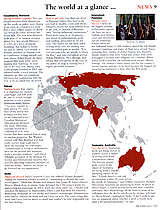 One nice feature is “The World at a Glance,” which summarizes major events around the world, along with a map to help put a story into geographical context. The “Briefing” section gives me all the sides of a current issue, including perspectives from several sources — not just a condensed version of a single article. Sections called “The Main Stories and How They Were Covered” and “Best Columns” are valuable (and self-explanatory) features, as well.
 Occasionally during downtime on a particularly slow photo shoot, I’ve played this game with my assistants. Everyone takes out a piece of paper, and numbers it from 1 to 50. Then you get 10 minutes to write down every state you can remember. Finally, you compare it to the master list and see who got the most answers. 10 minutes seems like more than enough time to remember a list of 50 items, right? And yet somehow I’ve never managed to get more than 48 of them.
 If you’ve ever walked through the science fiction and fantasy section of a bookstore, you’ve seen the artwork of Boris Vallejo. This weekend, I got to watch him create one of his paintings, a rather detailed picture of a dragon that he completed in only four hours.