Esoteric Comic #6


 Pre-pixelated clothes for Reality TV shows. Check out the post that started it all.

I'm a professional photographer, but sometimes I get ideas for projects, designs, gadgets, and other topics. I write about it all on this blog. You can find the meaning behind the name “Ironic Sans” back in the very first post.

David Friedman Photography
When I'm not writing the blog, I make a living as a photographer. This is my photography website.

You are reading all the entries posted to Ironic Sans in the “Politics” category. If you are looking for something specific, you may try searching in the Ironic Sans archive.


60 Seconds
Advertising
Animated Manhattan
Art
Business
Critical Thinking
Design
Education
Entertainment
Esoteric Comic
Favorites
Games
General
Ideas
Interview
Language
Lists
Long
Music
New York
Pareidolia
Photography
Politics
Science
Star Wars
Technology
Travel
Tree
You Made It
Behind The Post

May 2014
March 2014
February 2014
November 2013
October 2013
September 2013
July 2013
June 2013
May 2013
April 2013
March 2013
February 2013
January 2013
December 2012
November 2012
July 2012
May 2012
April 2012
March 2012
February 2012
January 2012
December 2011
November 2011
October 2011
September 2011
August 2011
July 2011
June 2011
May 2011
April 2011
March 2011
February 2011
January 2011
December 2010
November 2010
October 2010
September 2010
August 2010
July 2010
June 2010
May 2010
April 2010
March 2010
February 2010
January 2010
December 2009
November 2009
October 2009
September 2009
August 2009
July 2009
June 2009
May 2009
April 2009
March 2009
February 2009
January 2009
December 2008
November 2008
October 2008
September 2008
August 2008
July 2008
June 2008
May 2008
April 2008
March 2008
February 2008
January 2008
December 2007
November 2007
October 2007
September 2007
August 2007
July 2007
June 2007
May 2007
April 2007
March 2007
February 2007
January 2007
December 2006
November 2006
October 2006
September 2006
August 2006
July 2006
June 2006
May 2006
April 2006
March 2006
February 2006


ATOM | RSS
[What is this?]
Filed under “Politics”

 As the Democrats in Congress are struggling to get the rest of America on board with their proposed health plan, I can’t help but wonder if a better name wouldn’t help. Take a page from the Republican playbook. They give bills names that are loaded with meaning and are difficult to vote against without looking bad. Who would vote no on something called No Child Left Behind? Who wouldn’t support the USA Patriot act?
So I propose that the Senate rename their bill the American Legislative Insurance For Everyone act, a.k.a. the American LIFE act.
Who could vote against the American LIFE act? What Senator wants to be up for reelection and hear their opponent ask “Why did you vote against American LIFE, Senator?”
I floated the idea on Twitter and while many people thought it was a good idea, others rightly pointed out that the word “For” is often omitted from acronyms, so Republicans could just call it the American LIE act. That’s a good point. So make LIFE stand for something else. Or come up with another acronym. But a good name could help keep Republicans from defining the bill how they want people to see it.
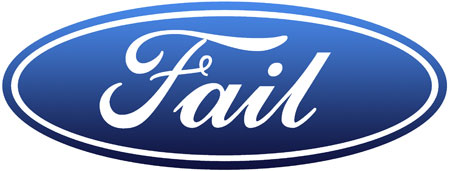
[Update: I had originally made this image available on shirts, but concern was expressed over whether or not selling such merchandise violates Ford’s trademark, even though the image is clearly a parody. Until the issue is resolved, I am posting the image alone as art.]
As Ford, GM, and Chrysler head to Washington DC once again in hopes of convincing the government to give them a bailout, I’ve invoked the ever popular “FAIL” meme and came up with this image:
 As George Bush prepares to move out of the White House at 1600 Pennsylvania Avenue in Washington, DC, and Barack Obama prepares to move in, I thought I’d take a virtual trip around the country and see what’s going on at other locations with the same address.
The following photos come via Google Street View:

1600 Pennsylvania Ave in Baltimore, MD

1600 Pennsylvania Ave in Glendora, CA

1600 Pennsylvania Ave in Wilmington, DE

1600 Pennsylvania Ave in Bremerton, WA

1600 Pennsylvania Ave in Savannah, GA

1600 Pennsylvania Ave in Terre Haute, IN

1600 Pennsylvania Ave in West Mifflin, PA

1600 Pennsylvania Ave in Los Angeles, CA

1600 Pennsylvania Ave in Croydon, PA

1600 Pennsylvania Ave in Brooklyn, NY

1600 Pennsylvania Ave in Des Moines, IA

1600 Pennsylvania Ave in Oreland, PA

1600 Pennsylvania Ave in Prospect Park, PA

1600 Pennsylvania Ave in Colton, CA

1600 Pennsylvania Ave in Dallas, TX
Note: For my British readers, here’s where else you can find Number 10 Downing Street
With less than a month until the election, the campaigns are bound to get pretty crazy. So I think we should take a minute to relax, inhale slowly, and bask in the glow of the CNN Election Center monitors in a quiet moment with no one else around.
Practice until it’s second nature.

On the left, the logo for the Congressional Budget Office, the federal agency that analyzes economic and budgetary decisions and provides projections on their effects on the national debt.
On the right, the logo for Omni Consumer Products, the megacorporation from the Robocop

The Congressional Budget Office is supposed to be nonpartisan, but I think I get a whiff of corporate interest.
Update: The Luke “Hope” Poster is now available for purchase with Lucasfilm’s blessing. Also available as a T-shirt.
Update: It’s not available anymore. Sorry!
A long time ago, in a political campaign far, far away, this poster was hanging in campaign offices across the galaxy…

…and these logos were on bumper stickers from Alderaan to Yavin:

With the first major Presidential primaries already behind us, the election year is officially under way. This November, the President, Vice President, one third of the Senate, and the entire House are up for election. Between now and then, we’ll see dozens of debates, thousands of ads, and hear mixed messages from various groups, pundits, candidates, their former co-workers, their third grade teachers, former lovers, and anyone else who can be pulled out of the woodwork to support or tear down a politician. So I figure this is a good time to review the 7 Common Propaganda Devices that were identified by the Institute for Propaganda Analysis (IPA) way back in 1937 and see if we can find them in use today.
1. GLITTERING GENERALITIES
The IPA used this term to describe virtuous words that mean different things to different people, but are used in such a general way that you can project your own meaning into the speaker’s words. So when people talk about freedom, strength, Democracy, or patriotism, you are likely to assume they think of those words the same way you do.
In 2008: It’s almost like this Mitt Romney ad was made just to demonstrate use of glittering generalities:
Remedy: When you hear someone speaking in glittering generalities, the IPA recommended that you stop to ask whether or not the idea being pitched is really a good one, or if it’s just being sold to you through association with words you like. If you take those words out of the equation, is the substance of what’s left still any good?
2. NAME CALLING
“Name calling” is a technique where someone uses words to link a person or proposal to a negative or emotionally charged symbol. The idea is to get you to reject the person due to the association with the symbol rather than actual evidence, which may or may not be there. Words like flip-flopper, radical, terrorist, and even liberal are contemporary labels that might qualify as name calling.
In 2008: The Annenberg Political Fact Check recently reported that e-mails have been circulating calling Barack Obama a racist and a radical Muslim. Neither claim seems to be supported by evidence, but aims to associate the Senator with negative views of racists and Muslim extremists.
Remedy: The IPA recommended that when you hear name-calling, you should stop to consider what the name means, whether or not it is being legitimately applied, and what the person or idea’s merits are without the name.
3. TRANSFER
There are institutions and objects that you have positive associations with, so politicians try to appear with symbols of those institutions in the hopes that you will transfer your positive associations onto them. For example, by standing in front of American flags or next to a cross, a candidate hopes that your positive associations with those symbols will be transferred to them. Transfer can be used for positive associations or negative associations, depending on the symbol and intent.
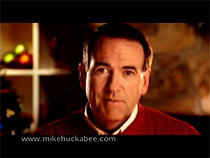 In 2008: Mike Huckabee’s Christmas campaign ad featured a bookcase in the background which resembled a cross. There was some debate in the media over whether or not the cross was a subtle but deliberate attempt at using transfer. Of course, Governor Huckabee’s statement in the ad that “what really matters is the celebration of the birth of Christ” is a much less subtle attempt to further align himself with the church.
Remedy: The IPA suggests that when you notice transfer in use, you ask what the merits of a person or idea are without the transferred associations, and whether or not there is a legitimate connection between the person or idea and the thing from which the person is attempting to transfer some association.
4. TESTIMONIAL
The IPA pointed out that sometimes citing a qualified source is a good way to emphasize a legitimate idea. But you should consider whether or not the source being cited is really qualified to make judgments about a particular issue.
In 2008: Barack Obama has received endorsements from Oprah Winfrey, Jennifer Aniston, Will I Am, and Jessica Beil. Hillary Clinton has Magic Johnson, Jenna Jameson, and Rob Reiner in her camp. Kevin Bacon endorses John Edwards. Bo Derek, Adam Sandler, and Kelsey Grammar have all come out for Giuliani. Chuck Norris has got Mike Huckabee’s back. Mitt Romney has the support of both Osmonds. And John McCain is endorsed by, um, Wilford Brimley. (source)
Remedy: The IPA recommended that, when considering endorsements like these, you ask what makes the individual qualified to be an expert on the subject in question. Does Oprah know what’s best for the country? Does Kelsey Grammar have more insight than you do? The IPA suggested that you should consider the merits of the person or idea without the testimonial.
5. PLAIN FOLKS
The “Plain Folks” technique is at work whenever a speaker promotes the idea that he or she is “of the people,” just an Average Joe despite the fact that he or she may go home to a mansion at the end of the day.
In 2008: John Edwards is fond of pointing out that he is the son of a mill worker. Several candidates have eschewed a suit and tie on the campaign trail in favor of a sweater and blue jeans. And Mitt Romney perfectly illustrates the technique in this campaign ad showing him as just a regular family guy. He does dishes, just like you!
Remedy: When you see examples of the Plain Folks technique at work, try temporarily ignoring the candidate’s personality, and just think about his or her ideas. Do they still sound good?
6. CARD STACKING
“Stacking the deck” is a gimmick used by magicians where a deck of cards appears to be randomly shuffled but is in fact arranged in a specific way. The IPA borrowed the term to describe a technique where only one side of a topic is favored, or another side is ignored or played down.
In 2008: Fox News is accused of having a right-wing bias, selectively reporting on issues that support a right-wing agenda. Similarly, PBS is accused by some of having a left-wing bias . And Ron Paul supporters have been shouting that the entire mainstream media has an anti-Ron Paul bias, downplaying his successes in the campaign.
Remedy: It can be difficult to recognize card stacking, because the viewer does not always know what other arguments are being ignored. If you don’t know about Ron Paul, for example, you wouldn’t know that he isn’t being represented in some discussions of the candidates. But by seeking out different media outlets with various viewpoints, you can get a more well rounded view of the issues.
7. BANDWAGON
The idea behind the Bandwagon technique is that, since everyone else is doing it, so too should you. There is a bit of showmanship involved in hyping the bandwagon, filling halls with supporters, playing music to get everyone excited, and waving colorful banners. Often the appeal is directed towards groups that already share a common tie based on religion, race, gender, etc. Studies have shown that the bandwagon effect really does work in elections. In the current race, the media reports poll results consistently, telling us who women are voting for, who blacks are voting for, who Christians are voting for, etc.
In 2008: The New York Times reports today that Barack Obama is increasingly being viewed as being electable among Democrats. In fact, the Times reports that “The percentage of Democrats who say he would be the strongest candidate against the Republicans has more than doubled in a month.” If enough Democrats hear that their fellow Dems feel this way, we may expect his electability rating to increase even more, based on the bandwagon effect. In a similar vein, there is sometimes an underdog effect at work, also. Many people want to vote for the winning team, but others like to throw support to the underdog. And the recent New Hampshire primary showed that the declared front-runner doesn’t always win anyway.
Remedy: The IPA recommended that, when you notice the bandwagon effect, you stop to consider whether or not you should support an idea or candidate regardless of the fact that others do. Does the person or idea really serve your individual and collective best interests?
These 7 techniques were identified by the IPA 70 years ago, but other techniques could be mentioned in this context including the use of fear, a technique employed to great effect in recent years. More information on propaganda techniques can be found at propagandacritic.com.
Previously: Idea: Approve of more than just “This Message.”
With a tip of the hat to Gilda Radner’s old SNL character Emily Litella, I present this blog entry on the constitutionality of storyboarding:
 America has a serious question to answer about storyboarding. I’m not talking about whether or not storyboard artists should join the writer’s guild and go on strike this week, or about whether “storyboard” is supposed to be written as one word or two. I’m talking about the more serious issue of whether or not storyboarding amounts to torture. Somewhere, in a parallel two-dimensional universe, I imagine last week’s Attorney General confirmation hearing of Michael Mukasey looked something like this:

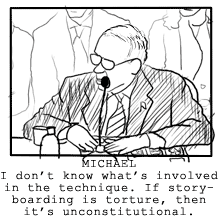
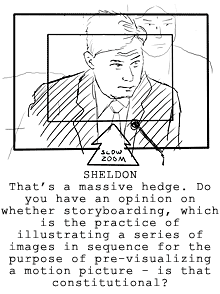

What? Water boarding? Ohh. Nevermind.
(This thought popped into my head shortly after I woke up this morning, and it wouldn’t go away until I posted it. Don’t know why.)

How am I supposed to know what terrorist group put out this video?Terrorist groups, like any organization, need brand identities. With so many groups claiming credit for terrorist acts, and so many videotapes being put out featuring men in ski masks, it’s hard to keep track of which group committed what violent act. So terrorist organizations have logos. It recently occurred to me that someone had to actually design those logos. But how did they decide who gets to do it? Did the job go to whichever terrorist had a copy of Adobe Illustrator?
I did some research and rounded up as many logos as I could find from terrorist groups past and present. While I hate to give terrorists any more attention, I still think it’s interesting to see the various approaches they took in their logos, and wonder what considerations went into designing them. Does the logo successfully convey the organization’s message? Is it confusingly similar to another group’s logo? Does it exhibit excessive drop shadows, gradients, or use of whatever font is the Arabic equivalent of Papyrus?
Quick Disclaimer: I picked these terrorist groups from a list of designated terrorist organizations on Wikipedia. Since Wikipedia is a user-edited website, I can’t verify who decided these groups are terrorist organizations. So if it turns out one of these groups is an actual army or a legitimate non-violent organization, don’t blame me.
I decided to group the logos roughly by their dominant design elements:
1) Stars
It occurs to me that “stars inside circles” is a subgroup of this category.
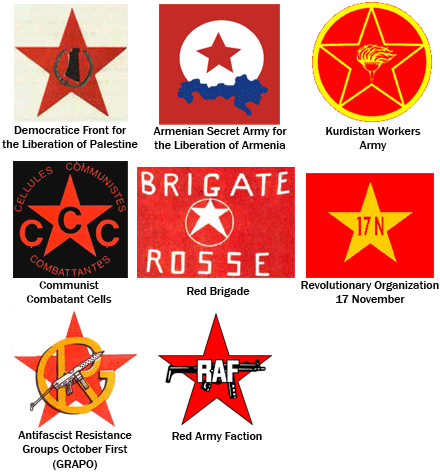
2) One Gun
Notice that there’s a little bit of overlap between this group and the last group. The last two “Stars” logos featured a gun, but I decided that the star motif was strong enough to keep them in the “Star” group. The first logo in this group has a star, too, but it’s small.

The bottom three logos are presented in the order they were designed, each inspired by the one before it.
3) Two guns crossed
Why settle for one gun, when you can have two?

4) Other weapons crossed
Guns are so barbaric. Here are some logos which feature blades instead.
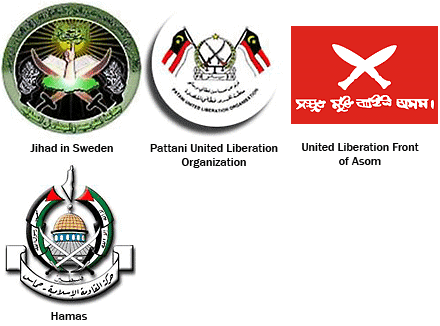
5) Crossbones
White supremacists seem to prefer skulls over swords. Hey, haven’t I seen that Combat 18 logo somewhere before?

6) Animals with multiple heads
The SLA’s seven-headed cobra, below, was apparently taken from an ancient Sri Lankan symbol.
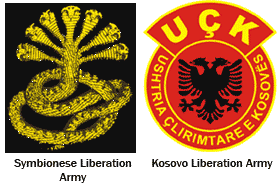
[Note: There is interesting discussion in the comments below over what constitutes a terrorist group, with the Kosovo Liberation Army particularly being called into question, and comments an both sides of the issue. The BBC has an interesting history of the KLA here, explaining why the US urged Kosovo Albanians to regard the KLA as a terrorist group, and why the Kosovo Albanians stopped short of that designation. I intend no offense by this logo’s inclusion.]
7) Other
What to make of the rest? I’m not sure what the Oromo Liberation Front logo is supposed to suggest. And that “EPB” logo doesn’t inspire terror at all. It looks like an Olympic team logo. I’ve never heard of the Creativity Movement before, and now I still have no idea what they stand for. What’s with the “W”?

Note:This weekend, an Al Qaeda suicide bomber killed 150 people in a market north of Baghdad. Another 250 were wounded. When this news broke, I had already begun working on this blog entry, and thinking of those victims made it hard to finish. So I just want to be clear that, although this entry focuses on a relatively trivial aspect of terror organizations, it is in no way intended to make light of terrorism. The guns, the blades, the maps of Israel, and other elements in these logos do effectively communicate with painful clarity what some of these groups intend. While my overview of terrorist logos is meant half-seriously as an examination of graphic design in a place we might not think to look, I don’t want to minimize the devastation these groups have wrought.
The Economist is a weekly magazine that focuses on world news, business, and politics. The magazine, based in London, is dense with information and can be tough to wade through. The publishers target an upper-class demographic, and it shows in their ads for the magazine. A recent ad had a tag line which read, “It’s lonely at the top, but at least there’s something to read.” The Economist is the sort of magazine pretentious people like to be seen reading.
Naturally, I have a subscription.
 As I was wading through this week’s issue, I realized that whoever writes the headlines (the copy editor, I think) has an interesting sense of humor and a penchant for puns and cultural references. Some of the headlines are better than others. I went through the stack of unread issues that’s been piling up in the living room and picked out some of the best and the worst headline puns and references from recent weeks. Whether you think they are the best or the worst probably depends on whether you like puns. Here are some examples:
Article topic: What conservatives get, and do not get, about foreign aid.
Headline: Right to bear alms
Article topic: Former CIA Director George Tenet’s new book has some factual errors but is still worth reading.
Headline: George’s tenets
Article topic:Two big meat producers agree to merge.
Headline:A steak in the market
Photograph: A polar bear stands on a piece of ice surrounded by water. The article is about global warming.
Caption: It’s getting unbearable
Article topic: Scrubbing carbon from coal-fired power stations is possible but pricey.
Headline: Dirty king coal
(I’m not sure if that’s supposed to be a play on Nat King Cole or Old King Cole)
Article topic: Businesses are engaging in war game style simulations to gain new perspective on complex problems.
Headline: Shall we play a game?
Article topic: The cost of making cell phone calls overseas.
Headline: When in roam
Article topic: Californians are leaving the state, filling its neighbor states with former Californians.
Headline: Dreams of Californication
Article topic: Ecuador has a new President, Rafael Correa
Headline: Magical mystery tour
(Seriously, I have no idea what this headline is supposed to mean. I read the whole article and still can’t figure it out. Correa isn’t touring anywhere. He’s not listening to the Beatles. Why the reference? I don’t get it.)
Article topic: Rio de Janeiro’s economy isn’t doing so well.
Headline: Blame it on Rio
Article topic: The popularity of the Russian royal family
Headline: Tsarstruck
Article topic: The president’s policies on global warming
Headline: Emissionary positions
Article topic: Scientist Craig Venter takes on yet another big project
Photo caption: Craig’s list gets longer and longer
I just noticed this. On the north side of City Hall Park, right next to the Tweed Courthouse, gated off from the public, there’s a basketball hoop.

When was this installed? Does anyone use it? Is Mayor Bloomberg enjoying an occasional game of H-O-R-S-E when he’s got some downtime?
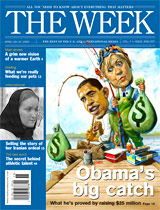 Lately I’ve been reading a news magazine called The Week. In a recent national survey (PDF), The Week was the only magazine to rank in the Top Ten for being most credible, most objective, and most enjoyable. It’s one of the fastest-growing magazines, but with a circulation that’s only around 10% of Time magazine, you’ve likely still never heard of it. Here’s why I like it:
I don’t have time to read every blog I enjoy. So I use an RSS aggregator to bring all the headlines from my favorite blogs into one place where I can read the highlights and get an idea of what’s happening in the blogosphere. The Week is like an RSS aggregator for magazines and newspapers. This one magazine condenses all the best articles from various sources into one easy-to-digest magazine. Sure, it tells me about Britney Spears’ hairstyle and Don Imus’ career woes, but it also tells me about suicide bombers in Morocco, a kidnapping in Pakistan, and a mysterious cancer afflicting the Tazmanian Devil in Australia — the kinds of stories that fall through the cracks in the mainstream media obsessed with the celebrity of the week and kittens stuck in trees.
Even more importantly, I get perspectives from publications I wouldn’t otherwise read. I may not like the political leanings of National Review, for example, but when their perspective is included in a round-up of editorials on a particular topic, I get a broader view of that topic. And a feature called “How They See Us” lets me know what editorialists in other countries are saying about the United States.
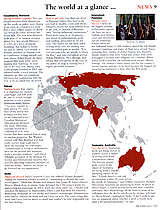 One nice feature is “The World at a Glance,” which summarizes major events around the world, along with a map to help put a story into geographical context. The “Briefing” section gives me all the sides of a current issue, including perspectives from several sources — not just a condensed version of a single article. Sections called “The Main Stories and How They Were Covered” and “Best Columns” are valuable (and self-explanatory) features, as well.
There’s light-hearted content, too, including “Good Week For / Bad Week For.” Last week was a good week for manatees, who are no longer facing extinction, but a bad week for Australian rugby star David Kidwell, who tripped over his 2-year-old at a barbecue, injuring himself so badly that he can’t finish the season.
Movie and book reviews are done Zagat-survey-style, using quotes from various reviews to boil down to one rating. It’s like RottenTomatoes, but with a less confusing rating system.
Each 40-page issue is packed with information that gives a broad view of the world in the past 7 days, but none of it is very deep. If I want more information on a particular topic, I still need to look elsewhere. But at least now I know what’s happening in the world as covered by different outlets with different perspectives, including foreign points of view, without the mountain of magazines to wade through.
I’ve been reading The Week for a while, but I decided that now is a good time to mention it because they’re publishing one free issue this week, and it’s going to be on-line only, starting this Friday. Go to their website www.theweekmagazine.com and check it out.
The term “F-Bomb” is used often these days to describe what we used to simply call The F Word (mp3). Specifically, it describes the F Word when it’s used unexpectedly. For example, if a caller on a radio show uses the F Word, the host might chastise him for “dropping the F-Bomb.”
 With that in mind, I think that if I were an evil dictator in a country developing a nuclear weapon, I would name my new weapon “The F-Bomb.” Then I’d get a little giggle every time it was reported in the news that my country is threatening to drop the F-Bomb. As in, “Ironicsansistan tested a long-range missile today, heightening fears that it will follow through on its threats to drop the F-Bomb on South Ironicsansistan.”
The current issue of the New Yorker magazine has an interesting article about Joel Surnow, the man behind the TV show “24
With that in mind, I found a similarity between George W. Bush and Jack Bauer that isn’t mentioned in the article. I put together a little video to demonstrate:
 Listening to NPR the other day, I heard a story filed by NPR National Desk reporter Libby Lewis. Immediately I had to wonder why she isn’t covering the Lewis Libby scandal. If I worked at the assignment desk, I’d put her on every story about the Vice President’s former Chief of Staff. I’d get a little kick out of hearing her introduced. “With more on Lewis Libby, here’s NPR’s Libby Lewis.”
Hmm. It looks like she has covered the story occasionally. Well then consider this a call for more Lewis Libby stories by Libby Lewis!
 Since Congress passed the Bipartisan Campaign Reform Act in 2002, candidates for federal office must state their approval of campaign ads. Most frequently, we hear the phrase, “I’m [candidate’s name] and I approve this message.” Sometimes, to make it less awkward, the statement is lengthened along the lines of, “I’m [candidate’s name] and I approve this message because it’s time to stop playing around in Congress, and time to start getting things done.”
Well I think an effective ad could be made that goes a step further and really embraces the “I approve this message” line as part of its campaign. It could go something like this:
“I’m John Candidate and I disapprove of the message this administration is sending the world by staying in Iraq. I disapprove of a the way the President is dealing with terrorism. And I certainly disapprove of the way Republicans are spending money with no regard as to who will pay the bills. It’s time to change the direction this country is headed. It’s time to remind the world through our actions that America is a noble country, a leader in ethics, economy, and education.
I approve of a plan to bring American kids back to school where they will recieve a top level education. I approve of getting health care where it’s needed most. I approve of helping Iraq get back on its feet and bringing our troops home. I approve of actions that send a message to the world that America is prouder, stronger, and safer than it ever has been.
I am John Candidate. And I approve this message.”
Of course, all those glittering generalities would be replaced by meaningful specifics and substance, but you get the idea.
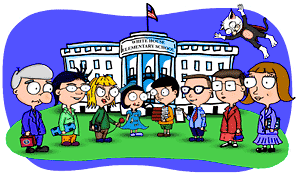 Back in the winter of 2002, while I was cocooning in my home after 9/11 like so many Americans, I conceived of a cartoon series all about grade-school versions of the various Clinton Administration characters. I called it “The Adventures of Li’l Bill & Hill and Friends.” There was Li’l Bill, and Li’l Hill, and Messy Monica, and Al, and Ken, and George, and Linda, and Janet, and Socks the Flying Cat (because every cartoon needs an anthropomorphic animal). I built a website for it that was partly a parody of Saturday Morning Cartoons, and partly a send up of the Clinton administration, and partly a parody of obsessive fan websites.
It was a big hit. Cory Doctorow at BoingBoing said, “This. Is. Amazing” (emphasis original). The Detroit Free Press called it “The work of a genius, albeit a warped one.” I got so much positive feedback that I even pitched it as a TV series to Comedy Central. But they didn’t bite. I guess the Clintons weren’t timely any more.
So of course I considered doing a version with Bush. But it was too early in the Bush administration to really know who the players would be that would make good characters, and what their personalities would be like.
Well, this morning, as I drank my coffee from my Li’l Bill & Hill Coffee Mug (seriously), I read an e-mail from a friend pointing me to this New York Times Article about a comedy writer named Donick Cary who recieved an offer from Amp’d Mobile to develop his own video project for wireless phones:
The result is a raunchy cartoon called “Lil’ Bush,” concerning the adventures of a grade-school version of President Bush and his pals, a heartsick Lil’ Condi, a raging Lil’ Rummy and a Lil’ Cheney reminiscent of the Frankenstein monster.
Yes, that’s right. Amp’d Mobile customers can watch the animated adventures of Lil’ Bush on their cellphones (and anyone can watch on-line). It’s essentially the same idea I had five years ago. But with George Bush. I had recently revisted this idea, even drawing some preliminary sketches of my version of “Li’l Bush” as a naive kid ready for adventure in his flight suit. But I didn’t have the time to develop it further.
 Well it’s bittersweet to see that someone else has done it. Did Donick Cary see my Li’l Bill website? It’s possible. It got a fair amount of publicity, mentions on talk radio, that sort of thing. And it’s linked to on the right side of the main page on this site, which has also gotten enough publicity that it’s concievable he’s seen it. But it’s probably not such a novel idea that I could prove he stole it from me. I think the law would say that he could have come up with it on his own. Which he may have. And you can’t copyright an idea, anyway, just the execution of the idea, and I guess his execution is different enough from mine except for in the obvious ways (setting it at the White House, etc). But still, I can’t help but feel like I’ve been ripped off a little bit, even though it’s nice to see Cary’s version has come to fruition. Great minds and all that.
 My friend and fellow photographer Brian Berman has been working on a series of portraits at off-beat conventions around the country. He recently came back from the Vent Haven Ventriloquists Convention where he purchased this book from 1902, Callahan’s Easy Method for Learning Ventriloquism Quickly.
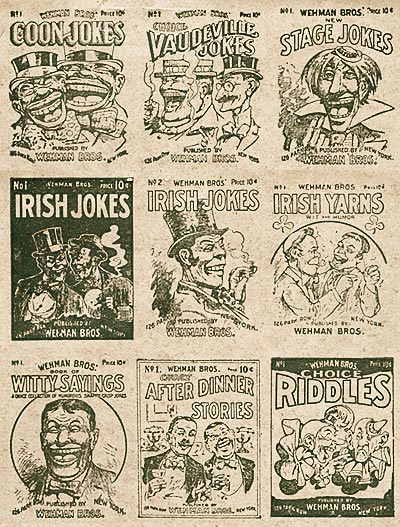
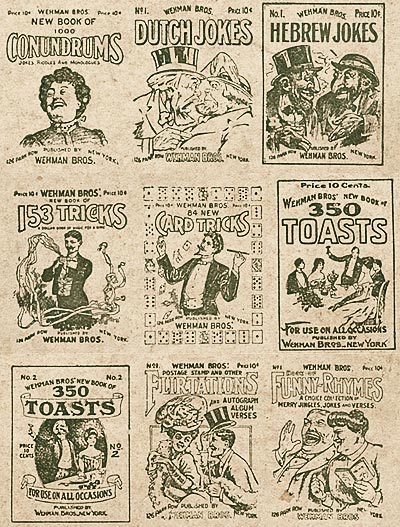
I wasn’t really too surprised by the racist depiction of the ventriloquist’s dummy on the cover, but I was surprised when I turned the book over and saw the advertisements on the back cover. The publisher, Wehman Brothers, featured a selection of racist joke books, available from their store in lower Manhattan. Some of the books are tame titles like Choice Riddles but then there are titles like Coon Jokes and Hebrew Jokes that would never fly today.

Chess is a game of war. So for those who disapprove of war, I’ve come up with the Pacifist Chess Set. The concept is illustrated above.
At first glance, it looks like you could play a legitimate game of chess with this set. But once you start playing you realize that you can’t play for very long — at least not very easily. As you play, and your pieces get closer to your opponent’s pieces, it becomes apparent that one side’s pieces are indistinguishable from the other side’s pieces. They are all the same color.
It’s not really a functional chess set. It’s more of an art or conversation piece. It makes the statement that, no matter what side of the battle we’re on, we have in common that we are all human.
[I got this idea while wandering through the Imagery of Chess Revisited exhibit at the Noguchi Museum in Queens. The exhibit is only around for two more weeks, but if you get a chance I highly recommend a visit. It features works by Man Ray, Marcel Duchamp, Max Ernst, Alexander Calder, and others. A book is also available, in case you miss the show.]
Seen in Newark International Airport, this advertisement for the Army National Guard:

 As soon as I saw it, I had to wonder whether or not it was sending the message it is meant to convey.
I mean, I can’t help but think that they seemed so much happier as citizens than soldiers. Look at those happy smiling faces. They’re relaxed. Enjoying life. And now look at them when they’re soldiers.
One girl even seems to have a look on her face as though to say, “Please help me. I didn’t know what I was getting myself into. I want to come home.”
Update: I just noticed the following in my visitor log (IP address redacted by me):

It looks like someone’s paying attention.

While traveling on business through Houston’s Bush Intercontinental Airport, I was struck by this statue of George Bush (the senior George Bush) in one of the terminals. What struck me was the eerie similarity between this statue and Michelangelo’s David.
The 8 foot tall George Bush was sculpted by David Adickes, the Houston artist whose busts of all the Presidents grace two different Presidents Parks.
I can’t help but wonder if the similarity is intentional. Michelangelo’s David depicts the second King of Israel, with a sling over his shoulder that he used to slay the giant Goliath of the Philistine army who threatened to destroy Israel. With that in mind, if Bush represents David, who represents Goliath in this scenario?

This site is © 2006 and except for fair use it may not be reproduced without my permission. Luckily, permission is usually easy to obtain. Contact me and we'll talk. This blog is typeset in Georgia, Times New Roman, or Times, in that order of priority based on what fonts are installed on your computer, or whatever standard serif font is installed if none of the above. The exceptions are the main title, which is based roughly on Baskerville Old Face, and the handwritten parts which are, well, my handwriting.

